Page loaded successfully. Showing biography for Edward Delaney.
Edward Delaney BIOGRAPHY
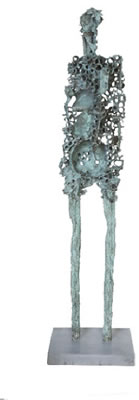
1930 Claremorris, County Mayo, Ireland - 2009 Connemara, Ireland. Known for: Bronze expressive figurative sculpture-public commissions, religious subjects.
Edward Delaney (1930-2009). One of the leading figures in Irish sculpture of the second half of the twentieth century, Edward Delaney is best known for two public bronze sculptures on show in Dublin:... Read full biography
Edward Delaney (1930-2009). One of the leading figures in Irish sculpture of the second half of the twentieth century, Edward Delaney is best known for two public bronze sculptures on show in Dublin: his statue of Wolfe Tone (1967) and his Famine Memorial (1967). Both created using the lost-wax... Read full biography
Edward Delaney (1930-2009). One of the leading figures in Irish sculpture of the second half of the twentieth century, Edward Delaney is best known for two public bronze sculptures on show in Dublin: his statue of Wolfe Tone (1967) and his Famine Memorial (1967). Both created using the lost-wax (cire perdue) method of bronze casting, these works exemplify his unique style of modern expressionism, developed during the 1950s and 1960s, whose minimalist (at times, skeletal) forms are said to... Read full biography
Edward Delaney (1930-2009). One of the leading figures in Irish sculpture of the second half of the twentieth century, Edward Delaney is best known for two public bronze sculptures on show in Dublin: his statue of Wolfe Tone (1967) and his Famine Memorial (1967). Both created using the lost-wax (cire perdue) method of bronze casting, these works exemplify his unique style of modern expressionism, developed during the 1950s and 1960s, whose minimalist (at times, skeletal) forms are said to reference holocaust and famine motifs, as well as the elongated emaciated figures and abstracts of Alberto Giacometti (1901-66). A member of the Royal Hibernian Academy (RHA), and Aosdana, Delaney's sculpture has been exhibited around the world, and is... Read full biography
Edward Delaney (1930-2009). One of the leading figures in Irish sculpture of the second half of the twentieth century, Edward Delaney is best known for two public bronze sculptures on show in Dublin: his statue of Wolfe Tone (1967) and his Famine Memorial (1967). Both created using the lost-wax (cire perdue) method of bronze casting, these works exemplify his unique style of modern expressionism, developed during the 1950s and 1960s, whose minimalist (at times, skeletal) forms are said to reference holocaust and famine motifs, as well as the elongated emaciated figures and abstracts of Alberto Giacometti (1901-66). A member of the Royal Hibernian Academy (RHA), and Aosdana, Delaney's sculpture has been exhibited around the world, and is represented in many important art collections in Ireland and overseas. In October 2009, 3 weeks after his death,... Read full biography
Artist Biography
Biography page for Edward Delaney ((1930 - 2009)), known for Bronze expressive figurative sculpture-public commissions, religious subjects. Showing 1 biographical entries and 0 sample artworks.
Edward Delaney - Artist Info
About Edward Delaney
Name variants
Eddie Delaney
Biography from the Archives of askART
 Edward Delaney (1930-2009)
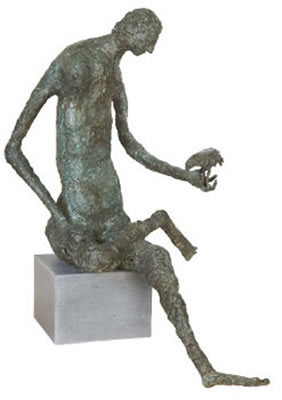
One of the leading figures in Irish sculpture of the second half of the twentieth century, Edward Delaney is best known for two public bronze sculptures on show in Dublin: his statue of Wolfe Tone (1967) and his Famine Memorial (1967). Both created using the lost-wax (cire perdue) method of bronze casting, these works exemplify his unique style of modern expressionism, developed during the 1950s and 1960s, whose minimalist (at times, skeletal) forms are said to reference holocaust and famine motifs, as well as the elongated emaciated figures and abstracts of Alberto Giacometti (1901-66).
A member of the Royal Hibernian Academy (RHA), and Aosdana, Delaney's sculpture has been exhibited around the world, and is represented in many important art collections in Ireland and overseas.
In October 2009, 3 weeks after his death, Delaney's bronze King & Queen sold at auction at Adams in Dublin for €190,000, a world record price for a piece of Irish sculpture.
Born in Claremorris, County Mayo in 1930, Delaney left school at 14, having already enquired about admission to the National College of Art in Dublin (now NCAD). Later he attended classes at the school, where he became increasingly interested in bronze sculpture. Afterwards, thanks to sponsorship from the Arts Council, as well as overseas fellowships and scholarships, he studied and worked in Munich, Bonn and Rome, and began showing his work on the world stage. He represented Ireland at the Biennale de Paris in 1959 and 1961, and at the New York World Fair in 1965. He married Nancy O'Brien, from Cootehill, Co Cavan, with whom he had five children, and lived in Dun Laoghaire where he set up a foundry and where most of his major public sculpture were created.
Much in demand as an artist during the 1960s and early 1970s, his public commissions for the Irish government included a statue of Wolfe Tone and a memorial sculpture to the Great Famine to be situated in St. Stephen's Green in Dublin, and a statue to Thomas Davis to be located on College Green, opposite Trinity College Dublin. (In 1979, Delaney's Wolfe Tone statue was destroyed by loyalist terrorists reportedly in response to the IRA demolition of Nelson's Pillar. Luckily the head survived, to be incorporated into the sculpture as it is today.)
In addition, for the Church of St Michael the Archangel, Ballinasloe, County Galway, he produced a cross and figure of Christ, together with bronze plates for a baptismal font. Other important commissions included his Finnegan's Wake piece for the First National Bank of Chicago in Dame Street, the Fountain Tree at Smurfit Headquarters, Dublin, as well as major works for the ESB offices in Galway. Although better known for his larger commissions, Delaney sculpted a wide variety of large, medium and smaller pieces. Notable examples being: the Figure of Cuchulain and the Great Hunger (Garech Onorach a Brún), Forms, Bather, The Piper, Bird Alighting and Dancer.
Ranging from strongly representational to almost pure abstraction, Delaney's style of sculpture up to the end of the 1970s, was noted in particular for its empathy of subject and its concern for texture. It was said that his expressionist abstraction lent his works a naturism and an egalitarianism which reflected a new sense of confidence in the nation.
However, in the mid-1980s Delaney quit Dublin to move to Connemara, where he began a new phase of his life. Leaving behind his previous style of sculpture, he founded a sculpture park and began a series of experimental works called 'steel trees'. After separating from his wife Nancy, he had two children, Emer and Ronan, with his new partner, Dr Anne Gillan.
Edward Delaney passed away on Wednesday, 23 September 2009, aged 79. He was buried at Crossboyne Church near Claremorris, County Galway.
Awards
Edward Delaney has been the recipient of numerous fellowships, scholarships and other arts prizes, including:
• 1991 RHA Award for Sculpture of Distinction in Bronze?• 1964 The Arts Council of Ireland Sculpture & Bronze-Casting Prize?• 1962 The Arts Council of Ireland Sculpture Prize ?• 1959-60 Sculpture Scholarship (Italian Government)?• 1958 Foreign Students Sculpture Prize (Bavarian State Government)?• 1956-7 Fellowship for sculpture (West German Government)
In addition, he was an elected academician (RHA) of the Royal Hibernian Academy, a member of the prestigious Irish arts group Aosdana, and a member of the International Sculptors Centre in Washington DC.
Exhibitions
As well as representing Ireland at the Biennale de Paris in 1959 and 1961, and at the New York World Fair in 1965, Delaney has shown his works at numerous venues around the world including New York, Tokyo, Buenos Aires, and Budapest. In Ireland, he has exhibited in the Hendriks, Royal Hibernian Academy, Davis and Solomon Galleries, and in the Project Arts Centre, among others. The RHA's Gallagher Gallery staged a retrospective of his sculpture in 1992 and again in 2004.
Collections
Delaney's works are represented in many major collections worldwide, including: Hugh Lane Municipal Gallery of Modern Art, An Chomhairle Ealaíon/The Irish Arts Council, The Central Bank, Office of Public Works (OPW), Bank of Ireland, Allied Irish Bank, Irish Management Institute, Abbey Theatre, (all Dublin); Ulster Museum, Belfast; Waterford Museum; First National Bank of Chicago; First National City Bank of New York; ; KLM Airlines Headquarters, New York; Jefferson Smurfit Group Ltd.; Norman B.Arnoff, New York.
Source:
Online Encyclopedia of Irish and World Art
http://www.visual-arts-cork.com/irish-sculpture/edward-delaney.htm