Page loaded successfully. Showing biography for Edward Sherriff Curtis.
Edward Sherriff Curtis BIOGRAPHY
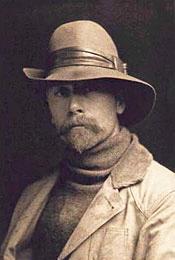
1868 Whitewater, Wisconsin - 1952 Los Angeles, California. Known for: Historical photographs of Native American culture.
EDWARD SHERIFF CURTIS (1868 - 1952). Born in 1868 near Whitewater, Wisconsin, Edward Sheriff Curtis became one of America's finest photographers and ethnologists. Beginning in 1896 and ending in... Read full biography
EDWARD SHERIFF CURTIS (1868 - 1952). Born in 1868 near Whitewater, Wisconsin, Edward Sheriff Curtis became one of America's finest photographers and ethnologists. Beginning in 1896 and ending in 1930, Curtis photographed and documented every major Native American tribe west of the Mississippi,... Read full biography
EDWARD SHERIFF CURTIS (1868 - 1952). Born in 1868 near Whitewater, Wisconsin, Edward Sheriff Curtis became one of America's finest photographers and ethnologists. Beginning in 1896 and ending in 1930, Curtis photographed and documented every major Native American tribe west of the Mississippi, taking over 40,000 negatives of eighty tribes. For thirty years, he devoted his life to an odyssey of photographing and documenting the lives and traditions of the Native people of North America. His... Read full biography
EDWARD SHERIFF CURTIS (1868 - 1952). Born in 1868 near Whitewater, Wisconsin, Edward Sheriff Curtis became one of America's finest photographers and ethnologists. Beginning in 1896 and ending in 1930, Curtis photographed and documented every major Native American tribe west of the Mississippi, taking over 40,000 negatives of eighty tribes. For thirty years, he devoted his life to an odyssey of photographing and documenting the lives and traditions of the Native people of North America. His photographs had an immense impact on the national imagination and continue to shape the way we see Native life and culture. Edward's father, Reverend Johnson Curtis, had returned from the Civil War penniless and debilitated, and young Curtis and his... Read full biography
EDWARD SHERIFF CURTIS (1868 - 1952). Born in 1868 near Whitewater, Wisconsin, Edward Sheriff Curtis became one of America's finest photographers and ethnologists. Beginning in 1896 and ending in 1930, Curtis photographed and documented every major Native American tribe west of the Mississippi, taking over 40,000 negatives of eighty tribes. For thirty years, he devoted his life to an odyssey of photographing and documenting the lives and traditions of the Native people of North America. His photographs had an immense impact on the national imagination and continue to shape the way we see Native life and culture. Edward's father, Reverend Johnson Curtis, had returned from the Civil War penniless and debilitated, and young Curtis and his three siblings grew up in poverty. The family moved to Cordova, Minnesota soon after his birth, where his father continued his vocation as an... Read full biography
Artist Biography
Biography page for Edward Sherriff Curtis ((1868 - 1952)), known for Historical photographs of Native American culture. Showing 3 biographical entries and 0 sample artworks.
Edward Sherriff Curtis - Artist Info
About Edward Sherriff Curtis
Biography from the Archives of askART
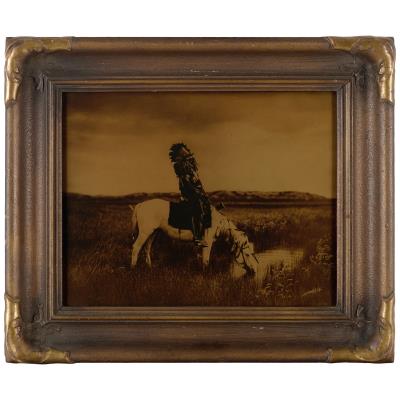 EDWARD SHERIFF CURTIS (1868 - 1952)
Born in 1868 near Whitewater, Wisconsin, Edward Sheriff Curtis became one of America's finest photographers and ethnologists. Beginning in 1896 and ending in 1930, Curtis photographed and documented every major Native American tribe west of the Mississippi, taking over 40,000 negatives of eighty tribes. For thirty years, he devoted his life to an odyssey of photographing and documenting the lives and traditions of the Native people of North America. His photographs had an immense impact on the national imagination and continue to shape the way we see Native life and culture.
Edward's father, Reverend Johnson Curtis, had returned from the Civil War penniless and debilitated, and young Curtis and his three siblings grew up in poverty. The family moved to Cordova, Minnesota soon after his birth, where his father continued his vocation as an itinerant preacher. Edward Curtis grew up near the Chippewa, Menomini, and Winnebago tribes, although most traditional Indian life there had disappeared by the time his family arrived in the 1870s. His formal education ended with the sixth grade. Curtis often accompanied his father on long treks, often by canoe, to visit his far-flung congregation, and these journeys may have been the inception of his love of the outdoors. His interest in photography started in his teens when he built his own crude cameras and taught himself photography from self-help guides. At the age of seventeen he became an apprentice to a photographer in St. Paul.
His father's failing health required the family to move to a more temperate climate, and they chose the booming Pacific Northwest. They moved to Port Orchard, Washington in 1887, but Curtis' father died shortly thereafter and Edward became responsible for the family's income. For some years theirs was a life of bare subsistence, gathering seafood and picking fruit and vegetables, but by 1890 the family was able to buy a small homestead. Edward's gift for photography led him to an investigation of the Indians living on the Seattle waterfront. In 1891 he purchased a share in a photographic studio, which became known as Rothi and Curtis, but it lasted for less than a year. He then formed a partnership with Thomas Guptill as both photographers and photogravers.
In 1893 Curtis married Clara Phillips, and she brought three of her family members to live with Curtis' family. Over the years, Edward and Clara were to have four children.
Around this time art became the aspiration of many photographers. Influences from painting, drawing, and printmaking found their way into photographs. Photographers began drawing and painting on negatives as well, and often employed printing processes such as platinotype, gum print, and photogravure to produce soft and atmospheric appearance akin to that achieved by the French Impressionistic painters. The movement known as Pictorialism promoted personal vision and expression in photography.
In 1895 Curtis began his Indian photography, and 'Princess Angeline', daughter of Chief Seattle, was one of his first subjects. The work won him a high award in a photographic contest. His reputation as a photographer was growing. He invented gold and silver processes, which later became known as 'goldtones' and 'silver tints'.
Having become well known for his work with the Indians, Curtis participated in the famous 1899 Harriman expedition to Alaska as one of two official photographers. This was the last great 19th century survey to ascertain the economic potential of America's frontier. Curtis' relationship with Harriman and other members of the group had a great influence on the rest of his life. After a trip of 9,000 miles, the party returned with 5,000 pictures and over 600 animal and plant species new to science. New glaciers were mapped and photographed and a new fjord was discovered. Curtis photographed many of the glaciers, but it was his Indian pictures from this trip that established his artistic reputation.
*In 1898 while photographing on Mt. Rainier, Curtis encountered a group of prominent scientists who were lost, among them George Bird Grinnell, a noted Indian expert who became interested in Curtis' work and invited him to photograph the Blackfeet Indian people in Montana two years later. It was there that Curtis practiced and developed his photographic skills and project methodology that would guide his lifetime of work among the other Indian tribes. Grinnell was instrumental in instructing Curtis on systematic methods required for gathering scientifically valid information.
Curtis' trip to northern Montana in the summer of 1900 with George Bird Grinnell, who became his early friend and mentor, was his first known formal photographing venture and likely the most profound experience of his life. During the expedition Curtis had the opportunity to photograph one of the last great enactments of the deeply sacred Sun Dance of the Piegan and Blackfoot tribes. The Sun Dance is primarily a supplication and sacrifice for supernatural aid and spiritual power, but also an affirmation of community and of personal vows, with entire tribes, thousands of individual lodges, coming to feast, give presents to the poor and form alliances with hostile tribes. He was later to describe the ritual as "wild, terrifying, and elaborately mystifying." "The great Sun Dance circle is sometimes a mile in diameter." Later, travelling on horseback with their pack horses trailing behind, the expedition emerged from the mountains to view the valley floor massed with over a thousand teepees - an awesome sight to Curtis and one that transformed his life.
Returning home, Curtis sold his engraving business and took over the studio of Frank La Roche, another famous photographer of Alaska and the Indians. 1901 marked the formal beginning of Curtis' then self and family financed project to study all of the North American Indian tribes. A project as massive as his is almost incomprehensible in this day and age. In addition to the constant struggle for financing, Curtis required the cooperation of the weather, vehicles, mechanical equipment, skilled technicians, scholars and researchers and the Indian tribes as well. He dispatched assistants, led by W.E. Myers, to make tribal visits months in advance. With the proper arrangements Curtis would travel by horseback or horse drawn wagon over paths or primitive "roads" to visit the tribes in their home territory. Once on site Curtis and his assistants would start work by interviewing the people and then photographing them outside, in a structure, or inside his studio tent with an adjustable skylight.
Employing these and other techniques over his lifetime he captured some of the most beautiful images of the Indian people ever recorded. He originally thought the project would take 5 years, but it took 30. The "New York Herald" hailed his study as 'the most gigantic undertaking since the making of the King James edition of the Bible'. For its completion, it required one and a half million dollars and the assistance of a vast array of patrons, researchers, scientists, editors, master craftsmen, interpreters, tribal elders, and medicine men.
Ultimately the study cost Curtis his family, his financial security and his health. Nevertheless, he pursued his vision with a sense of mission to catalogue how the Indians had lived prior to their contact with the white man. "The passing of every old man or woman means the passing of some tradition, some knowledge of sacred rites possessed by no other', believed Curtis, "...the information must be collected at once or the opportunity will be lost for all time". His vision was prophetic, as by 1930, the year his first volume was published, few visible vestiges remained of the peoples who had once been the continent's sole inhabitants.
Edward S. Curtis devoted the next three decades to photographing and documenting over eighty tribes west of the Mississippi, from the Mexican border to northern Alaska. The "Shadow Catcher" as he was later called by some of the tribes, took over 40,000 images and recorded rare ethnographic information from over eighty American Indian tribal groups, ranging from the Eskimo or Inuit people of the far north to the Hopi people of the Southwest. He captured the likeness of many important and well-known Indian people of that time, including Geronimo, Chief Joseph, Red Cloud, Medicine Crow and others. His project won support from such prominent and powerful figures as President Theodore Roosevelt and J. Pierpont Morgan.
In 1906, at President Theodore Roosevelt's inaugural parade, Curtis was asked by Roosevelt to photograph Geronimo and five other Native American chiefs on the lawn of the White House. Roosevelt was to become one of Curtis' most ardent supporters, and the foreword to "The North American Indian" was written by Roosevelt. Upon its completion in 1930, the work consisted of 20 volumes, each containing 75 hand--pressed photogravures and 300 pages of text. A corresponding portfolio containing at least 36 photogravures accompanied each volume.
One of Curtis' major goals was to record as much of the people's way of traditional life as possible. Not content to deal only with the present population, and their arts and industries, he recognized that the present was a result of the past, and the past dimension must be included, as well. Guided by this concept, Curtis made 10,000 wax cylinder recordings of Indian language and music. Many of these recordings still survive at the University of Indiana archives, and may be the only extant record of certain lost languages, music, and family histories. In addition he took over 40,000 images from over 80 tribes, recorded tribal mythologies and history, and described tribal population, traditional foods, dwellings, clothing, games, ceremonies, burial customs, biographical sketches and other primary source information: all from a living as well as past tradition. Extending the same principle to the photographs, he presented his subjects in a traditional way whenever possible and even supplied a bit of the proper clothing when his subjects had none. Reenactments of battles, moving camp, ceremonies and other past activities were also photographed.
In 1919 Curtis' wife, Clara, filed for divorce. The original filing was years earlier, but Curtis was always in the field and could not be made to come to court. Clara continued to manage the photography studio with her sister. At that time Curtis destroyed all of his glass negatives. In 1920 he moved from Seattle to Los Angeles with his daughter Beth, and began his involvement with the film industry by assisting Cecil B. Demille.
With the publication of volume twenty in 1930, the years of struggle finally took their toll with Curtis suffering a physical and nervous break down. The declining interest in the American Indian, the Great depression, and other negative forces slowed, then halted the successful financial completion of the project. Less than 300 sets of "The North American Indian" were sold. Curtis spent the remaining years of his life with his daughter Beth and her husband in Los Angeles. On October 21, 1952 at the age of 84, E. S. Curtis, virtually unknown, died of a heart attack in Los Angeles.
Curtis' work is not without its critics, and some dismiss him as a romantic. He went to great lengths to reconstruct the past, with the intent of capturing the essence of Native Americans and their traditional culture, though not necessarily their circumstances in 1900. Perhaps his most important legacy is his expression of an extraordinary sympathy with the personal sand spiritual lives of the American Indian. In this respect Edward S. Curtis stands alone among the photographers of Native American. His methods may have been controversial, but what a legacy he recorded for us.
Credit for parts of the above information is given to Christopher Cardozo 'Sacred Legacy, Edward S. Curtis and the North American Indian'; George Horse Capture 'Shadow Catcher'; Paula R. Fleming and J.L. Luskey "Grand Endeavors of American Indian Photography'; Tom Beck " The Art of Edward Curtis'
*Amendment: In paragraph 8, it states Curtis rescued Grinnell among others on Mt. Ranier. This has been a major error in the Curtis story for decades. Long explanation, but John Taliaferro who wrote the Grinnell biography recently has written this never happened. In addition, Tim Grayhavens, the leading authority on Curtis, who runs the online Curtis Foundation site, has a long article online stating this also didn’t happen. This story has been now removed from the most recent scholarship and not mentioned in the current exhibit at the Scottsdale Museum of the West. (Submitted by Larry Peterson 5/3/2022)Biography from the Archives of askART
 Edward S. Curtis (1868-1952)
Excerpt from The American West Reimagined (2021)
By Dr. Larry Len Peterson
In 1907 The New York Herald dubbed a planned photographic book series by Edward Sheriff Curtis as the, “Most gigantic undertaking in the making of books since the King James edition of the Bible.” Pulitzer Prize and National Book Award recipient Timothy Egan called The North American Indian, “The greatest photographic achievement of all time.” Curtis, the West’s greatest Indian photographer, had a profound effect on how whites viewed the many Native American cultures. He also instilled a sense of pride for Indians in their heritage.
The quintessential searcher, Curtis was born on February 19, 1868 in Whitewater, Wisconsin, a son of an itinerant minister, and early on took an interest in photography. He built his first camera by modifying a slide projector with two wooden boxes, one fitting into the other. In 1873 the family relocated to La Seuer County, Minnesota.
At age nineteen, Curtis moved with his family and settled on a claim of land in Sydney, Washington, a small village on Puget Sound across the bay from Seattle, Washington. In 1892 he married Clara Phillips. They would eventually go through a bitter divorce. Over the following years, Curtis bought an interest in a photo studio in Seattle. Within three years, he was the most sought-after society portrait photographer in the Emerald City. His fame rapidly spread, and President Theodore Roosevelt invited him to photograph his family. Roosevelt had thousands of photographs taken of him, but the one Curtis snapped was his favorite. Whenever possible, Curtis spent time photographing the nearby Suquamish Indians and became known as the “Shadow Catcher.”
One of his favorite subjects was Princess Angeline, daughter of Chief Sealth, after whom Seattle was named. Ironically, Seattle prohibited Indians from entering the city, with the exception of Princess Angeline.
In the summer of 1900, George Bird Grinnell invited Curtis to witness firsthand the Blackfeet Sun Dance outside Browning, Montana. “Their humanity has been forgotten,” Grinnell said, explaining the stereotypes of either virtuous savage or victim who turned to vices. The Piegans, aka Blackfeet, were gathered to worship the Great Mystery. Curtis later recalled, “It is wild, terrifying and elaborately mystifying. The first time I witnessed it I sat in the hallowed lodge with my friend George Bird Grinnell, who was called the ‘Father of the Blackfoot people.’”
Inspired, Curtis wrote, “I don’t know how many tribes there are west of the Missouri…maybe a hundred. But I want to make them live forever—in sort of history photographs.” At the suggestion of Theodore Roosevelt, Curtis solicited John Pierpont Morgan who promised to loan him $15,000 a year for five years. In return, Curtis would author twenty volumes of text, each volume illustrated with approximately seventy-five small prints and each was accompanied by a portfolio of about thirty-five large photogravures. The first volume was published in 1907.
George Bird Grinnell commented, “The results which Curtis gets with his camera stirs one as one is stirred by a great painting.” In time, Curtis crisscrossed North America by train 125 times, promoting his Indian photographs by giving lectures accompanied with hand-colored lantern slides and presenting exhibitions.
The first feature-length film on Native Americans, In the Land of the Head Hunters (1914), was his creation. Besides being a photographer, Curtis was an author, ethnographer, and a pioneering environmentalist. Papers from coast to coast often featured him on the front page.
He even sold-out Carnegie Hall. But the start of WW I ended his notoriety. Still, he carried on with his grand work. The final volume of The North American Indian was published in 1930, by which time the Morgan family had contributed almost $400,000 ($10 million in today’s dollars)—about one- quarter of the total cost of the entire project. In the end, it required thirty years and over 40,000 photographs of eighty tribes along with 10,000 wax cylinder recordings of indigenous languages and music by Curtis to complete his mission. Each of the twenty volume sets contained 2,234 original photographic reproductions (the twenty books contained a total of 1,511 photogravures and the twenty portfolios a total of 723 photogravures), 2.5 million words of enlightening anthropologic text by Curtis, and numerous transcriptions of language and music. Initially, 500 set were proposed, but only 214 sets were subscribed.
At the time Curtis completed his project in 1930 during the Great Depression, the public had moved on. In 1935 the Morgan family sold all the assets of the North American Indian, Inc. to Charles Lauriat Books of Boston for $1,000. Lauriat would assemble approximately 60 more sets. Combining the original and Lauriat sets, an estimated 272 sets in total were produced, but some were subsequently broken up, and the images sold separately. Today, at least 220 sets of The North American Indian are intact, and approximately ninety percent of these are in institutional collections. Less than twenty are held privately. Importantly, the sets were not numbered chronologically, and only the early sets were signed by Roosevelt in volume one.
According to a leading expert on Curtis, Christopher Cardozo, “Because they compromise approximately 98 percent of his extant vintage work, Curtis is known almost exclusively through his photogravure prints, commonly referred to as ‘gravures.’ These hand-pulled photoengravings were produced by master engravers and printers in Boston primarily for inclusion in The North American Indian.
Photogravure is essentially a marriage of photography and engraving wherein the photographic image is chemically etched into the surface of a copper-clad engraving plate.” Master prints, those non-photogravure prints made by Curtis, include: gold-toned printing-out paper prints, platinum prints (the highest form of photographic printing), toned gelatin silver prints, and hand-colored prints.
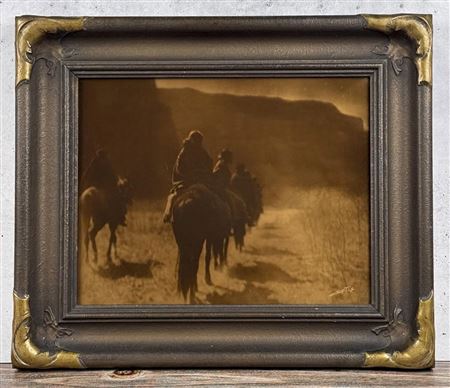
Still, some of his most collectible photographs are the Curt-tone or orotone. Curtis did not create the process but eventually was considered its master. The orotone was a positive image on glass, while most photographic prints are a positive image on paper.
Curtis goldtone expert Robert W. Kapoun wrote, “When viewed next to a paper print, the Curt-Tone/goldtone/orotone truly has a three dimensional quality that transcends our normal perception of a photograph.” Curtis explained, “The ordinary photographic print, however good, lacks depth and transparency, or more strictly speaking, translucency. We all know how beautiful are the stones and pebbles in the limpid brook of the forest where the water absorbs the blue of the sky and the green of the foliage, yet when we take the same iridescent pebbles from the water and dry them they are dull and lifeless, so it is with the ordinary photographic print, but in the Curt-Tones all the transparency is retained and they are full of life and sparkle as an opal. ” The goldtones were always sold with frames, most commonly in the “batwing style” either created or commissioned by Curtis.
Curtis’s personal, unique Stickley Brothers (Grand Rapids, Michigan) oak book cabinet made specially to display a complete set of The North American Indian is a poignant reminder of the untold story of a close friendship between two famous people, which spanned decades. There was no man in America who loved the Indians more than Curtis. Likewise, there was no woman in America who loved the Indians more than Marah Ellis Ryan (1866-1934).
Ryan was born in Butler County, Pennsylvania and became a noted author and Indian activist. The two most likely met around 1906 when they were trekking through the Southwest, especially in the land of the Navajo and Hopi. In March 1907 Ellis published Indian Love Letters about the Hopi, decorated with an illustration of a Curtis photograph on the frontispiece. Two years later she published The Flute of the Gods with twenty-four illustrations of Curtis photographs.
In 1922 the two teamed up again along with others to establish the Indian Welfare League headquartered in the Southwest Museum in Los Angeles. In a Southwest Museum leaflet published that year Ryan who was the chairman of publicity wrote, “The primary object of the League is to encourage all efforts which make for the permanent good of the American Indian.” United States citizenship for Native American followed in 1924.
The New York Times wrote in her obituary on July 11, 1934, “Mrs. Ryan went to live among the Hopi Indians twenty-five years ago and claimed to be the only white woman ever admitted to the secret religious rites.” When Curtis was penniless in the early 1930’s, she gifted to her dear friend her set of the The North American Indian along with her Stickley Brothers cabinet, custom made in 1909 to hold them. Amazingly, he was so self-sacrificing that he didn’t even have his own set at this time.
After he died, his set, #106, was eventually purchased in 1993 from the family by the University of Oregon library. The cabinet was owned by his daughter Beth Curtis Magnuson (1896-1973) from 1935 until her death. It remained in the Curtis family until 1980.
Curtis died at his daughter Beth’s home on October 19, 1952 in Los Angeles—poor and unremembered. It is hard to image that there was any artist of the American West who was more dedicated than him. His unparalleled work is still appreciated today with more books written about him by far than any other Western American photographer. Pulitzer Prize- winning Kiowa author N. Scott Momaday wrote, “Never before have we seen the Indians of North America so close to the origins of their humanity, their sense of themselves in the world, their innate dignity and self-possessions.”
From 2021 to 2023, thanks to the visionary Tim Peterson [no relationship to the author], the Western Spirit: Scottsdale’s Museum of the West in Scottsdale, Arizona held the finest and most extensive exhibition ever on Curtis. The show was based primarily on Peterson’s stunning collection, and many consider it the most significant exhibition ever on Western American art.Biography from Adobe Gallery
From 1904 to 1930, Edward Sheriff Curtis (1868-1952) sought out the vanishing tribes of Native Americans with an unwavering passion and dedication. His life's work was to record the faces and lifestyles of the Indians before they vanished forever beneath the settling of the continent by the white man.
Edward S. Curtis photographed his subjects from the deserts of the Southwest to the ice floes of the Arctic, recording with his camera and pen the look and the culture of more than eighty tribes. It was an achievement both poignant and monumental.