Page loaded successfully. Showing biography for Edwin Deakin.
Edwin Deakin BIOGRAPHY
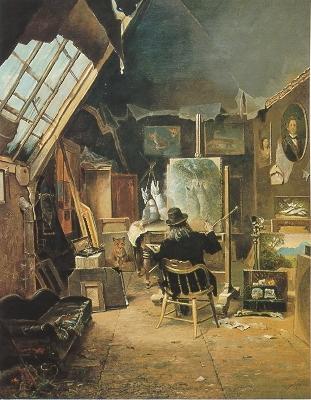
1838 Sheffield, England - 1923 Berkeley, California. Known for: Landscape, architecture, still life.
Born in Sheffield, England on May 21, 1838. At age 12 Deakin was apprenticed to a decorative japanning firm where he was taught to paint landscapes on boxes and tables. This appears to have been the... Read full biography
Born in Sheffield, England on May 21, 1838. At age 12 Deakin was apprenticed to a decorative japanning firm where he was taught to paint landscapes on boxes and tables. This appears to have been the extent of his art training and he remained a self-taught artist. A most talented youth, by 18 he was... Read full biography
Born in Sheffield, England on May 21, 1838. At age 12 Deakin was apprenticed to a decorative japanning firm where he was taught to paint landscapes on boxes and tables. This appears to have been the extent of his art training and he remained a self-taught artist. A most talented youth, by 18 he was recognized in France and his native England for his architectural paintings. After moving to America in 1856, Deakin settled in Chicago and soon was exhibiting portraits of Civil War heroes at the... Read full biography
Born in Sheffield, England on May 21, 1838. At age 12 Deakin was apprenticed to a decorative japanning firm where he was taught to paint landscapes on boxes and tables. This appears to have been the extent of his art training and he remained a self-taught artist. A most talented youth, by 18 he was recognized in France and his native England for his architectural paintings. After moving to America in 1856, Deakin settled in Chicago and soon was exhibiting portraits of Civil War heroes at the Chicago Art Academy. In 1870 he moved to San Francisco, established a studio, and within a few years had gained a fine reputation as a painter while exhibiting regularly with the San Francisco Art Ass'n and at the Mechanics' Institute Fairs. He was a... Read full biography
Born in Sheffield, England on May 21, 1838. At age 12 Deakin was apprenticed to a decorative japanning firm where he was taught to paint landscapes on boxes and tables. This appears to have been the extent of his art training and he remained a self-taught artist. A most talented youth, by 18 he was recognized in France and his native England for his architectural paintings. After moving to America in 1856, Deakin settled in Chicago and soon was exhibiting portraits of Civil War heroes at the Chicago Art Academy. In 1870 he moved to San Francisco, established a studio, and within a few years had gained a fine reputation as a painter while exhibiting regularly with the San Francisco Art Ass'n and at the Mechanics' Institute Fairs. He was a member of the Bohemian Club and a close friend of Samuel Brookes with whom he shared a studio. Deakin traveled and sketched in Europe during 187.... Read full biography
Artist Biography
Biography page for Edwin Deakin ((1838 - 1923)), known for Landscape, architecture, still life. Showing 3 biographical entries and 0 sample artworks.
Edwin Deakin - Artist Info
About Edwin Deakin
Biography from the Archives of askART
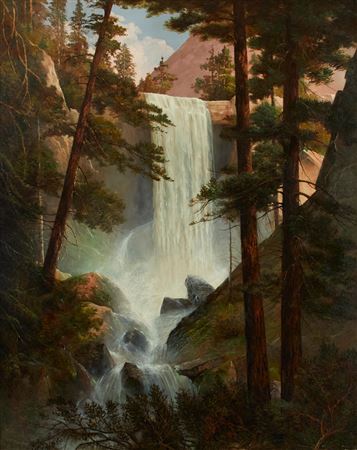 Born in Sheffield, England on May 21, 1838. At age 12 Deakin was apprenticed to a decorative japanning firm where he was taught to paint landscapes on boxes and tables. This appears to have been the extent of his art training and he remained a self-taught artist. A most talented youth, by 18 he was recognized in France and his native England for his architectural paintings. After moving to America in 1856, Deakin settled in Chicago and soon was exhibiting portraits of Civil War heroes at the Chicago Art Academy. In 1870 he moved to San Francisco, established a studio, and within a few years had gained a fine reputation as a painter while exhibiting regularly with the San Francisco Art Ass'n and at the Mechanics' Institute Fairs. He was a member of the Bohemian Club and a close friend of Samuel Brookes with whom he shared a studio. Deakin traveled and sketched in Europe during 1877-79. While there, he produced many paintings of Switzerland and France and exhibited at the Paris Salon. During 1882-83 he occupied a studio in Denver, CO and then returned to San Francisco. His last years were spent in Berkeley, CA where in 1890 he purchased a large tract of land which was a portion of the old Peralta land grant. He built a Mission-Style studio on the property and remained there until his death on May 11, 1923. Later the property was subdivided and a street named for him there. Having developed an early enthusiasm for ruins and historic architecture, in later years Deakin turned to painting these sharply delineated scenes in a style that was termed "romantic, picturesque, and nostalgic." Most of his paintings are characterized by the skillful rendering of architectural surfaces. Most famous for his series of mission paintings, from 1879 until the turn of the century he painted two sets in oil and one in watercolor of the 21 missions. His legacy to California also includes skillfully rendered paintings of grapes, Chinatown genre, and scenes of the disaster of 1906. Exh: San Francisco Art Association, 1872-85; Mechanics' Inst. (SF), 1875-87; Calif. State Fair, 1876-89; Alaska-Yukon Expo (Seattle), 1909; De Young Museum, 1940; Oakland Museum, 1962, 1971, 1992; Whitney Museum, 1981. In: De Young Museum (Flaming Tokay); Natural History Museum of LA (missions); Oakland Museum; CHS; Society of Calif. Pioneers; Nevada Museum (Reno); Orange Co. (CA) Museum.
Biography from the Archives of askART
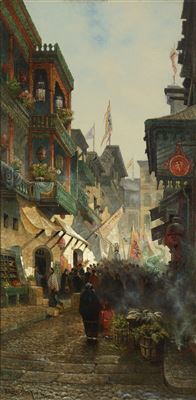 An aristocrat from England with minimal artistic training, Edwin Deakin settled in Northern California where he painted landscapes of ruins and historic architecture and scenes from a genteel time in the past such as medieval streets in London, romantic views of castles, and quaint English villages.
He was born in Sheffield, England and came to America in 1856, living first in Chicago where he earned some reputation for portraits of Civil War Heroes. In 1870, he moved to San Francisco and set up a studio and soon was very much a part of the local art scene. He was a member of the Bohemian Club and a close associate and studio mate of Samuel Marsden Brookes.
From 1887 to 1890, he painted in Europe and exhibited at the Paris Salon. From then until his death in 1923, he lived in Berkeley on a large tract of land he purchased where he built a mission style studio.
His works are in many California collections including the California Historical Society, the Oakland Museum, and the De Young Memorial Museum. He made three sets of paintings of the California missions (two in oil and one in watercolor, the one in oil is at the Natural History Museum of Los Angeles County (NHMLAC).Biography from Altermann Galleries and Auctioneers, IV
Edwin Deakin (1838-1923) was born in Sheffield, England, and immigrated to America in 1856. He lived in Chicago where, for a time, he earned his living painting commissioned portraits of Civil War heroes. In 1870, he moved west to San Francisco and established his home and studio. Deakin's paintings, in the Romantic landscape tradition, created iconic images of the Sierra Nevada, especially the Lake Tahoe Basin.
Other than the painters and photographers who accompanied teams that were mapping overland routes for settlers and establishing rights-of-way for the railroad, it was rare for artists in the mid-to-late nineteenth century to ply their trade, much less settle in the dry, barren expanses of Nevada. Conversely, the western boundary of the state, particularly the spectacular crest of the Sierra Nevada, was favored by artists who were attracted by its dramatic snow-capped peaks and deep vistas.
Deakin was a popular and versatile painter whose subject matter ranged from still lifes to mountain landscapes. Lake Tahoe and its much smaller neighbor, Fallen Leaf Lake, were locales that attracted Deakin-Tahoe because of the possibilities it offered for creating scenes with dramatic atmospheric effects and Fallen Leaf because of the intimate scale, especially the outcropping of rocks along its shoreline.
The artist's landscapes were in part a matter of formula. The influence of late American Romantic landscape painters such as Albert Bierstadt (1830-1902), Thomas Moran (1837-1926), and Thomas Hill (1829-1908) is evident in Deakin's manner of composition and the way he imparted color to his canvases. A characteristic Deakin landscape featured a sweep of tall, dark trees across the foreground, silhouettes that made the sun-drenched peaks in the distance seem even farther away. It was often atmospheric perspective at its most exaggerated, and American collectors could not get enough of it.
Deakin moved to Berkeley, California, and built a home on a large tract of land shortly after he returned from sketching and painting in Europe between 1887 and 1890. His reputation rested most comfortably on a series of twenty-one oil and watercolor paintings depicting the Spanish missions in California that were established by Father Junipero Serra, a project that took the artist twenty-nine years to complete. Deakin died in Berkeley in 1923 at the age of eighty-five.
Source: www.onlinenevadaencyclopedia.com