Page loaded successfully. Showing biography for Edwin Scheier.
Edwin Scheier BIOGRAPHY
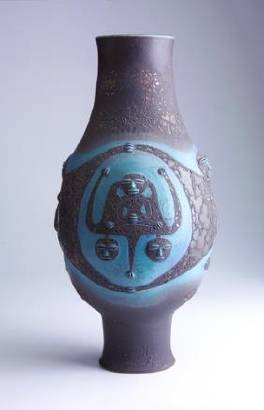
1910 New York City - 2008. Known for: Ceramics, sculpture, painting, teaching.
A pioneer in the techniques of glazes for modern studio pottery and a long-time art teacher, Edwin Scheier, working with his wife, Mary Goldsmith Scheier, was known for utilitarian pots highlighted... Read full biography
A pioneer in the techniques of glazes for modern studio pottery and a long-time art teacher, Edwin Scheier, working with his wife, Mary Goldsmith Scheier, was known for utilitarian pots highlighted by skillfully applied glazes. With him creating and applying the glazes to forms made by Mary, the... Read full biography
A pioneer in the techniques of glazes for modern studio pottery and a long-time art teacher, Edwin Scheier, working with his wife, Mary Goldsmith Scheier, was known for utilitarian pots highlighted by skillfully applied glazes. With him creating and applying the glazes to forms made by Mary, the couple worked side by side most of their married life. Many of their thrown pots had themes of birth and rebirth in humans and animals. In addition to pottery, they made small sculptures from local... Read full biography
A pioneer in the techniques of glazes for modern studio pottery and a long-time art teacher, Edwin Scheier, working with his wife, Mary Goldsmith Scheier, was known for utilitarian pots highlighted by skillfully applied glazes. With him creating and applying the glazes to forms made by Mary, the couple worked side by side most of their married life. Many of their thrown pots had themes of birth and rebirth in humans and animals. In addition to pottery, they made small sculptures from local clay, and some of these pieces resembled Sung Dynasty-era pottery. Edwin Scheier was born in New York City in the Bronx to an American mother and Jewish German father. The father died when Edwin was very young, which left the family struggling... Read full biography
A pioneer in the techniques of glazes for modern studio pottery and a long-time art teacher, Edwin Scheier, working with his wife, Mary Goldsmith Scheier, was known for utilitarian pots highlighted by skillfully applied glazes. With him creating and applying the glazes to forms made by Mary, the couple worked side by side most of their married life. Many of their thrown pots had themes of birth and rebirth in humans and animals. In addition to pottery, they made small sculptures from local clay, and some of these pieces resembled Sung Dynasty-era pottery. Edwin Scheier was born in New York City in the Bronx to an American mother and Jewish German father. The father died when Edwin was very young, which left the family struggling financially. He dropped out of high school in order to earn money but later studied art in New York City at the Art... Read full biography
Artist Biography
Biography page for Edwin Scheier ((1910 - 2008)), known for Ceramics, sculpture, painting, teaching. Showing 2 biographical entries and 0 sample artworks.
Edwin Scheier - Artist Info
About Edwin Scheier
Biography from the Archives of askART
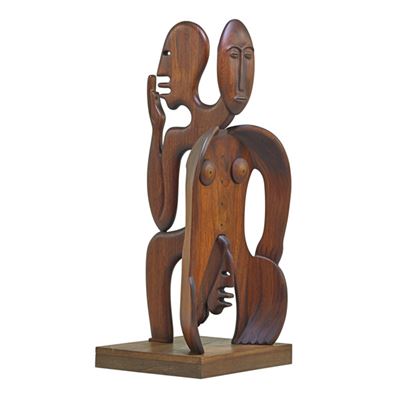 A pioneer in the techniques of glazes for modern studio pottery and a long-time art teacher, Edwin Scheier, working with his wife, Mary Goldsmith Scheier, was known for utilitarian pots highlighted by skillfully applied glazes. With him creating and applying the glazes to forms made by Mary, the couple worked side by side most of their married life. Many of their thrown pots had themes of birth and rebirth in humans and animals. In addition to pottery, they made small sculptures from local clay, and some of these pieces resembled Sung Dynasty-era pottery.
Edwin Scheier was born in New York City in the Bronx to an American mother and Jewish German father. The father died when Edwin was very young, which left the family struggling financially. He dropped out of high school in order to earn money but later studied art in New York City at the Art Students League and Columbia University and attended free seminars at Cooper Union.
Work with a silversmith and ceramist provided skills for his future creative endeavors. He was also a puppeteer and then a crafts instructor with the WPA (Works Progress Administration), which led to his meeting his future wife, Mary, at the Metropolitan Museum of Art where he was teaching classes. She, also a WPA artist, was director of a ceramics studio in Salem, Virginia. They married in 1927.
Considered a modernist, he exhibited work at the Whitney Museum of American Art as well as other venues including the Toledo Museum of Art, Dartmouth College and the Syracuse Museum of Art.
In 1940, the couple moved to Durham, New Hampshire, and for the next 28 years, both taught at the University of New Hampshire. Between 1968 and 1978, they lived in Oaxaca, Mexico, to study native arts and crafts, especially weaving and painting of the Zapote peoples. In 1978, they moved to Green Valley, Arizona where she died on May 14, 2007 at age 99.
In his later years, Edwin Scheier did increasingly more designing on the computer instead of in his ceramics studio.
Pottery by the Scheiers is in the permanent collections of the Currier Museum of Art, the Art Institute of Chicago, Museum of Modern Art, Walker Art Center and the Detroit Museum of Art.
Sources include:
Wikipedia: a b http://www.phoenixnewtimes.com/issues/2001-01-11/art.html; http://216.204.67.110/Obj3647$2100; http://www.izaak.unh.edu/specoll/mancoll/scheier.htm]; http://www.newarkmuseum.org/greatpots/fig85.htm; http://216.204.67.110/Obj3647$2100; http://collections.currier.org/
Roja Heydarpour, "Mary Scheier, 99, Creator of Elegant Pottery", The New York Times, May 19, 2007, Obituaries, A26
Peter Hastings Falk, Editor, Who Was Who in American ArtBiography from Butler Institute of American Art
Edwin Scheier
Edwin Scheier was born in New York City in 1910. Following early training and apprenticeship in jewelry design and production he worked as an industrial designer. In 1934 Scheier taught crafts in New York State C.C.C. program; he also started a puppet troupe for the C.C.C. after working with puppeteer Rimo Bufano.
From 1935 to 1937 he was Field Supervisor for the W.P.A. crafts program in the southern states; marriage to Mary Goldsmith, 1937. In 1938 the Scheiers were active as puppeteers along the East Coast. Directed the T.V.A. Art Center at Norris, Tennessee, 1938-1939 where both Scheiers learned pottery technique on their own. Operated their pottery at Glade Springs, Virginia, 1938-1940.
Taught pottery and sculpture at University of New Hampshire, from 1941-1960. Military service with Army Air Corps, 1942-1943. In 1945 invited by Puerto Rico Development Corporation of the Department of Interior to establish a program to train personnel to staff projected island ceramics industry; retained as consultant for a second year. Honorary degree Doctor of Humane Letters from University of New Hampshire, 1966.
Juror for 15th and 21st Syracuse Nationals.
Edwin Scheier's work is represented in some 30 museum collections in this country and in Canada, Italy and Japan.
In Mexico, 1953 and 1958-1959; Europe, chiefly Spain, 1960-1961