Page loaded successfully. Showing biography for Elizabeth Catlett.
Elizabeth Catlett BIOGRAPHY
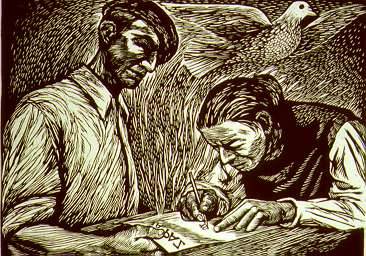
1915 Washington, District of Columbia - 2012 Cuernavaca, Mexico. Known for: Abstract sculpture, modernist figure and portrait painting, graphics.
Elizabeth Catlett (1915-2012). Known for abstract sculpture in bronze and marble as well as prints and paintings, particularly depicting the female figure, Elizabeth Catlett is unique for distilling... Read full biography
Elizabeth Catlett (1915-2012). Known for abstract sculpture in bronze and marble as well as prints and paintings, particularly depicting the female figure, Elizabeth Catlett is unique for distilling African American, Native American, and Mexican art in her work. She is "considered by many to be the... Read full biography
Elizabeth Catlett (1915-2012). Known for abstract sculpture in bronze and marble as well as prints and paintings, particularly depicting the female figure, Elizabeth Catlett is unique for distilling African American, Native American, and Mexican art in her work. She is "considered by many to be the greatest American black sculptor". (Rubinstein 320). Catlett was born in Washington D.C. and later became a Mexican citizen, residing in Cuernavaca Morelos, Mexico. She spent the last 35 years of her... Read full biography
Elizabeth Catlett (1915-2012). Known for abstract sculpture in bronze and marble as well as prints and paintings, particularly depicting the female figure, Elizabeth Catlett is unique for distilling African American, Native American, and Mexican art in her work. She is "considered by many to be the greatest American black sculptor". (Rubinstein 320). Catlett was born in Washington D.C. and later became a Mexican citizen, residing in Cuernavaca Morelos, Mexico. She spent the last 35 years of her life in Mexico. Her father, a math teacher at Tuskegee Institute in Alabama, died before she was born, but the family, including her working mother, lived in the relatively commodious home of his family in DC. Catlett received a Bachelor of Arts... Read full biography
Elizabeth Catlett (1915-2012). Known for abstract sculpture in bronze and marble as well as prints and paintings, particularly depicting the female figure, Elizabeth Catlett is unique for distilling African American, Native American, and Mexican art in her work. She is "considered by many to be the greatest American black sculptor". (Rubinstein 320). Catlett was born in Washington D.C. and later became a Mexican citizen, residing in Cuernavaca Morelos, Mexico. She spent the last 35 years of her life in Mexico. Her father, a math teacher at Tuskegee Institute in Alabama, died before she was born, but the family, including her working mother, lived in the relatively commodious home of his family in DC. Catlett received a Bachelor of Arts degree from Howard University, where there was much discussion about whether or not b... Read full biography
Artist Biography
Biography page for Elizabeth Catlett ((1915 - 2012)), known for Abstract sculpture, modernist figure and portrait painting, graphics. Showing 4 biographical entries and 0 sample artworks.
Elizabeth Catlett - Artist Info
About Elizabeth Catlett
Name variants
Elizabeth Catlett Mora
Biography from the Archives of askART
 Elizabeth Catlett (1915-2012)
Known for abstract sculpture in bronze and marble as well as prints and paintings, particularly depicting the female figure, Elizabeth Catlett is unique for distilling African American, Native American, and Mexican art in her work. She is "considered by many to be the greatest American black sculptor". . .(Rubinstein 320)
Catlett was born in Washington D.C. and later became a Mexican citizen, residing in Cuernavaca Morelos, Mexico. She spent the last 35 years of her life in Mexico.
Her father, a math teacher at Tuskegee Institute in Alabama, died before she was born, but the family, including her working mother, lived in the relatively commodious home of his family in DC. Catlett received a Bachelor of Arts degree from Howard University, where there was much discussion about whether or not black artists should depict their own heritage or embrace European modernism.
She earned a Master of Fine Arts degree in 1940 from the University of Iowa, where she had gone to study with Grant Wood, Regionalist* painter. His teaching dictum was "paint what you know best," and this advice set her on the path of dealing with her own background. She credits Wood with excellent teaching and deep concern for his students, but she had a problem during that time of taking classes from him because black students were not allowed housing in the University's dormitories.
Following graduation in 1940, she became Chair of the Art Department at Dillard University in New Orleans. There she successfully lobbied for life classes with nude models, and gained museum admission to black students at a local museum that to that point, had banned their entrance. That same year, her painting Mother and Child, depicting African-American figures won her much recognition.
From 1944 to 1946, she taught at the George Washington Carver School, an alternative community school in Harlem that provided instruction for working men and women of the city. From her experiences with these people, she did a series of paintings, prints, and sculptures with the theme "I Am a Negro Woman."
In 1946, she received a Rosenwald Fellowship*, and she and her artist husband, Charles White, traveled to Mexico where she became interested in the Mexican working classes. In 1947, she settled permanently in Mexico where she, divorced from White, married artist Francisco Mora. The couple had three children. From 1958 to 1973, she became the first woman professor of sculpture and later Chair of the department of sculpture at the National School of Fine Arts, Mexico.
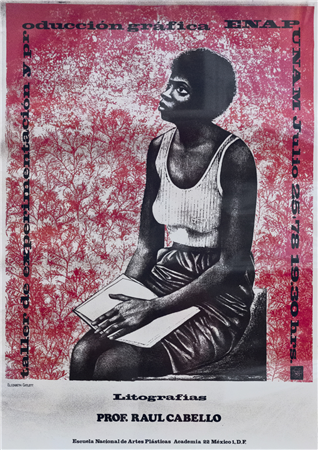
There she also did much printmaking, which she found an affordable medium for reaching the masses of people and produced images of African-American and Mexican working class women.
Source:
Charlotte Streifer Rubinstein, American Women Artists
Added note: Elizabeth Catlett died at the age of 96 on April 2, 2012 at her home in Cuernavaca, Mexico. (Obituary. Chicago Tribune April 4, 2012)
* For more in-depth information about these terms and others, see AskART.com Glossary http://www.askart.com/AskART/lists/Art_Definition.aspx
Biography from RoGallery
 Elizabeth Catlett was born April 15, 1919 in Washington DC to John and Mary Carson Catlett, both of whom had taught school. Catlett combines the basic elements of African traditions with those of west Mexico and U.S. African American. Catlett decided to become an artist while attending Dunbar High School, and won a competitive examination for a scholarship to the Carnegie Institute of Technology in Pittsburgh, but was rejected because of her race.
Catlett went on to study at Howard University with such luminaries as Dr. Alain Leroy Locke, Professor James A. Porter, James Lesense Wells, and Lois Mailou Jones. With the passing of Franklin Roosevelt's New Deal, and the oppressive McCarthy hearings, the loyalty oath and other such irritants drove artists into seclusion by the hundreds. By 1947, Catlett decided to retreat to Mexico where she had previously spent time while working on a Rosenfeld Fellowship.
Her artistic talent has won Catlett significant recognition as an artist in two very different cultures. Catlett's prints have been exhibited all over the world. She has received grants and fellowships, which have allowed her to study in England, east Germany, China, and the Soviet Union.
The work of Elizabeth Catlett is in many museums, including the National Institute of Fine Arts in Mexico City, Metropolitan Museum of Art and the Museum of Modern Art in New York, and the Museum of American Art in Washington, DC. Catlett continues to reside in Mexico with her husband, artist Victor Mora, and their sons.
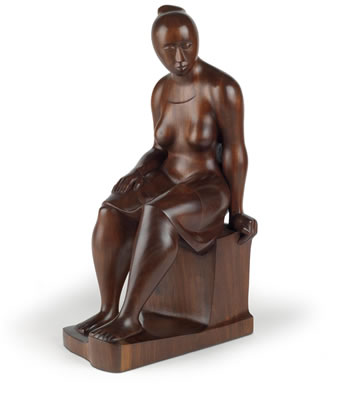
Elizabeth Catlett has made sculpture in wood, mostly of the female nude, since the mid-1950s. In Mexico, Catlett studied sculpture at the University of Iowa and then in New York with the Modernist Ossip Zadkine. According to Melanie Herzog, when Catlett returned to sculpture after 8 years of motherhood, she began working in wood for the first time, studying with Jose L. Ruiz at the Esmeralda school; from 1955-1959. Catlett describes her work as representations of women, black women and herself - " I am a black woman. I use my body in working. When I am bathing or dresing, I see and feeel how my body looks and moves. I never do sculpture from a nude model... Mostly I watch women."
Education:
1955 - Studied wood carving with Jose L. Ruiz
1947 - Sculpture with Francisco Zuniga, Escuela de Pintura y Escultura, Esmeralda, Mexico
1943 - Studied with Sculptor Ossip Zadkine, NY
1942 - Studied lithography at Art Students League, NY
1941 - Studied ceramics, Art Institute of Chicago, IL
1940 - MFA, University of Iowa
1935 - BS, Cum Laude, Howard University School of Art, Washington, DCBiography from Tobey C. Moss Gallery
ELIZABETH CATLETT is first and foremost a sculptor in stone, wood and bronze. But, printmaking has been an equally important facet of her artistic expression since she was introduced to lithography in 1942 at the Art Students League in New York.
From there, it was a natural transition to the wood and linoleum block with tools that were familiar from her sculptural work. Catlett chose printmaking as the best path for reaching the masses of people (especially women) in the United States and Mexico who were also African-American and Mexican natives.
From early experiences, Catlett faced racial challenges which she met squarely. She fought for equality in the classrooms, in the public theaters, in the museums. In her work is the proof.Biography from The Johnson Collection
ALICE ELIZABETH / ELIZABETH ALICE {WHITE} {MORA} CATLETT (1915–2012)
Painter, printmaker, and sculptor Elizabeth Catlett believed art could affect social change and that she should be an agent for that change: “I have always wanted my art to service black people—to reflect us, to relate to us, to stimulate us, to make us aware of our potential.” As an artist and an activist, Catlett highlighted the dignity and courage of motherhood, poverty, and the working class, returning again and again to the subject she understood best—African American women.
The granddaughter of slaves, Elizabeth Alice Catlett grew up in a middle-class home in Washington, DC, and dreamed of becoming an artist. She executed her first sculpture in high school—carving an elephant from soap—but did not return to the three-dimensional form until graduate school. Catlett matriculated at Howard University, having been denied admittance to her first choice, the Carnegie Institute of Technology in Pittsburgh, because of the color of her skin. At Howard, Catlett studied painting with several notable artists including James Herring, Loïs Mailou Jones, James Porter, and James Lesesne Wells. Following her graduation in 1935, she taught art in the Durham, North Carolina, public school system for two years. While she enjoyed teaching, her classroom responsibilities left little time for her own creativity.
In hopes of better balancing her artistic aspirations with the need for a steady income, Catlett enrolled in graduate school at the University of Iowa, where Regionalist painter Grant Wood was one of her instructors. When Catlett soon shifted her academic emphasis to sculpture, Wood continued to serve as a mentor and encouraged her to focus on “what she knew.” For Catlett, this meant images of African American women and children, which she channeled in her 1939 thesis project, a carved limestone sculpture of a mother and baby, which was awarded the first prize in sculpture at the 1940 American Negro Exposition in Chicago. She became the first black woman to earn an MFA from the university.
Catlett joined the faculty of Dillard University in New Orleans in the fall of 1940 and lobbied for her students’ opportunities in the segregated city. One pupil, Samella Lewis, recounted an episode when Catlett wanted to visit a Picasso exhibition at the Isaac Delgado Museum (now the New Orleans Museum of Art), which was located in the center of a segregated park. Rather than be deterred by Jim Crow laws, she transported her class by bus to the museum’s front steps on a day when the institution was closed to white members.
Catlett spent the summer between her first and second years at Dillard in Chicago, staying with her good friend and fellow artist Margaret Burroughs. She took a course in ceramics at the Art Institute of Chicago, studied lithography at the South Side Community Art Center, and became immersed in the city’s politically active art circles. Through Burroughs, Catlett met another promising artist, Charles White, whom she married just a few months later in December 1941. When a dispute about faculty salaries arose at Dillard the following year, she resigned and relocated with her husband to New York.
There, Catlett took courses in lithography at the Art Students League and studied with Ossip Zadkine, a Russian émigré who inspired her to experiment with abstraction, encouragement that led to her prolonged exploration of the feminine form in a forceful, fluid modernist mode. In the mid-1940s, Catlett taught at the progressive George Washington Carver School, where her students—primarily working class black men and women—had a profound impact on her values and artistic output, as borne out in her later linocut series titled “I Am the Negro Woman” (which Catlett later renamed “I Am the Black Woman”). Catlett also served on the faculty of Hampton Institute in Virginia where she influenced John Biggers.
For most of their marriage, White’s achievements overshadowed Catlett’s despite the similarity of their styles and subject matter. Finally, in 1945, Catlett received recognition for her work through a Julius Rosenwald Foundation Fellowship which funded the couple’s travel to Mexico to study at the famed Taller de Gráfica Popular. While at this graphic artists’ collective and workshop, Catlett began working with linoleum cut, a printmaking technique that was efficient and affordable.
As Catlett’s career flourished, her marriage dissolved, prompting her to leave Mexico after several months to initiate divorce proceedings. By 1947, she had returned to Mexico to establish permanent residency. Catlett met printmaker and muralist Francisco Mora when she was associated with the Taller; they later married and had three sons. In 1958, Catlett became the first female professor of sculpture and head of the art department of the Universidad Nacional Autónoma de México in Mexico City, an appointment she held until her retirement in 1975.
Although Catlett never joined the Communist party, her political activism and association with several known party members caused the United States State Department to label her as an “undesirable alien.” In response, Catlett renounced her American citizenship in 1962 and became a citizen of Mexico. In her adopted country, Catlett continued to champion women and fight for social justice. For nearly a decade, the United States denied Catlett a travel visa, until she was permitted to attend an exhibition of her work at the Studio Museum in Harlem in 1971; her American citizenship was reinstated in 2002.
Catlett’s international success as a socially conscious artist and tireless advocate earned her numerous recognition and awards, including the Women's Caucus for Art Lifetime Achievement Award in 1981, a Legends and Legacy award from the Art Institute of Chicago in 2005, and an NAACP Key of Life award in 2009; in 2008, Carnegie Mellon University presented her with an honorary doctorate. Elizabeth Catlett’s work is held in the collections of every major American museum.
The Johnson Collection, Spartanburg, South Carolina
thejohnsoncollection.org