Eric Grate BIOGRAPHY
Artist Biography
Biography page for Eric Grate ((1896 - 1983)), known for Painting and sculpture. Showing 2 biographical entries and 0 sample artworks.
Eric Grate - Artist Info
About Eric Grate
Biography from Bukowski Stockholm
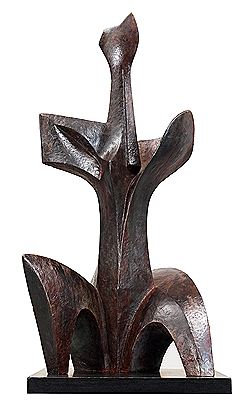
Eric Grate's idiosyncratic world of images always invites exploration and wandering within the imagination. While he respects the earths natural forms, he sometimes "plays with god", manipulating and playing with nature to create new surprising objects which recognise we simultaneously but dont recall. He borrows fragments from nature and uses his endless imagination to create art in his unique way. His visual language emualtes an aura of abstract surrealism derived from "object trouvés". Grate was inspired by inspired natures radiance and different forms. Stones, roots, insects,obes, all were transformed into sculptures, particularly the insect world was a source of great inspiration for Grates. During the 1960s, beach, hull, and bones were particularly the starting points for his sculptures. He created numerous official artworks.
Grate started his academic trips after finishing his studies at Royal Swedish Academy of Fine Arts from 1979, where he travelled to Italy and Greece, his filling sketchbooks with studies of insects, plants, unique architecture, sculpture, and ceramics. He spent a longer period between 1924 and 1933 in Paris, a formative period where he was one of the few Swedish artists who were associated with the avante garde; we got in contact with none other than the surrealists Jean Arp, Paul Eluard, and Tristan Tzara. Grate is seen by many as one of Sweden's most influential sculptors during the 1900s.
Biography from Palm Beach Modern Auctions
Eric Grate studied at the Royal Academy of Arts in Stockholm between 1917 and 1920. Thereafter he undertook study trips to Germany, especially to Munich, and to Italy and Greece. He moved to Paris in 1924 and stayed there for ten years. In France he lived in the companionship of a number of other Swedish artists including Nils Dardel, Isaac Grünewald, Sigrid Hjertén, Otto G. Carlsund and Otte Sköld. Between 1941 and 1951 he was a professor at the [Swedish] Royal Academy of Arts.