Page loaded successfully. Showing biography for Ernest Major.
Ernest Major BIOGRAPHY
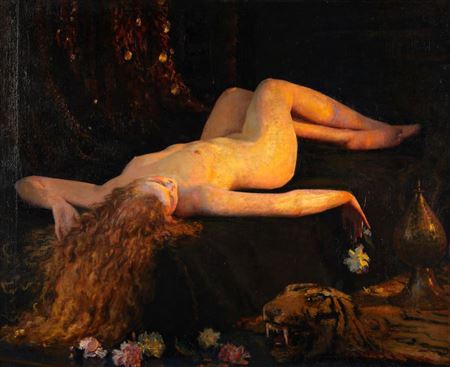
1864 Washington District Of Columbia - 1950 Boston, Massachusetts. Known for: Portrait, figure, and still life paintings.
Born in Washington, DC in 1864, the under-researched artist Ernest L. Major immersed himself into the Boston milieu that orbited around Edmund Tarbell and Frank W. Benson. E. C. Messer was Major's... Read full biography
Born in Washington, DC in 1864, the under-researched artist Ernest L. Major immersed himself into the Boston milieu that orbited around Edmund Tarbell and Frank W. Benson. E. C. Messer was Major's first instructor at the Corcoran Gallery of Art and by the early 1880s, he was studying under William... Read full biography
Born in Washington, DC in 1864, the under-researched artist Ernest L. Major immersed himself into the Boston milieu that orbited around Edmund Tarbell and Frank W. Benson. E. C. Messer was Major's first instructor at the Corcoran Gallery of Art and by the early 1880s, he was studying under William Merritt Chase at the Art Students League in New York City. At the age of twenty-one, Major was the first to win the Hallgarten Art Scholarship, which at that time included travel expenses for study in... Read full biography
Born in Washington, DC in 1864, the under-researched artist Ernest L. Major immersed himself into the Boston milieu that orbited around Edmund Tarbell and Frank W. Benson. E. C. Messer was Major's first instructor at the Corcoran Gallery of Art and by the early 1880s, he was studying under William Merritt Chase at the Art Students League in New York City. At the age of twenty-one, Major was the first to win the Hallgarten Art Scholarship, which at that time included travel expenses for study in Europe ("Correspondence," The Studio, 1885, p. 132). Major joined the burgeoning ranks of American expatriate artists, most of whom were trained at the Académie Julian in Paris, and he was one of the many American students of Boulanger and Lefebvre.... Read full biography
Born in Washington, DC in 1864, the under-researched artist Ernest L. Major immersed himself into the Boston milieu that orbited around Edmund Tarbell and Frank W. Benson. E. C. Messer was Major's first instructor at the Corcoran Gallery of Art and by the early 1880s, he was studying under William Merritt Chase at the Art Students League in New York City. At the age of twenty-one, Major was the first to win the Hallgarten Art Scholarship, which at that time included travel expenses for study in Europe ("Correspondence," The Studio, 1885, p. 132). Major joined the burgeoning ranks of American expatriate artists, most of whom were trained at the Académie Julian in Paris, and he was one of the many American students of Boulanger and Lefebvre. Quite serious about becoming a self-supporting professional painter, Major made his debut in 1886 when he exhibited a landscap... Read full biography
Artist Biography
Biography page for Ernest Major ((1864 - 1950)), known for Portrait, figure, and still life paintings. Showing 2 biographical entries and 0 sample artworks.
Ernest Major - Artist Info
About Ernest Major
Biography from the Archives of askART
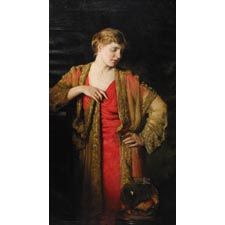 Born in Washington, DC in 1864, the under-researched artist Ernest L. Major immersed himself into the Boston milieu that orbited around Edmund Tarbell and Frank W. Benson. E. C. Messer was Major's first instructor at the Corcoran Gallery of Art and by the early 1880s, he was studying under William Merritt Chase at the Art Students League in New York City. At the age of twenty-one, Major was the first to win the Hallgarten Art Scholarship, which at that time included travel expenses for study in Europe ("Correspondence," The Studio, 1885, p. 132). Major joined the burgeoning ranks of American expatriate artists, most of whom were trained at the Académie Julian in Paris, and he was one of the many American students of Boulanger and Lefebvre. Quite serious about becoming a self-supporting professional painter, Major made his debut in 1886 when he exhibited a landscape at the Paris Salon (his works would appear there through 1889). Eight drawings in the Salon of 1887 proved Major's skill in draftsmanship. In the following year, he showed Sainte-Geneviève in the Salon and shipped two works to New York for the NAD exhibition.
In 1888, Major returned to Boston when he resumed his career as a teacher at the Cowles Art School. Major sent The Little Knitting Girl, an oil painting, to the Paris Salon of 1889 (illustrated in Sheldon, 1890, p. 139) but did not take part in that year's Universal Exposition. While teaching at Cowles, as Dennis Miller Bunker's replacement, his work was seen in exhibitions at the Jordan Marsh Art Gallery and the Boston Art Club. Still clinging to classical academicism in his subjects, in 1890, Major sent a painting entitled Diana, Huntress to the Art Institute of Chicago. Continuing in this vein through the 1890s, as French impressionism made its indelible imprint on aesthetics in Boston, Major swerved only slightly. In 1892, he sent On the Banks of the Agawam to the Pennsylvania Academy. His Sainte-Geneviève, Youth, and a portrait appeared at the World's Columbian Exposition. By 1896, he was teaching at the Massachusetts Normal Art School where Robert Vonnoh had studied twenty years earlier. Here in this bastion of art conservatism, Major remained, teaching the basics of art, drawing, and painting.
Major spent most of his non-teaching hours at the famous Fenway Studios in Boston, while during the summers he worked en plein air at Tamworth, New Hampshire. The painter became a regular participant in most large annual exhibitions in Boston, New York, Chicago, and Philadelphia. The Museum of Fine Arts, Boston also has Marion Pond, 1903, a portrait of a slightly anxious, seated little girl, and the striking Miss F. (ca. 1910), a seated woman who holds an open fan. In 1915 at the Panama-Pacific International Exposition in San Francisco, Major was awarded a silver medal for Blonde in Blue and two years later he received the Bok Prize from the PAFA. Major's charming style offended no one and pleased many and his well planned manner exuded the basics of sound draftsmanship along with a noticeable manipulation of pigment. His subjects were relatively diversified including portraits, genre, still-life, and some landscapes. Major also excelled in the medium of pastel. He died in Boston in 1950.
Sources:
Sheldon, George William. Recent Ideals of American Art. New York: D. Appleton and Co., 1890, p. 139; Pierce, Patricia Jobe. Edmund C. Tarbell and the Boston School of Painting, 1889-1980. Boston: 1980, pp. 74, 117, 118, 166; Fairbrother, Trevor J. The Bostonians: Painters of an Elegant Age, 1870-1930. Boston: Northeastern University Press, 1986, p. 219; Gammell, R.H. Ives. The Boston Painters 1900-1930. Orleans, MA: Parnassus Imprints, 1986, pp. 135-136, 138; Zellman, Michael David. 300 Years of American Art. Seacacus, NJ: Wellfleet Press, 1987, p. 587.
Submitted by Richard H. Love and Michael Preston Worley, Ph.D.Biography from the Archives of askART
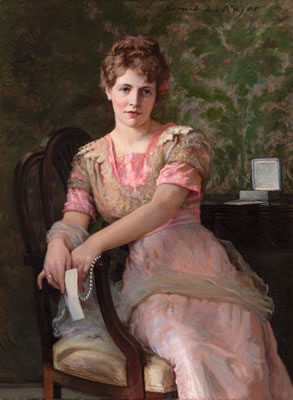 A teacher and painter of portraits, figures, and still lifes, Ernest Lee Major was among the leaders of the Boston School of artists. He won the prestigious Hallgarten Prize while studying with William Merritt Chase at the New York Art Students League, and then went to Europe for three years. He attended the Academie Julian in Paris and exhibited at the Paris Salon.
In 1889, he returned to Boston and replaced Dennis Miller Bunker as a teacher at the Cowles Art School. In 1896, he joined the faculty of the Massachusetts Normal Art School where he taught for 46 years.
In 1915, he won a silver medal at the Panama-Pacific Exposition, and in 1917 won the Bok Prize at the Pennsylvania Academy.
Source:
Vose Galleries, Boston. Exhibition catalogue, "Ernest Lee Major," 1995.