Page loaded successfully. Showing biography for Ernie Eugene Barnes Jr.
Ernie Eugene Barnes Jr BIOGRAPHY
1938 Durham, North Carolina - 2009 Los Angeles, California. Known for: African-American figure, genre and sports painting.
Painter Ernie Barnes was born July 15, 1938 in Durham, North Carolina during the height of the Jim Crow Era. He lived in a section of the city called “The Bottom” with his parents and younger... Read full biography
Painter Ernie Barnes was born July 15, 1938 in Durham, North Carolina during the height of the Jim Crow Era. He lived in a section of the city called “The Bottom” with his parents and younger brother, James. His father, Ernest Barnes, Sr. was a shipping clerk for Liggett & Myers tobacco company.... Read full biography
Painter Ernie Barnes was born July 15, 1938 in Durham, North Carolina during the height of the Jim Crow Era. He lived in a section of the city called “The Bottom” with his parents and younger brother, James. His father, Ernest Barnes, Sr. was a shipping clerk for Liggett & Myers tobacco company. His mother, Fannie Geer, supervised the household for a prominent attorney who shared his extensive art book collection with the young “June” Barnes. By the time he began elementary school, Barnes was... Read full biography
Painter Ernie Barnes was born July 15, 1938 in Durham, North Carolina during the height of the Jim Crow Era. He lived in a section of the city called “The Bottom” with his parents and younger brother, James. His father, Ernest Barnes, Sr. was a shipping clerk for Liggett & Myers tobacco company. His mother, Fannie Geer, supervised the household for a prominent attorney who shared his extensive art book collection with the young “June” Barnes. By the time he began elementary school, Barnes was familiar with the Master artists. Bullied as a child for being shy and sensitive, Barnes found solace in drawing. In his freshman year, a weightlifting coach put Barnes on a fitness program which taught him effort and discipline. By his senior year at... Read full biography
Painter Ernie Barnes was born July 15, 1938 in Durham, North Carolina during the height of the Jim Crow Era. He lived in a section of the city called “The Bottom” with his parents and younger brother, James. His father, Ernest Barnes, Sr. was a shipping clerk for Liggett & Myers tobacco company. His mother, Fannie Geer, supervised the household for a prominent attorney who shared his extensive art book collection with the young “June” Barnes. By the time he began elementary school, Barnes was familiar with the Master artists. Bullied as a child for being shy and sensitive, Barnes found solace in drawing. In his freshman year, a weightlifting coach put Barnes on a fitness program which taught him effort and discipline. By his senior year at segregated Hillside High School in Durham, Barnes was captain of the football team and state champion in the... Read full biography
Artist Biography
Biography page for Ernie Eugene Barnes Jr ((1938 - 2009)), known for African-American figure, genre and sports painting. Showing 3 biographical entries and 0 sample artworks.
Ernie Eugene Barnes Jr - Artist Info
About Ernie Eugene Barnes Jr
Name variants
Ernest Eugene Barnes, Ernie Barnes
Biography from the Archives of askART
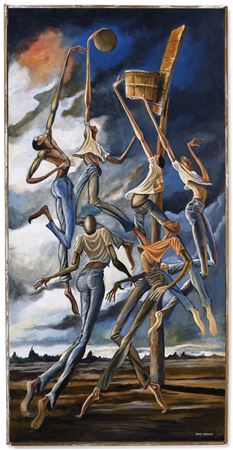 Painter Ernie Barnes was born July 15, 1938 in Durham, North Carolina during the height of the Jim Crow Era. He lived in a section of the city called “The Bottom” with his parents and younger brother, James. His father, Ernest Barnes, Sr. was a shipping clerk for Liggett & Myers tobacco company. His mother, Fannie Geer, supervised the household for a prominent attorney who shared his extensive art book collection with the young “June” Barnes. By the time he began elementary school, Barnes was familiar with the Master artists.
Bullied as a child for being shy and sensitive, Barnes found solace in drawing. In his freshman year, a weightlifting coach put Barnes on a fitness program which taught him effort and discipline. By his senior year at segregated Hillside High School in Durham, Barnes was captain of the football team and state champion in the shot put.
Barnes earned a full athletic scholarship to North Carolina College (now North Carolina Central University) where his art instructor, sculptor Ed Wilson, encouraged him to create images from his own life experiences.
In 1960, Barnes was one of 30 African-Americans drafted into the National Football League. (One of nine players selected that year from a Historically Black College and University.) For five seasons, Barnes was an offensive lineman for the New York Titans, San Diego Chargers and Denver Broncos. In 1965, New York Jets owner Sonny Werblin paid Barnes a season’s salary “to paint” and subsequently sponsored the first Ernie Barnes art exhibition in a prestigious gallery. After the success of the show, Barnes retired from football at age 28 and settled in Los Angeles, California to devote himself to art.
Barnes is the first professional American athlete to become a noted painter. From his sports experience and the study of anatomy, Barnes’ unique style of elongation captures the movement, energy and grace of his subjects. This earned him numerous appointments, including “Sports Artist of the 1984 Olympic Games” and “America’s Best Painter of Sports” by the American Sport Art Museum & Archives. He was commissioned to paint artwork for the National Basketball Association, Los Angeles Lakers, Carolina Panthers, New Orleans Saints, Oakland Raiders, educational institutions, corporations, musicians, celebrities and professional athletes. His beloved painting, The Bench, that Barnes created in 1959 before his rookie season, was presented in 2014 to the Pro Football Hall of Fame.
In pop culture, Barnes artwork appears in television, movies and music album covers, including his famous dance hall scene, The Sugar Shack.
His pride of North Carolina is evident in his artwork of pool halls, barber shops, porch ladies, church, street singers, sandlot games and other memories of growing up in the South. His commentary on dance, music, sports, women, education, social justice and everyday life continue to inspire viewers of all ages, race, religion, education and social status.
Barnes died of cancer on April 27, 2009. He is survived by his wife Bernie and his five children, Deidre, Michael, Sean, Erin and Paige.
The current exhibition, The North Carolina Roots of Artist Ernie Barnes at the North Carolina Museum of History in Raleigh is an unprecedented success, with over 85,000 visitors and counting since July 2018. In May 2019, the exhibition Ernie Barnes: A Retrospective opens the California African American Museum in Los Angeles.
Source/Submitted by Luz Rodriguez, for the estate of Ernie Barnes. Also in part from the artist autobiography
Updated: February 15, 2019Biography from RoGallery
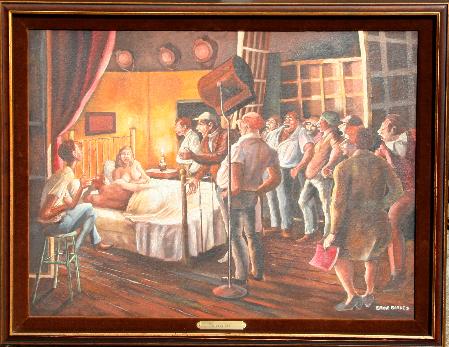 Ernie Barnes' involvement with art began at an early age; however, when he reached high school his creative endeavors were temporarily detoured in his determination to become a successful athlete. In part this change was a response to the demands of peer pressure, which can be so strong at that age. He graduated from his high school a hero and star football player, and with a choice of 26 full athletic scholarships. He chose North Carolina Central University and a major in art. After college, he continued in a professional athletic career, but never let his love for football overshadow his love for art. Football gave him an enormous satisfaction of achievement, of being able to do something extremely difficult, and do it well. Art, however, allowed him the privilege to interpret for the public his concepts of the relationship between art and life.
In 1966, Ernie Barnes retired from football to commit himself to his art. His athletic career made a special contribution to his sensibility and his art, and he often weds physical with artistic expression. Many of his subjects are satirical, and he uses exaggeration, and even caricature, to enhance their mood, humor and physical vitality. Usig dramatic-comic vision, Barnes hopes that human figures will play out their roles in a contemporary scenario in a manner that is both entertaining and finely executed.
* INDIVIDUAL EXHIBITIONS 1979
o North Carolina Museum of Art, Raleigh, North Carolina
* 1976
o City Museum, Cedar Rapids, Iowa
* 1975
o Bedford Stuyvesant Restoration Center, Brooklyn, N.Y
o North Carolina Central University, Durham, North Carolina
* 1974
o Museum of African Arts, Washington, D.C.
* 1973
o High Museum, Atlanta, Georgia
* 1972
o Science and Industry Museum, Los Angeles, Cal.
* 1971
o Elizabeth City State University, Elizabeth City, North Carolina
o Agra Gallery, Washington, D.C.
* 1969
o Mckenzie Gallery, Los Angeles, California
* 1968
o Mckenzie Gallery, Los Angeles, California
* 1966
o Grand Central Art Gallery, New York
Biography submitted on April 30, 2010.Biography from The Johnson Collection
ERNEST EUGENE BARNES (1938–2009)
Well known in both the professional sports and visual arts worlds, Ernest Eugene Barnes’s experience as an athlete was pivotal to his development as a painter of rhythm and vigor. He has been celebrated as “the most expressive painter of sports since George Bellows.” In his own words, Barnes’s work offers “a pictorial background for an understanding into the aesthetics of Black America.”
Born in Durham, North Carolina, during the Jim Crow years, Barnes did not have access to art museums. Instead, he familiarized himself with art history in the personal library of his mother’s prominent employer. Bullied because of his weight as a youth, Barnes sought acceptance through athletics and relied on art as an emotional outlet. In 1956, Barnes enrolled at North Carolina College (now North Carolina Central University) on a full athletic scholarship and pursued a degree in art.
One influential college instructor urged Barnes to translate the physical movement of his body on the football field to the canvas—a lesson Barnes never forgot. His sports and tavern paintings, populated with expressive, elongated figures reminiscent of Parmigianino or Michelangelo’s later work, have been described as Neo-Mannerist. These figures are most often depicted with their eyes closed, a practice Barnes adopted to illustrate “how blind we are to one another's humanity” and the tendency to “stop at color.” He preferred to present his paintings in frames made of distressed wood inspired by the ramshackle fence that had encircled his childhood home in Durham.
Barnes played in the American Football League (AFL) as a lineman from 1960 to 1965 and briefly for the Canadian Football League. However, after suffering a career-ending foot injury in 1965, Barnes devoted himself to art, becoming the official artist of the New York Jets and, later, of the 1984 Olympics. His decades of work capturing athletes at rest or in motion was honored twice, once in 1984 and again in 2004 when he was named Sport Artist of the Year by the American Sport Art Museum and Archives. His detailed transition from professional athlete to artist is documented in his 1995 autobiography, From Pads to Palette.
Barnes’s portrayal of African American family and social life in thirty-five paintings toured the United States from 1972–1979 in the esteemed exhibition, The Beauty of the Ghetto. Of that exhibition, his best-known work, The Sugar Shack, was featured on the popular television show Good Times. After some alterations, it became the cover design for Marvin Gaye’s 1976 I Want You album.
Barnes received numerous awards for his paintings, which continue to appear in exhibitions nationwide and are held in prominent private collections, as well as the California African American Museum. He died from a rare blood disorder in 2009, and, as he had requested, a portion of his ashes were spread over the site of his family’s home in Durham.
The Johnson Collection, Spartanburg, South Carolina
thejohnsoncollection.org