Page loaded successfully. Showing biography for Ettore Sottsass.
Ettore Sottsass BIOGRAPHY
1917 Innsbruck, Austria - 2007. Known for: Avant-garde furniture design, ceramics, jewelry, handcrafted glass.
"A Polymathic Italian Designer, With Muses and Friends," By Roberta Smith, July 26, 2017, The New York Times, Art & Design section. Exhibition Review of "Ettore Sottsass: Design Radical," ?Through... Read full biography
"A Polymathic Italian Designer, With Muses and Friends," By Roberta Smith, July 26, 2017, The New York Times, Art & Design section. Exhibition Review of "Ettore Sottsass: Design Radical," ?Through Oct. 8, 2017 at the Met Breuer, Manhattan; . Ettore Sottsass. You can’t always live comfortably with... Read full biography
"A Polymathic Italian Designer, With Muses and Friends," By Roberta Smith, July 26, 2017, The New York Times, Art & Design section. Exhibition Review of "Ettore Sottsass: Design Radical," ?Through Oct. 8, 2017 at the Met Breuer, Manhattan; . Ettore Sottsass. You can’t always live comfortably with his eccentric furniture, but you can’t write the history of late 20th-century art without it. On the 100th anniversary of his birth and only a decade since his death, in 2007, the Milanese maestro best... Read full biography
"A Polymathic Italian Designer, With Muses and Friends," By Roberta Smith, July 26, 2017, The New York Times, Art & Design section. Exhibition Review of "Ettore Sottsass: Design Radical," ?Through Oct. 8, 2017 at the Met Breuer, Manhattan; . Ettore Sottsass. You can’t always live comfortably with his eccentric furniture, but you can’t write the history of late 20th-century art without it. On the 100th anniversary of his birth and only a decade since his death, in 2007, the Milanese maestro best known for his red Olivetti portable typewriter and as the guru of the revolutionary postmodern design group Memphis remains a magnificent irritant and an exemplar of originality. Unsurprisingly, “Ettore Sottsass: Design Radical” at the Met Breuer... Read full biography
"A Polymathic Italian Designer, With Muses and Friends," By Roberta Smith, July 26, 2017, The New York Times, Art & Design section. Exhibition Review of "Ettore Sottsass: Design Radical," ?Through Oct. 8, 2017 at the Met Breuer, Manhattan; . Ettore Sottsass. You can’t always live comfortably with his eccentric furniture, but you can’t write the history of late 20th-century art without it. On the 100th anniversary of his birth and only a decade since his death, in 2007, the Milanese maestro best known for his red Olivetti portable typewriter and as the guru of the revolutionary postmodern design group Memphis remains a magnificent irritant and an exemplar of originality. Unsurprisingly, “Ettore Sottsass: Design Radical” at the Met Breuer has a combative air. You may argue your way through it, and also take issue with some of its contextual artworks — this show is n... Read full biography
Artist Biography
Biography page for Ettore Sottsass ((1917 - 2007)), known for Avant-garde furniture design, ceramics, jewelry, handcrafted glass. Showing 3 biographical entries and 0 sample artworks.
Ettore Sottsass - Artist Info
About Ettore Sottsass
Name variants
Ettore Sottass
Biography from the Archives of askART
 "A Polymathic Italian Designer, With Muses and Friends," By Roberta Smith, July 26, 2017, The New York Times, Art & Design section. Exhibition Review of "Ettore Sottsass: Design Radical," ?Through Oct. 8, 2017 at the Met Breuer, Manhattan;
Ettore Sottsass. You can’t always live comfortably with his eccentric furniture, but you can’t write the history of late 20th-century art without it. On the 100th anniversary of his birth and only a decade since his death, in 2007, the Milanese maestro best known for his red Olivetti portable typewriter and as the guru of the revolutionary postmodern design group Memphis remains a magnificent irritant and an exemplar of originality.
Unsurprisingly, “Ettore Sottsass: Design Radical” at the Met Breuer has a combative air. You may argue your way through it, and also take issue with some of its contextual artworks — this show is nearly half non-Sottsass — but it is an invigorating, illuminating experience.
Early furniture designs by Sottsass include Tower Furniture (1960-63), in wood, paint and gold leaf, and the Commode column (circa 1965), made of laminated wood and painted steel.
The largest Sottsass show staged in a New York museum, and one of a celebratory crop for the centenary, it provides a broad picture of the origins of this architect/designer and of Memphis itself that few are familiar with. It details his influences and inspirations with artifacts from Egyptian, Indian and other non-Western cultures; examples of European and American modernism, as well as designs by Sottsass’s Memphis contemporaries (especially Peter Shire and Shiro Kuramata) and also some acolytes, misguided and not.
This effort has been organized seemingly on the fly by Christian Larsen, who arrived as the Met’s associate curator of modern design and decorative arts only 18 months ago. Unusual for a show of this size and ambition, there is no catalog, although Mr. Larsen does his best to compensate with expert labels and several short, effective slide shows.
But excepting architecture, this is a fairly complete Sottsass sampler: furniture, decorative objects, textiles, office machinery and jewelry and, of course, the idiosyncratic laminates so important to the indelible Memphis look. My favorite is Bacterio, a combination of little black squiggles on white that sheaths a 1979 proto-Memphis cabinet for Studio Alchymia and is completed by a windowed door, three fluorescent lights and lunar-module feet.
Born in 1917 in Innsbruck, Austria, Sottsass teethed in proximity to one of the founts of modernism as the devoted son of Ettore Sottsass Sr., an architect who trained in Vienna when its design ethic was steeped in the grids and geometries of Otto Wagner and his brilliant student Josef Hoffmann, a founder in 1903 of the Wiener Werkstätte. (Junior would also be inspired by the Bauhaus, modernism’s second front.)
His father moved the family to Turin and after World War II, in Italy’s frenzy of Marshall Plan rebuilding, father and son collaborated on designs for low-cost housing and schools that were inspired by the varied structures and materials of small Italian villages. Their work is postmodernism in embryo and a veritable template for the 1989 house in Ridgway, Colo., that Sottsass designed for the couple Daniel Wolf, an art collector and d
During his 60-year career, Sottsass Jr. designed office systems (including the shell of the Olivetti mainframe computer, from 1957 to 1959) and systems for simplified living, as well, that were intended to discourage consumption. His Superbox, for example, designed in 1966, was an outhouse-proportioned wardrobe with a surface of plastic laminates of the buyer’s choice — had it been produced. It stands out from the wall like one of Anne Truitt’s painted Minimalist plinths. Complete with its own pedestal that ignored the Minimalist practice, while also complicating its use, it was intended to hold all your carefully winnowed belongings.
His experimental Environment units similarly compressed the basic household functions (cooking, sleeping, bathing) into mobile modular cabinets that would link together for moving. At least in theory. They never got beyond the maquette stage and are present here only in a 1972 film that Sottsass made with Massimo Magrì, and two excellent drawings.
But he also had an obsession with handcrafted glass and especially ceramics, fed by his many trips to India. A grove of Sottsass’s looming ceramic totems, built from cylinders glazed in many colors, are in a gallery painted marigold yellow, alongside tiny Indian stupas with similarly stacked structures. The remaining Sottsass ceramics here mostly lose out to the antiquities, except for the more delicate, Deco-like black-and-silver vases of the Tenebre (Darkness) series from 1963.
Initially a devotee of modernism, Sottsass designed one of its postwar classics: the Olivetti manual typewriter of 1968, intoxicatingly bright and enshrined in the Museum of Modern Art by 1969. Its form-follows-function economy is articulated by its magnetic color, but it was eventually cursed by its creator for overshadowing his other achievements (in an expletive probably never before seen in a Met wall text).
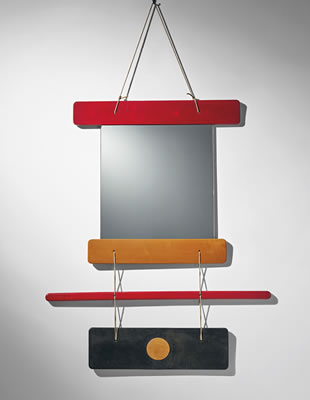
But Memphis seems to have been in Sottsass’s blood. Even before the Olivetti typewriter, he was intimating a sundering of modernism’s form-function credo, as evidenced by two towerlike cabinets from the early- and mid-1960s in the show’s first, dense gallery. Enlarging the Viennese grid seen nearby in designs by Hoffmann and Kolomon Moser, they attest to an inborn preference for bright color, combined materials and bold, subtly humorous scale.
Sottsass’s apostasy culminated in the exuberant wildness of his Memphis furniture, with its angled forms, Fiestaware hues, enlarged faux-wood grains and startling modern laminates. The design group took its name from the cities in Tennessee and ancient Egypt and the Bob Dylan song Stuck Inside of Mobile With the Memphis Blues Again, which played repeatedly during its first meeting in 1981. Later that year, Memphis caused a furor at the annual Salone del Mobile, Milan’s revered Italian furniture fair, un-apologetically infecting design with postmodernism’s skeptical mixing of styles, symbols and emotional content.
Karl Lagerfeld bought many of the Memphis prototypes for his Monaco apartment and — well, the rest is history. (The pieces ultimately were priced too high for average consumers and became symbols of ’80s excess.) For better and for worse, Sottsass’s influence still ripples through contemporary design.
The Met’s insistence on mixing and matching, always pushing the relevance of its vast holdings to more contemporary developments, may become a tick. (It certainly diluted the recent show of Marsden Hartley’s Maine paintings.) Mr. Larsen’s add-ons here are usually effective and they point up a strength of this tactic: singling out historical works you might otherwise have missed in the flow of the collection galleries, like the terrific little painted-wood reliquary from New Kingdom Egypt that resembles a Romanesque chapel.
Some add-ons feel superfluous, including overexposed works by Roy Lichtenstein and Frank Stella. The Met’s exceptional 1964 canvas by the Abstract Expressionist Adolph Gottlieb serves mostly to make the show’s single Sottsass painting look bad. Some indication of Sottsass Sr.’s work, or his collaborations with his son, seem in order, as does the inclusion of relevant non-Memphis legends like Joe Colombo and Gaetano Pesce.
Mr. Larsen has some revelatory decoy maneuvers. A black-and-white cane armchair from 1903 by Hoffmann and Moser is accompanied by what initially appears to be a Werkstätte oddity but is actually a wood planter that Sottsass designed in 1961, more straightforward and less refined. One of the best juxtapositions is a vitrine that alternates three Sottsass glass objects with three kachina figures by unrecorded Hopi artists whose colorful geometric forms clearly relate. And the kachinas come racing back to mind in one of the high points in the show’s final gallery: the akimbo, symmetrical semaphore of Sottsass’s Carlton Room Divider, a standout from the 1981 Milan furniture fair. Here Sottsass, as in his other Memphis pieces, achieves a new friction between form and function, while slyly merging painting, sculpture and furniture with the spirit of architecture.
The not-always-pertinent non-Sottsass material means that this exhibition sometimes feels padded. Sottsass could easily have filled the space at the Met Breuer if there had been more lead time. Nonetheless, it provides an invaluable introduction to his complex, resonating achievement.Biography from Heritage Auctions
Born in Innsbruck, Austria, of Italian parents, 14 September 1917. Educated in Turin, 1928-1934; studied architecture at the Polytechnic, Turin, 1935-1939, Dip. Arch. 1939. Associated with the designer Luigi Spazzapan, Turin, 1937-1940.
Since 1946 in private practice as architect, and since 1958 as an industrial designer, Milan. Principal, Sottsass Associati, Milan, since 1980. Designer Consultant to the Olivetti Company since 1958; established additional office for Olivetti at Ivrea, near Turin, 1960. Founder-member, Global Tools group, Milan, 1975.
Worked with Studio Alchymia designers. group, Milan, from 1979. Founder, Memphis design group, Milan, 1981. Designed chairs and a table for the Shaughnessy House (Montréal, Québec).Biography from Wright
Ettore Sottsass is one of the most significant designers and architects of the late 20th Century, his bold and colorful, Post Modern aesthetic enlivening objects, furniture and interiors and influencing design around the world.
Born in Innsbruck, Austria in 1917, Sottsass and his family moved to Turin, Italy in 1929 so he could study architecture at the Politecnico di Turino. He graduated with a degree in architecture in 1939 but he was called to serve the Italian army during World War II and he spent most of the war in a concentration camp. Upon his return in 1945, he worked for his father, Ettore Sottsass senior, an architect practicing in Turin, before relocating to Milan to curate a craft exhibition at the 1946 Triennale. In Milan, Sottsass began writing for the art and architectural magazine, Domus. It was also here in Milan that Sottsass founded his own architectural and industrial design practice establishing a name for himself by the end of the 1950s with the design of fashionable office equipment for Olivetti.
Throughout the 1960s and 1970s, Sottsass created radical and experimental designs for forward thinking companies like Poltronova. Sottsass’ exploration of a new visual language included collaborating with artists such as Alessandro Mendini and Andrea Branzi and culminated in the formation of the radical design collective, Memphis whose work was widely accepted and shown all over the world. Notable architectural projects by Sottsass include the interiors of a chain of stores for Esprit (1985) and the Malpensa airport near Milan (2000).
He received many awards and honors throughout his lifetime and his work has been the subject of numerous international publications and exhibitions including a recent retrospective at The Metropolitan Museum of Art, New York. Designs by Sottsass can be found in the permanent collections of many museums including the Museum of Modern Art, New York and the Los Angeles County Museum of Art.