Page loaded successfully. Showing biography for Fang Lijun.
Fang Lijun BIOGRAPHY
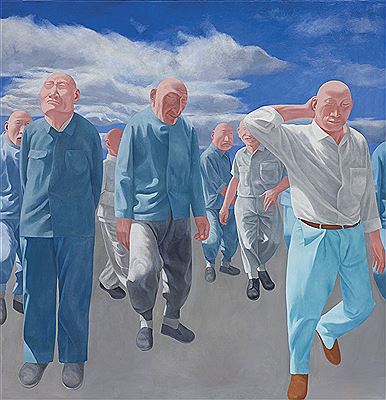
Born 1963 Handan, Hebei Province, China. Known for: Bald figure social narrative painting, abstraction.
One of the leading proponents of the early 1990s Cynical Realist movement, Fang Lijun did work which encapsulates the disillusionment of China's youth; a generation defined by the events at Tiananmen... Read full biography
One of the leading proponents of the early 1990s Cynical Realist movement, Fang Lijun did work which encapsulates the disillusionment of China's youth; a generation defined by the events at Tiananmen Square and China's internal domestic policies. Constructed around loose narratives Fang's images... Read full biography
One of the leading proponents of the early 1990s Cynical Realist movement, Fang Lijun did work which encapsulates the disillusionment of China's youth; a generation defined by the events at Tiananmen Square and China's internal domestic policies. Constructed around loose narratives Fang's images personalize sentiments of disenchantment, angst, and rebellion; his fictional suggestions conveyed through his illustrative style and re-occurring bald-headed protagonist. Fang's practice exhibits a... Read full biography
One of the leading proponents of the early 1990s Cynical Realist movement, Fang Lijun did work which encapsulates the disillusionment of China's youth; a generation defined by the events at Tiananmen Square and China's internal domestic policies. Constructed around loose narratives Fang's images personalize sentiments of disenchantment, angst, and rebellion; his fictional suggestions conveyed through his illustrative style and re-occurring bald-headed protagonist. Fang's practice exhibits a rarefied technical skill rigorously studied through his Social Realist training; his combination of this aesthetic with references to contemporary comics, folk art, and dynastic painting characterize a national identity in flux, distilling a position of... Read full biography
One of the leading proponents of the early 1990s Cynical Realist movement, Fang Lijun did work which encapsulates the disillusionment of China's youth; a generation defined by the events at Tiananmen Square and China's internal domestic policies. Constructed around loose narratives Fang's images personalize sentiments of disenchantment, angst, and rebellion; his fictional suggestions conveyed through his illustrative style and re-occurring bald-headed protagonist. Fang's practice exhibits a rarefied technical skill rigorously studied through his Social Realist training; his combination of this aesthetic with references to contemporary comics, folk art, and dynastic painting characterize a national identity in flux, distilling a position of integrity from tradition and the modern world. Fang's monumental sized prints revive the ancient Asian practice of woodblock printing... Read full biography
Artist Biography
Biography page for Fang Lijun ((Born 1963)), known for Bald figure social narrative painting, abstraction. Showing 2 biographical entries and 0 sample artworks.
Fang Lijun - Artist Info
About Fang Lijun
Name variants
Lijun Fang
Biography from Saatchi Gallery
One of the leading proponents of the early 1990s Cynical Realist movement, Fang Lijun did work which encapsulates the disillusionment of China's youth; a generation defined by the events at Tiananmen Square and China's internal domestic policies. Constructed around loose narratives Fang's images personalize sentiments of disenchantment, angst, and rebellion; his fictional suggestions conveyed through his illustrative style and re-occurring bald-headed protagonist.
Fang's practice exhibits a rarefied technical skill rigorously studied through his Social Realist training; his combination of this aesthetic with references to contemporary comics, folk art, and dynastic painting characterize a national identity in flux, distilling a position of integrity from tradition and the modern world.
Fang's monumental sized prints revive the ancient Asian practice of woodblock printing -- a complicated and exacting process of carving a 'negative' image into a panel, coating the surface in ink, and impressing the image onto paper; each different colour and tone requires a separate plate and order of printing. Due to their immense scale, Fang's images are composed on several adjoined scrolls; the elongated strips create both an emotive fragmenting of the image, and create a reference to memory and historical testimony. Thematically, each of these prints describe the plight of the individual against the 'mass', creating a spiritual contemplation of solitude the quest for personal probity in the face of adversity.
Fang's painting 30th Mary evokes these same sentiments with a humorous effect. Reminiscent of European church ceiling paintings, Fang portrays an order of ascendancy of same-same kewpie figures, each based on his own image. Executed with painstaking hyper-realism, the clouds formulate as a tempestuous funnel rather than a portal of billowing promise. Contrasted with the kitsch palette and pop rendering of the grotesque cherubs, Fang's painting approaches the sanctity of ideological assurance with an empathetic cynicism.
SOLO EXHIBITIONS
2006
Kupferstichkabinett Staatliche Museen zu Berlin, Germany
2005
National Galerie / China Art Museum, Beijing, China
Art Cologne, Germany
2004
Fang Lijun, Leben Ist Jetzt, Alexander Ochs Galleries Berlin, Beijing, Berlin, Germany
2002
Fang Lijun, Between Beijing & Dali, Woodcuts & Paintings 1989 - 2002, Ludwig Forum für InternationaleKunst Aachen
2001
Fang lijun, Asian Fine Art, Berlin
Prüss + Ochs Gallery Germany
1998
Fang Lijun, Max Protetch Gallery, New York
From Beijing to Amsterdam and Back, Stedelijk Museum/ Galerie Serieuse Zaken, Amsterdam
1996
Fang Lijun: Human Images in an Uncertain Age, The Japan Foundation Asia Center, Tokyo
Fang Lijun, Galerie Bellefroid, Paris
Fang Lijun, Galerie Serieuse Zaken, Amsterdam
GROUP EXHIBITIONS
2005
Kinderszenen - Child's Play, Rohbaukunst, Groß Leuthen Berlin - Brandenburg, Germany
Mahjong, Kunstmuseum Bern, Switzerland
New Work / New Aquisitions, MoMa New York, USA
Clues, WHITE SPACE BEIJING , Beijing, China
Sammlung Hoffmann Berlin, Präsentation 2006/2007, Germany
ART FORUM Berlin 2005, Berlin, Germany
2001
C'est Moi, C'est Nous, Galerie de France, Paris
Millennium Portrait of China, Bremen City Gallery, Bremen
2000
Portraits de Chine Contemporaine, Espace Culturel Francois Mitterand, Perigueux, France
1998-2000
Inside Out, Asia Society, New York, MoMA San Francisco, Seattle, Monterey
1999
d'APERTutto, 48th Venice Biennale, Venice
1998
Black & White, Chinese Contemporary, London
5000 + 10, Chinese Contemporary (London), Bilbao, Spain
Double Kitsch: Painters from China, Max Protetch Gallery, New York
1996-1997
CHINA!, Kunstmuseum, Bonn
1996
4 Points de Rencontre, Chine, 1996, Galerie de France, Paris
Begegnungen mit China, Ludwig Forum, Aachen, Germany
Beijing/No No Soap Opera?, Munich, Germany
New Collection of Commissioned works on the theme 'Hiroshima', Hiroshima City Museum of Contemporary Art
1995
Visions of Happiness - Ten Asian Contemporary Artists, The Japan Foundation, ASEAN Cultural Centre, Tokyo
Unser Jahrhundert, Ludwig Museum, Cologne
First Kwangju Biennial, Kwangju, Korea
Couplet 4, Stedelijk Museum, Amsterdam
Avant Gardes Artistiques Xineses, Centre d'Art Santa Monica, Barcelona
1994-1995
Fourth Asian Art Show, Fukuoka Art Museum, Fukuoka/Setagaya Art Museum, Tokyo
1994
Welt-Moral Kunsthalle, Basel
Chinese Contemporary Art at Sao Paulo, 22nd International Biennial of Sao Paulo
New Chinese Art, Hanart TZ Gallery, Taipei
1993-1994
China Avant Garde, Haus der Kulturen der Welt, Berlin (also Kunsthalle, Rotterdam, Museum of Modern Art, Oxford, Kunsthallen Brandts Kloedefabrik, Odense, Denmark)
1993
China's New Art, Post-1989, Hong Kong Art Centre, Hong Kong
Mao Goes Pop, Museum of Contemporary Art, Sydney
Passagio ad Oriente, 45th Venice Biennale, Venice
New Art From China Post-1989, Marlborough Fine Art London
1992-1993
New Art From China/Post Mao Product, The Art Gallery of New South Wales, Sydney, Queensland Art Gallery, Brisbane, City of Ballaart Fine Art Gallery, Ballaart, Canberra School of Art Gallery, Canberra
1992
Fang Lijun and Liu Wei Oil Painting Exhibition, Beijing Art Museum, Beijing
1991
Fang Lijun/Liu Wei, private exhibition, Beijing
1989
China/Avant Garde, China National Gallery, Beijing
1984
Sixth National Art Exhibition, Guangzhou
Internet Source:
http://www.saatchi-gallery.co.uk/artists/fang_lijun.htmBiography from Kingsley Art Auction (CLOSED)
Born in Hebei Province, China. In 1989, he graduated from the Central Academy of Fine Arts. He joined Venice Biennial in 1993 and San Paulo Biennial the next year. He was invited by the Museum Ludwing for the group exhibition - "Our Century" in 1995. He had solo exhibition in Stedelijk Museum in Amsterdam and Max Protetch Gallery in New York in 1998. In 2006, his works were shown in Germany and Indonesia. In his paintings, shaven-head figures rapidly show in groups. They often have silly laughing faces that give viewers the feel of emptiness. His intention is to call the value of life into question.