Page loaded successfully. Showing biography for Frank III Faulkner.
Frank III Faulkner BIOGRAPHY
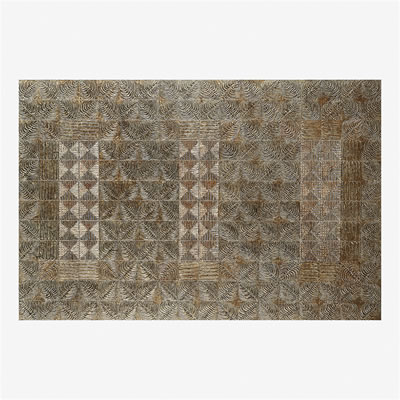
1946 Sumter, South Carolina - 2018. Known for: Non objective biotic patterns.
Born in Sumter, South Carolina in 1946, Frank Faulkner received his B.F.A. from the University of North Carolina in 1968, Phi Beta Kappa, and his M.F.A. from the same institution in 1972. Faulkner's... Read full biography
Born in Sumter, South Carolina in 1946, Frank Faulkner received his B.F.A. from the University of North Carolina in 1968, Phi Beta Kappa, and his M.F.A. from the same institution in 1972. Faulkner's work quickly won him numerous grants and awards, including an individual artist grant from the... Read full biography
Born in Sumter, South Carolina in 1946, Frank Faulkner received his B.F.A. from the University of North Carolina in 1968, Phi Beta Kappa, and his M.F.A. from the same institution in 1972. Faulkner's work quickly won him numerous grants and awards, including an individual artist grant from the National Endowment for the Arts in 1974. He was selected for the Whitney Biennial in 1975, which prompted him to settle in New York. There, he came to the attention of Dorothy Miller, Curator Emeritus of... Read full biography
Born in Sumter, South Carolina in 1946, Frank Faulkner received his B.F.A. from the University of North Carolina in 1968, Phi Beta Kappa, and his M.F.A. from the same institution in 1972. Faulkner's work quickly won him numerous grants and awards, including an individual artist grant from the National Endowment for the Arts in 1974. He was selected for the Whitney Biennial in 1975, which prompted him to settle in New York. There, he came to the attention of Dorothy Miller, Curator Emeritus of the Museum of Modern Art with a legendary eye for new talent. Since then, Faulkner has continued to garner acclaim and awards. He has been featured in dozens of one-person exhibitions (not to mention group exhibitions) in this country, as well as in... Read full biography
Born in Sumter, South Carolina in 1946, Frank Faulkner received his B.F.A. from the University of North Carolina in 1968, Phi Beta Kappa, and his M.F.A. from the same institution in 1972. Faulkner's work quickly won him numerous grants and awards, including an individual artist grant from the National Endowment for the Arts in 1974. He was selected for the Whitney Biennial in 1975, which prompted him to settle in New York. There, he came to the attention of Dorothy Miller, Curator Emeritus of the Museum of Modern Art with a legendary eye for new talent. Since then, Faulkner has continued to garner acclaim and awards. He has been featured in dozens of one-person exhibitions (not to mention group exhibitions) in this country, as well as in Japan, Switzerland, and Germany. Faulkner's work is owned by leading museums (the Smith College... Read full biography
Artist Biography
Biography page for Frank III Faulkner ((1946 - 2018)), known for Non objective biotic patterns. Showing 2 biographical entries and 0 sample artworks.
Frank III Faulkner - Artist Info
About Frank III Faulkner
Biography from the Archives of askART
 Born in Sumter, South Carolina in 1946, Frank Faulkner received his B.F.A. from the University of North Carolina in 1968, Phi Beta Kappa, and his M.F.A. from the same institution in 1972. Faulkner's work quickly won him numerous grants and awards, including an individual artist grant from the National Endowment for the Arts in 1974.
He was selected for the Whitney Biennial in 1975, which prompted him to settle in New York. There, he came to the attention of Dorothy Miller, Curator Emeritus of the Museum of Modern Art with a legendary eye for new talent. Since then, Faulkner has continued to garner acclaim and awards. He has been featured in dozens of one-person exhibitions (not to mention group exhibitions) in this country, as well as in Japan, Switzerland, and Germany.
Faulkner's work is owned by leading museums (the Smith College museum in Northampton, Massachusetts, for example, the National Museum of American Art and the Hirshhorn in Washington, D.C.) and by renowned collectors such as Nelson Rockefeller, Baron Leon Lambert, Phillip Hanes and Abba Eban. What a viewer first notices is the sheer elegance of the pieces, no matter what materials Faulkner uses—metal, wood and fabric as well as canvas and paper.
Obvious, too, is the artist's originality. Faulkner belongs to no school. His work is patterned but is far too intellectual to qualify as so-called "pattern art," which mainly strives to be merely pretty. Rather, he paints in his own highly organized way, filling the surface without being excessive or boring.
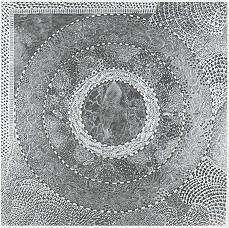
Faulkner sets up a system, say, of dots or dashes, then subtly changes the visual rhythms in order to add life and surprise—what he calls "the gymnastics of seeing." He works and reworks the surfaces of his canvases, often laying down one thin layer of slightly reflective gold, silver or bronze paint upon another until the final work seems to glow with inner light. John Ashbery, a leading critic and poet, has likened Faulkner's art to minimalist music, which achieves both simplicity and beauty from its obsessive repetitions. The critic Carter Ratcliff describes it more simply as "brilliant artifice."
Faulkner's current work, a series of paintings on paper, continues and deepens this exploration of the relationship between wrought surface and changing light. Another striking aspect of the work is the influence of the decorative arts. Faulkner has made some paintings on wood that stand independently and fold open like screens. Other pieces resemble large tapestries, and yet others take their inspiration from Art Nouveau inlays.
Faulkner is quick to admit his sources. To him, the applied arts are indistinguishable from the fine art. He knows and loves Samurai armor, Classical architectural details, chinoiserie, Persian rugs—the whole gamut of the applied arts—and they, of course, inform his creations. Indeed, he is so interested in interiors that he has, while continuing to paint, spent much of the last decade restoring old houses and advising clients how to decorate their homes. (Many of the results have been featured in periodicals such as Architectural Digest and House & Garden.)
Faulkner now lives and works in Hudson, New York.
Philip Herrera, June 2006
EDUCATORM.F.A. University of North Carolina, 1972
B.F.A. University of North Carolina, 1968, Phi Beta Kappa
AWARDS
North Carolina Arts Council, 1991
Collaboration Artist Award, American Institute of Architects, 1976
SECCA National Endowment Grant, 1976
National Endowment for the Arts, Individual Artists Grant, 1976
Urban Walls Project, National Endowment for the Arts Grant
Winston-Salem, North Carolina, 1974
SELECTED SOLO EXHIBITIONS
Contemporary Arts Center, New Orleans, Louisiana, 1994
Associated American Artists, New York, New York, 1990
Associated American Artists, New York, New York, 1987
Mint Museum, Charlotte, North Carolina, 1987
Wake Forest Arts Association, Raleigh, North Carolina, 1987
Gibbs Museum, Charleston, South Carolina, 1986
Southeastern Center for Contemporary Art, Winston-Salem, North Carolina, 1983
Arts Club of Chicago, Chicago, Illinois, 1981
Davidson College, Davidson, North Carolina, 1979
East Tennessee State University, Johnson City, Tennessee, 1977
SELECTED GROUP EXHIBITIONS
Chicago International ArtFair, Chicago, Illinois, 1995
Associated American Artists, New York, New York, 1990
"New Concepts in Printmaking", Associated American Artists, New York, New York, 1985
"Andrew Wyeth, A Trojan Horse Modernist", Greenville County Museum of Art, Greenville, North Carolina, 1984
"The Fabric of Ornamentation", Bruce Museum, Greenwich, Connecticut, 1983
"Transpersonal Images", International Transpersonal Association Conference, Davos, Switzerland, 1983
"The Spirit of Orientalism", Nueberger Museum, Purchase, New York, 1982
"The Art of North Carolina", Squibb Center, Princeton, New Jersey and Duke University Museum of Art, Durham, North Carolina, 1981
"Abstract Art in the 80's", Randolph-Macon Women's College, Lynchburg, Virginia, 1981
"Patterns", Albright-Knox Art Gallery, Buffalo, New York, 1979
"New York Now", Phoenix Art Museum, Phoenix, Arizona, 1979
"13 Galleries", High Museum of Art, Atlanta, Georgia, 1979
"Southeastern Painters and Sculptors", High Museum of Art, Atlanta, Georgia, 1977
"Biennial of Contemporary American Art", Whitney Museum of American Art, New York, New York, 1975
"James River Annual", Norfolk, Virginia, 1971
SELECTED NATIONAL COLLECTIONS
National Collection of Fine Arts, Washington, D.C.
Hirshorn Museum and Sculpture Garden, Washington, D.C.
Albright-Knox Art Gallery, uffalo, New York
Sammlung Ludwig, Neue Galerie, Aachen, Germany
Delaware Art Museum, Wilmington, Delaware
Springfield Art Museum, Springfield, Missouri
Smith College Museum of Art, Northampton, Massachusetts
North Carolina Museum of Art, Raleigh, North Carolina
Ackland Memorial Art Center, Chapel Hill, North Carolina
Pennsylvania State University Museum of Art, University Park, Pennsylvania
North Carolina State University Raleigh, North Carolina
Source:
Website of the artisttBiography from The Johnson Collection
FRANK FAULKNER (1946–2018)
Frances Marion (Frank) Faulkner III was a highly disciplined creative artist whose interest in both the decorative arts and fine arts contributed to his work as a painter and his dedication to interior design and renovation. He found joy in his experimentation in symmetry and pattern-making, declaring: “I find it very calming, soothing, and stabilizing.”
Faulkner was born in Sumter, South Carolina, but considered his artistic roots to be more in North Carolina. In 1968 he received his Bachelor of Fine Arts degree from the University of North Carolina as a newly minted member of Phi Beta Kappa. Four years later he earned his master’s degree from the same institution. During the 1970s he was a curator at the Southeastern Center for Contemporary art, known as SECCA, and now an affiliate of the North Carolina Museum of Art—NCMA Winston-Salem. In 1974 he was the recipient of an individual artist grant from the National Endowment for the Arts.
By 1982 Faulkner had moved to Columbia County, New York, near the Hudson River. He bought an old house and refurbished it, the first of eighteen or so such projects. He explained: “It’s never been about flipping them or reselling them. I always intended to grow old in them. But after everything is finished and I’ve lived in it for a while, I see another house I want to play with.” He decorated the houses with antiques and collectibles, and rarely his own paintings. Of his last house in Spencertown, New York, he said: “I just love the dignity of this house. It’s not a grand house by any means, but it’s a very, very beautiful house.”
For his paintings Faulkner often chose square format canvases on which he applied various materials such as bronze paint and metal used as dots or dashes that shimmer. He frequently introduced motifs drawn from nature, featuring organic shapes such as leaves or ovals that, from a distance, might mirror the textural surface of reptilian skin or even armored plates. Architectural details sometimes sneak into his two-dimensional work, showing low relief layers of applied paint when seen at close range. When viewed from afar these small marks come together to form a hazy glimpse into an abstracted or camouflaged plane, perhaps paying homage to the aged homes in which he also dedicated his time.
The Johnson Collection, Spartanburg, South Carolina
thejohnsoncollection.org