Page loaded successfully. Showing biography for Frederic Gruger.
Frederic Gruger BIOGRAPHY
1871 - 1953. Known for: Genre, illustrator, portrait.
Frederic Gruger, perhaps best known for his work for Saturday Evening Post, is counted among the Whos Who of American illustrators. He was considered to be one illustrator who began a new trend, and... Read full biography
Frederic Gruger, perhaps best known for his work for Saturday Evening Post, is counted among the Whos Who of American illustrators. He was considered to be one illustrator who began a new trend, and his work had a strong influence on many other illustrators. Arthur W. Brown (1881-1966) once wrote... Read full biography
Frederic Gruger, perhaps best known for his work for Saturday Evening Post, is counted among the Whos Who of American illustrators. He was considered to be one illustrator who began a new trend, and his work had a strong influence on many other illustrators. Arthur W. Brown (1881-1966) once wrote that to Henry Raleigh, H.J. Mowat, and himself, Gruger was their hero during the Golden Era of Illustration, the decade from 1910 to 1920. His compositions were monumental even in miniature. His... Read full biography
Frederic Gruger, perhaps best known for his work for Saturday Evening Post, is counted among the Whos Who of American illustrators. He was considered to be one illustrator who began a new trend, and his work had a strong influence on many other illustrators. Arthur W. Brown (1881-1966) once wrote that to Henry Raleigh, H.J. Mowat, and himself, Gruger was their hero during the Golden Era of Illustration, the decade from 1910 to 1920. His compositions were monumental even in miniature. His characters were part of the story and believable. Another illustrator strongly influenced by the point of view of Gruger was Ernest Fuhr (1874-1933). Gruger taught at the Art Students League, where he gave instruction to many budding illustrators,... Read full biography
Frederic Gruger, perhaps best known for his work for Saturday Evening Post, is counted among the Whos Who of American illustrators. He was considered to be one illustrator who began a new trend, and his work had a strong influence on many other illustrators. Arthur W. Brown (1881-1966) once wrote that to Henry Raleigh, H.J. Mowat, and himself, Gruger was their hero during the Golden Era of Illustration, the decade from 1910 to 1920. His compositions were monumental even in miniature. His characters were part of the story and believable. Another illustrator strongly influenced by the point of view of Gruger was Ernest Fuhr (1874-1933). Gruger taught at the Art Students League, where he gave instruction to many budding illustrators, including R. John Holmgren (1897-1963). Orison MacPherson (1896-1966) is also said to have most admired the work of Gruger. The artist h... Read full biography
Artist Biography
Biography page for Frederic Gruger ((1871 - 1953)), known for Genre, illustrator, portrait. Showing 1 biographical entries and 0 sample artworks.
Frederic Gruger - Artist Info
About Frederic Gruger
Biography from the Archives of askART
 Frederic Gruger, perhaps best known for his work for Saturday Evening Post, is counted among the Whos Who of American illustrators.
He was considered to be one illustrator who began a new trend, and his work had a strong influence on many other illustrators. Arthur W. Brown (1881-1966) once wrote that to Henry Raleigh, H.J. Mowat, and himself, Gruger was their hero during the Golden Era of Illustration, the decade from 1910 to 1920. His compositions were monumental even in miniature. His characters were part of the story and believable. Another illustrator strongly influenced by the point of view of Gruger was Ernest Fuhr (1874-1933).
Gruger taught at the Art Students League, where he gave instruction to many budding illustrators, including R. John Holmgren (1897-1963). Orison MacPherson (1896-1966) is also said to have most admired the work of Gruger.
The artist himself wrote on the subject of Illustration for the Encyclopedia Britannica, and described the illustrators role as follows:
" . . . Illustration may become a great art, but to become a great art, it must be creative. It cannot hope to compete with the camera in the reporting of facts. It has no business with the outer shell of things at all. It deals with the spirit. Dealing with the psychological aspects is a great opportunity and a serious handicap. Presupposing a pictorial presentation of the relations of people, the telling of a story is inevitable. A great and simple story, akin to truth, or a poor and trivial one, akin to meager facts, may be told by the same incident depending upon the insight, the vision of the artist. The nature of the story portrayed is the measure of the artist who portrays it . . ."
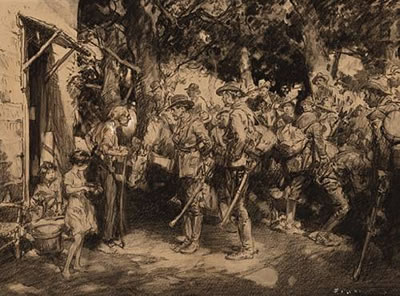
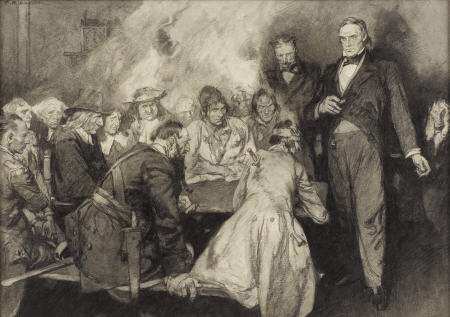
Gruger demonstrated this insight and vision in his work. His pictures were always concerned with the larger themes, and although the original drawings were actually quite small, they appear monumental in scale.
He worked in a medium developed out of his earlier work for the Philadelphia Ledger. The drawings were made with Wolff pencil, rubbed with a stump or eraser, oftentimes over an underlying wash, which produced a full range of values, particularly a rich, velvety black. The board he used was inexpensive cardboard used by newspapers for mounting silver prints. It had a receptive, soft surface and has since become known as "Gruger board". He preferred to work in black and white, obscuring many of the details, and highlighting others out of an overall tonality.
Gruger got his start with the old Century magazine and worked subsequently for many other publishers and advertisers. His work appeared in the first issue of The Saturday Evening Post, with whom he was to have a long career.
In 1981 Frederic Gruger was posthumously elected to the Society of Illustrators Hall of Fame. The Hall of Fame award was begun in 1958 for artists recognized for their "distinguished achievement in the art of illustration", and the list of winners is truly a "Who's Who" of illustration.
(Information on the biography above is based on writings from the book, "The Illustrator In America, 1880-1980," A Century of Illustration, by Walt and Roger Reed.)