Page loaded successfully. Showing biography for Frederick Edward (FE) McWilliam.
Frederick Edward (FE) McWilliam BIOGRAPHY
1909 Banbridge, County Down, Ireland - 1992 London, England. Known for: Surrealist social theme sculpture, elongated figure.
Frederick (FE) McWilliam was an Irish surrealist* sculptor, who worked mainly in stone, bronze and wood. He constantly changed his style and subject throughout his career, but is perhaps best known... Read full biography
Frederick (FE) McWilliam was an Irish surrealist* sculptor, who worked mainly in stone, bronze and wood. He constantly changed his style and subject throughout his career, but is perhaps best known for his 'Women of Belfast' series of Irish sculptures from 1971, which reflected the escalation of... Read full biography
Frederick (FE) McWilliam was an Irish surrealist* sculptor, who worked mainly in stone, bronze and wood. He constantly changed his style and subject throughout his career, but is perhaps best known for his 'Women of Belfast' series of Irish sculptures from 1971, which reflected the escalation of violence in Northern Ireland at the time. There are 20 pieces in the series, several of which show women flying through the air after a bomb explosion. ??McWilliam was born in Banbridge, County Down in... Read full biography
Frederick (FE) McWilliam was an Irish surrealist* sculptor, who worked mainly in stone, bronze and wood. He constantly changed his style and subject throughout his career, but is perhaps best known for his 'Women of Belfast' series of Irish sculptures from 1971, which reflected the escalation of violence in Northern Ireland at the time. There are 20 pieces in the series, several of which show women flying through the air after a bomb explosion. ??McWilliam was born in Banbridge, County Down in 1909, the son of a local doctor. He studied fine art painting at the Belfast School of Art and the Slade School of Fine Art* in London between 1928 and 1931, before transitioning to sculpture in the early 1930s. His early wood carving works were... Read full biography
Frederick (FE) McWilliam was an Irish surrealist* sculptor, who worked mainly in stone, bronze and wood. He constantly changed his style and subject throughout his career, but is perhaps best known for his 'Women of Belfast' series of Irish sculptures from 1971, which reflected the escalation of violence in Northern Ireland at the time. There are 20 pieces in the series, several of which show women flying through the air after a bomb explosion. ??McWilliam was born in Banbridge, County Down in 1909, the son of a local doctor. He studied fine art painting at the Belfast School of Art and the Slade School of Fine Art* in London between 1928 and 1931, before transitioning to sculpture in the early 1930s. His early wood carving works were influenced by primitive art, in particular by African art and by the almost primeval simplicity of Romanian sculptor Consta... Read full biography
Artist Biography
Biography page for Frederick Edward (FE) McWilliam ((1909 - 1992)), known for Surrealist social theme sculpture, elongated figure. Showing 2 biographical entries and 0 sample artworks.
Frederick Edward (FE) McWilliam - Artist Info
About Frederick Edward (FE) McWilliam
Name variants
Frederick Edward MacWilliam, Frederick Edward McWilliam
Biography from the Archives of askART
 Frederick (FE) McWilliam was an Irish surrealist* sculptor, who worked mainly in stone, bronze and wood. He constantly changed his style and subject throughout his career, but is perhaps best known for his 'Women of Belfast' series of Irish sculptures from 1971, which reflected the escalation of violence in Northern Ireland at the time. There are 20 pieces in the series, several of which show women flying through the air after a bomb explosion.
??McWilliam was born in Banbridge, County Down in 1909, the son of a local doctor. He studied fine art painting at the Belfast School of Art and the Slade School of Fine Art* in London between 1928 and 1931, before transitioning to sculpture in the early 1930s.
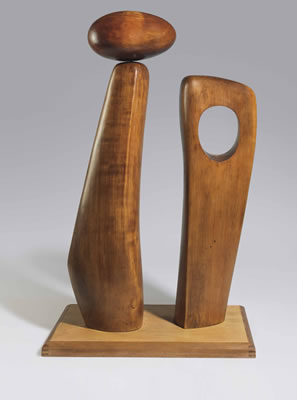
His early wood carving works were influenced by primitive art, in particular by African art and by the almost primeval simplicity of Romanian sculptor Constantin Brancusi's works. An early example of this style is McWilliam's Figure (1937, British Government Art Collection).
From 1936 onwards, his works gradually became more influenced by Surrealism and he was loosely associated with the British Surrealist movement.
His work Eye Nose and Cheek (1939, Tate Gallery, London) is an important piece from this time, as it demonstrates the artist's interest in the interplay between solid volume and surrounding space, and how the viewer completes the 'missing' parts of the sculpture in the mind's eye.
During World War II, McWilliam spent most of his service in India. When he returned, he went to teach at the Chelsea School of Art in London. At the same time he resumed work on a number of different pieces, in various media including bronze, wood, terracotta and stone.
Important commissions included The Four Seasons for the Festival of Britain (1951), Father Courage for Kent University at Canterbury, New Zealand (1960) and Hampstead Figure at Swiss Cottage, London (1964).
As the years progressed, his works tended to become more symbolic and imaginative. His 1965 Bean Sculptures, with their swollen organic forms, celebrate and satirize sexuality. McWilliam tended to work in series, producing several versions of the same theme, until that theme was exhausted and then making a radical change in subject and style.
Although he lived most of his life outside Ireland, he continued exhibiting here and maintained strong links with Irish art. He was elected Associate member of the Royal Academy in 1950 and became a full member in 1959.
McWilliam died in London in 1992. He is represented in many public collections including the Museum of Modern Art, New York, the Tate Gallery, London, the Irish Museum of Modern Art and The Hugh Lane Gallery, Dublin. Retrospectives held at Arts Council of Northern Ireland in 1981 and Tate Gallery in 1989.
Source:
Online Encyclopedia of Irish and World Art
http://www.visual-arts-cork.com/irish-sculpture/mcwilliam-fe.htm
* For more in-depth information about these terms and others, see AskART.com Glossary http://www.askart.com/AskART/lists/Art_Definition.aspxBiography from Halls Fine Art Auctioneers
Frederick Edward (FE) McWilliam was born in Bainbridge, County Down, Ireland. Influenced by violent clashes in his hometown, he created impactful sculptures reflecting the tragedies of The Troubles in Northern Ireland. His series "The Women of Belfast" memorializes victims of the Abercorn bombing in 1972, portraying female figures in different poses reacting to the explosion with powerful emotion and energy.