Page loaded successfully. Showing biography for Frederick Wagner.
Frederick Wagner BIOGRAPHY
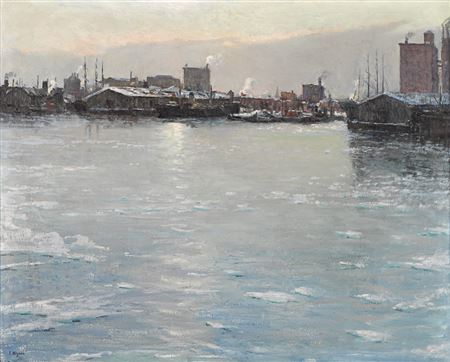
1864 Port Kentucky, Pennsylvania - 1940 Philadelphia, Pennsylvania. Known for: Marine, urban landscape-genre painting.
A native of Pennsylvania, Frederick Wagner was a painter of impressionist urban scenes, often views of Philadelphia. His many cityscapes including views of bridges and skyscapes were a distinct genre... Read full biography
A native of Pennsylvania, Frederick Wagner was a painter of impressionist urban scenes, often views of Philadelphia. His many cityscapes including views of bridges and skyscapes were a distinct genre in the United States at the turn of the 20th century, and he began these subjects as early as 1906.... Read full biography
A native of Pennsylvania, Frederick Wagner was a painter of impressionist urban scenes, often views of Philadelphia. His many cityscapes including views of bridges and skyscapes were a distinct genre in the United States at the turn of the 20th century, and he began these subjects as early as 1906. The suggestion of many of his paintings is that the city is overwhelming and that human beings are diminished in importance and fragile. He was born in Valley Forge and became a student of Thomas... Read full biography
A native of Pennsylvania, Frederick Wagner was a painter of impressionist urban scenes, often views of Philadelphia. His many cityscapes including views of bridges and skyscapes were a distinct genre in the United States at the turn of the 20th century, and he began these subjects as early as 1906. The suggestion of many of his paintings is that the city is overwhelming and that human beings are diminished in importance and fragile. He was born in Valley Forge and became a student of Thomas Eakins at the Pennsylvania Academy of the Fine Arts from 1879 to 1884. He worked as an illustrator for the Philadelphia Press, spent time in the West, and returned to Philadelphia in 1902. There he was influenced by Robert Henri, William Glackens, and... Read full biography
A native of Pennsylvania, Frederick Wagner was a painter of impressionist urban scenes, often views of Philadelphia. His many cityscapes including views of bridges and skyscapes were a distinct genre in the United States at the turn of the 20th century, and he began these subjects as early as 1906. The suggestion of many of his paintings is that the city is overwhelming and that human beings are diminished in importance and fragile. He was born in Valley Forge and became a student of Thomas Eakins at the Pennsylvania Academy of the Fine Arts from 1879 to 1884. He worked as an illustrator for the Philadelphia Press, spent time in the West, and returned to Philadelphia in 1902. There he was influenced by Robert Henri, William Glackens, and John Sloan who espoused realism in subject matter and rebellion against the romantic aura of impressionism. His working method was to sket... Read full biography
Artist Biography
Biography page for Frederick Wagner ((1864 - 1940)), known for Marine, urban landscape-genre painting. Showing 4 biographical entries and 0 sample artworks.
Frederick Wagner - Artist Info
About Frederick Wagner
Biography from the Archives of askART
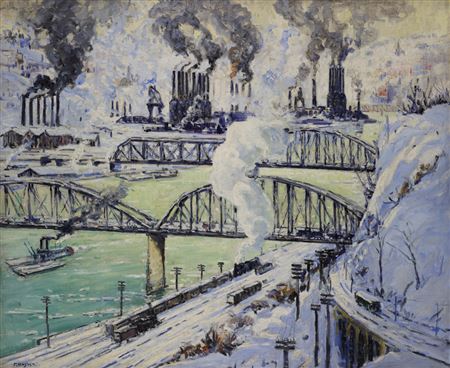 A native of Pennsylvania, Frederick Wagner was a painter of impressionist urban scenes, often views of Philadelphia. His many cityscapes including views of bridges and skyscapes were a distinct genre in the United States at the turn of the 20th century, and he began these subjects as early as 1906. The suggestion of many of his paintings is that the city is overwhelming and that human beings are diminished in importance and fragile.
He was born in Valley Forge and became a student of Thomas Eakins at the Pennsylvania Academy of the Fine Arts from 1879 to 1884. He worked as an illustrator for the Philadelphia Press, spent time in the West, and returned to Philadelphia in 1902. There he was influenced by Robert Henri, William Glackens, and John Sloan who espoused realism in subject matter and rebellion against the romantic aura of impressionism. His working method was to sketch something of interest and to complete the work in his studio by painting on coarse burlap, glued to canvas.
He was a member of the Philadelphia Sketch Club and exhibited at the Pennsylvania Academy over 35 times from 1906-1940, winning prizes in 1914 and 1922. Wagner exhibited at the Carnegie 14 times from 1898 - 1925. He showed two works at the Armory Show, and exhibited 11 times at the Corcoran between 1907 - 1935. He had a special exhibit of 100 pastels, at the Corcoran in April 1924. Wagner exhibited at the National Academy of Design in 1884, 1907, 1925 and 1928.
After his death, Zabriskie Gallery, NYC held a Solo Show in 1959, and in October of 1961, the Philadelphia Art Alliance held a 100th Anniversary Exhibition of Fred Wagner Paintings.
Sources:
exhibition information courtesy of Linda Petrov-WilliamsBiography from the Archives of askART
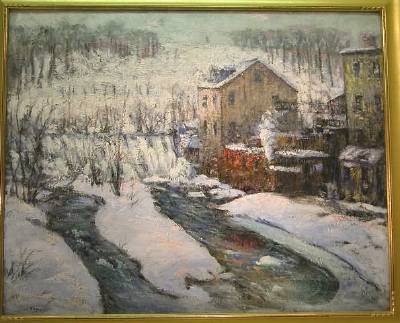 Fred Wagner was born in Valley Forge, Pennsylvania in 1864. He received a scholarship to study art at the Pennsylvania Academy of the Fine Arts under Thomas Eakins and in 1884 was made chief Demonstrator of Anatomy there. In 1885, Wagner left the Academy to make a painting tour of San Antonio, Texas, and then went on to Los Angeles, California, where he painted a number of landscapes and portraits. He returned to Philadelphia as an illustrator for the Philadelphia Press until 1902, and then moved to Norristown, Pennsylvania to paint full time.
In 1912, Wagner opened a Philadelphia studio and taught classes in outdoor painting at Addingham, and later, at the Pennsylvania Academy's summer school in Chester Springs. His reputation grew, and he took on additional classes at his studio in the Fuller Building. In 1913, Wagner exhibited in the now famous Armory Show in New York City. He exhibited frequently at the Pennsylvania Academy's annual exhibitions, and in 1914, was awarded the Fellowship Prize. He was awarded Honorable Mentions from the Pittsburgh International, the Philadelphia Art Club, and the Carnegie Institute in 1922. His paintings are in the collections of the Cleveland Museum; St. Louis Museum, MO; Fort Wayne Museum, IN; Kalamazoo Museum, MI; Rochester Museum, NY; Worcester Art Museum, MA, and the Reading Museum, PA.
Source:
Newman GalleriesBiography from Williams American Art Galleries
Frederick Wagner, a Philadelphia, Pennsylvania painter and teacher, was born in Port Kennedy, Pennsylvania in 1864. Wagner enrolled at the Pennsylvania Academy of the Fine Arts (1878-1884) and was made chief demonstrator of anatomy to the life classes by the Academy. After completing his studies at the Academy where he studied under Thomas Eakins, he traveled west and began painting in California.
Upon returning to Philadelphia, he took a job as an illustrator for the Philadelphia Press and was heavily influenced by the Urban Realism propagated by Robert Henri, William Glackens and John Sloan. Wagner often painted impressionist urban scenes of Philadelphia, and like many of his contemporaries, he did work that often portrayed the overwhelming city diminishing the importance and frailty of humanity.
He was asked to teach at the Pennsylvania Academy's Chester Springs School and did so for seven years. Around 1912, Wagner opened his studio in Philadelphia and founded the Addingham School of Painting in an old farmhouse, in a colony similar to the one in the New Hope area. His modernist work is also highly sought after by collectors whose interest's center around the artworks created by America's "Avant-Garde" during the late 19th century and first four decades of the 20th century.
Studied:
Pennsylvania Academy of Fine Arts with Thomas Eakins, 1878-1884
Member:
Philadelphia Sketch Club
Philadelphia Watercolor Club
Philadelphia Art Alliance
Exhibited:
Pennsylvania Academy of Fine Arts, 1882, 1883, 1885, 1887, 1888, 1890,
1891, 1894, 1898-1902, 1906-1940 (Fellowship Prize, 1914)
National Academy of Design, 1884, 1907, 1925, 1928
Corcoran Gallery of Art Biennials, 1907-1935
Art Institute of Chicago, 1906-1912, 1914, 1917, 1922, 1925, 1926
Carnegie Institute, 1922 (honorable mention)
Armory Show, New York City, 1913
Philadelphia Art Club, 1922
Philadelphia Sketch Club
Panama-Pacific Expo, 1915
Zabriskie Gallery, New York City, 1959 (solo)
Work:
Pennsylvania Academy of the Fine Arts
Philadelphia Art Club
Reading Art Museum, Pennsylvania
Cleveland Museum of Art
Parrish Art Museum
Philadelphia Museum of Art
American College of Surgeons
Farnsworth Art Museum, Rockland, Maine
Sewell C. Biggs Museum of American Art, Dover, Delaware
Philadelphia Sketch Club
Delval Fine Art Consortium, Lansdale, Pennsylvania
St. Louis Museum of Art
Fort Wayne Museum, Fort Wayne, Indiana
Kalamazoo Museum, Michigan
Rochester Museum of Art, New York
Worcester Art Museum, Massachusetts
James A. Michener Art Museum
Taught:
Pennsylvania Academy's Chester Springs School
References:
Alterman, "Pennsylvania Impressionists & Modernists,"
American Art Review, Oct. 2001
Falk (ed.), Who Was Who in American Art 1564-1975
Falk (ed.), The Annual Exhibition Record, 1876-1913, Pennsylvania Academy of Fine Arts
Gerdts, Peterson and Yount, Pennsylvania Impressionism
Mallett, Mallett's Index of Artists: International - Biographical
Naeve, Selections from 150 Years of Philadelphia Painters and Paintings
Opitz (ed.), Mantle Fielding's Dictionary of American Painters, Sculptors & Engravers
Preato & Langer, Impressionism and Post-Impressionism Transformations 1885-1945
Schwarz & Son (pub.), One Hundred Paintings by American and European Artists
Schwarz & Son (pub.), American Impressionism and Other Movements
Alterman, New Hope for American Art: A Comprehensive Showing of Important
20th Century Paintings from and Surrounding the New Hope Art Colony
Falk (ed.), The Annual Exhibition Record of the Art Institute of Chicago
Falk (ed.), Annual Exhibition Record, National Academy of Design 1901-1950
Falk (ed.) Annual Exhibition Record, 1914-68, Pennsylvania Academy of the Fine Arts
Fresella-Lee, The American Paintings in the Pennsylvania Academy of the Fine Arts
Marling, Looking Back, A Perspective on the 1913 Inaugural Exhibition
Walter and Lemos, Panama-Pacific Exposition: Catalogue of the Post-Exposition Exhibit
Dunbier (ed.), The Artists Bluebook: 34,000 North American Artists to March 2005
Alterman, Blue Chips
Sellin and Sullivan, Thomas Eakins and His Fellow Artists at the Philadelphia Sketch Club
Falk (ed.), Who Was Who in American Art 1898-1947
Lowe Art Museum, Panama-Pacific Exposition: Catalogue of the Post-Exposition Exhibit
Peterson (ed.), Pennsylvania ImpressionismBiography from Newman Galleries
Born in Valley Forge, PA in 1864, Fred Wagner received a scholarship at age fifteen to study art at the Pennsylvania Academy of Fine Arts under Thomas Eakins. Five years later, in 1884, he was made chief demonstrator of Anatomy.
In 1885, Wagner left the Academy to make a painting tour of San Antonio, Texas, and then went on to Los Angeles, California, where he painted a number of landscapes and portraits. He returned to Philadelphia as an illustrator for the Philadelphia Press until 1902, and then moved to Norristown, Pennsylvania, to paint full time.
In 1912, Wagner opened a Philadelphia studio and taught classes in outdoor painting at Adingham, and later, at the Pennsylvania Academy's summer school in Chester Springs. His reputation grew, and he took on additional classes at his studio in the Fuller Building.
In 1913, Wagner exhibited in the now famous Armory Show in New York City. He exhibited frequently at the Pennsylvania Academy's annual exhibitions and they awarded him the Fellowship Prize in 1914. He received Honorable Mentions from the Pittsburgh International, the Philadelphia Art Club, and the Carnegie Institute in 1922.
His paintings are in the collections of the Cleveland Museum; St. Louis Museum, MO; Fort Wayne Museum, IN; Kalamazoo Museum, MI; Rochester Museum, NY; Worcester Art Museum, MA; and the Reading Museum, PA.
In addition, Fred was active at the Philadelphia Sketch Club where he enjoyed leisure activities such as chess and playing pool with other area artists. As well as being a life member of the club, Fred served as Vice President for a brief period in 1923.
Fred Wagner died in Philadelphia in 1940.