Page loaded successfully. Showing biography for Gabriele Münter.
Gabriele Münter BIOGRAPHY
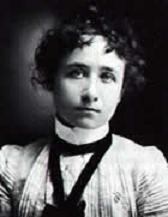
1877 Berlin, Germany - 1962 Murnau, Germany. Known for: Expressionist painting.
Gabriele Munter. Gabriele Münter (1877-1962) was identified with the Blue Rider group in Munich (conceived in the fall of 1911), yet her art seems closer to the Fauves and Gauguin's Pont Aven style... Read full biography
Gabriele Munter. Gabriele Münter (1877-1962) was identified with the Blue Rider group in Munich (conceived in the fall of 1911), yet her art seems closer to the Fauves and Gauguin's Pont Aven style than to German Expressionism. Born in Berlin, Gabriele studied at a school for women in Düsseldorf -... Read full biography
Gabriele Munter. Gabriele Münter (1877-1962) was identified with the Blue Rider group in Munich (conceived in the fall of 1911), yet her art seems closer to the Fauves and Gauguin's Pont Aven style than to German Expressionism. Born in Berlin, Gabriele studied at a school for women in Düsseldorf - not at the academy, where women were not admitted. Between 1898 and 1901 she was in America, then she studied art in Munich later that year. In 1902 Münter was in Kandinsky's recently organized... Read full biography
Gabriele Munter. Gabriele Münter (1877-1962) was identified with the Blue Rider group in Munich (conceived in the fall of 1911), yet her art seems closer to the Fauves and Gauguin's Pont Aven style than to German Expressionism. Born in Berlin, Gabriele studied at a school for women in Düsseldorf - not at the academy, where women were not admitted. Between 1898 and 1901 she was in America, then she studied art in Munich later that year. In 1902 Münter was in Kandinsky's recently organized Phalanx School. She wrote, "Kandinsky, quite unlike the other teachers, explained all problems thoroughly and intensely and accepted me as a human being. " The two became engaged, traveled together to Paris and Sèvres, underwent the influence of the... Read full biography
Gabriele Munter. Gabriele Münter (1877-1962) was identified with the Blue Rider group in Munich (conceived in the fall of 1911), yet her art seems closer to the Fauves and Gauguin's Pont Aven style than to German Expressionism. Born in Berlin, Gabriele studied at a school for women in Düsseldorf - not at the academy, where women were not admitted. Between 1898 and 1901 she was in America, then she studied art in Munich later that year. In 1902 Münter was in Kandinsky's recently organized Phalanx School. She wrote, "Kandinsky, quite unlike the other teachers, explained all problems thoroughly and intensely and accepted me as a human being. " The two became engaged, traveled together to Paris and Sèvres, underwent the influence of the Fauves, and exhibited in both the Salon des Indépendants and the Salon d'Automne. Then they traveled to the Riviera,... Read full biography
Artist Biography
Biography page for Gabriele Münter ((1877 - 1962)), known for Expressionist painting. Showing 3 biographical entries and 0 sample artworks.
Gabriele Münter - Artist Info
About Gabriele Münter
Name variants
Gabriele Munter
Biography from the Archives of askART
 Gabriele Munter
Gabriele Münter (1877-1962) was identified with the Blue Rider group in Munich (conceived in the fall of 1911), yet her art seems closer to the Fauves and Gauguin's Pont Aven style than to German Expressionism. Born in Berlin, Gabriele studied at a school for women in Düsseldorf - not at the academy, where women were not admitted. Between 1898 and 1901 she was in America, then she studied art in Munich later that year. In 1902 Münter was in Kandinsky's recently organized Phalanx School. She wrote, "Kandinsky, quite unlike the other teachers, explained all problems thoroughly and intensely and accepted me as a human being. . . ." The two became engaged, traveled together to Paris and Sèvres, underwent the influence of the Fauves, and exhibited in both the Salon des Indépendants and the Salon d'Automne. Then they traveled to the Riviera, North Africa, Italy and Austria. They settled in Murnau, on Lake Staffel in the Bavarian Alps near Alexej Jawlensky, who had been influenced by both Gauguin and Matisse. Jawlensky would have acquainted Münter with Gauguin's concept of synthetism. There she also met Jawlensky's companion, Marianne Werefkin (1860-1938) and did her portrait, now in the Lenbachhaus, Munich. The face in this Matisse-like image is largely in green hues with magenta-purple shadows. Murnau was the center of peasant glass painting, and this strain of primitivism influenced modern German art. Blaue Reiter painters were inspired to attempt paintings in this medium, "and even the symbol - the figure of the blue rider - owes its final character to these intensive studies of folk art."(Quote from Klaus Lankheit, "A History of the Almanac," in The Blaue Reiter Almanac. Ed. Wassily Kandinsky and Franz Marc. New York: Da Capo Press, 1974, p. 40). Münter's Boating from 1910 (Milwaukee Art Center) reflects this primitive art movement. Portrait of a Young Woman of 1909 (Milwaukee Art Center), on the other hand, is pure Nabis-inspired cloisonnisme.
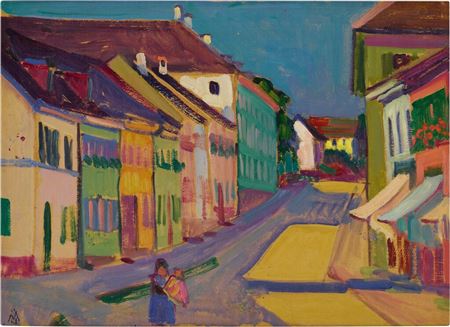
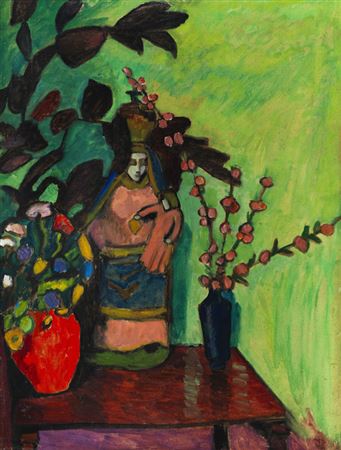
Kandinsky, Münter and Jawlensky founded the New Artists' Association of Munich (Neue Künstlervereinigung München) in 1909 but all withdrew with Franz Marc in 1911 to form the Blaue Reiter. August Macke and Henri Rousseau were the other participants of the group's first exhibition. From 1911 comes Münter's Village Street in Winter, characterized by broad planes of color and bold black contours, The Green House (Milwaukee Art Center; in Ann Sutherland Harris and Linda Nochlin, Women Artists: 1550-1950. New York: Alfred A. Knopf, 1976, cat. no. 120) and Still-life with St. George (both paintings in the Lenbachhaus, Munich). The artist wrote how she jumped from impressionism to "feeling [nature's] inner content, towards abstracting and expressing the essence. It was a wonderful, interesting, joyful working period with much discussion about art. . . ." (Quoted in Shulamith Behr, Women Expressionists. New York: Rizzoli, 1988, p. 42) In the second Blaue Reiter show in 1912 Münter exhibited fourteen works, including the portrait of Paul Klee. Münter and Kandinsky went to Switzerland, then to Stockholm and Denmark during the years of World War I. The couple separated in 1917; Kandinsky went on to Moscow and married Nina Andrewsky there. Klaus Lankheit (1974, p. 20) called Münter hypersensitive. Münter was far more spontaneous and eclectic than her teacher.
Gabriele Münter's palette reached a Fauve or post-Fauve intensity and her landscapes recall those of both Cézanne and Van Gogh. In her figures she used greatly simplified forms into expressive color areas, often marked by black contours. One of her early patrons was Bernhard Koehler, a manufacturer in Berlin and the uncle of August Macke's wife, Elisabeth. His son, the younger Bernhard, was the same age as Macke. The Mackes went to Paris with the elder Koehler in 1908 where he purchased works by Courbet, Monet, Manet, Pissarro and Seurat. In addition, he bought works by Franz Marc.
Münter had a retrospective exhibition in 1913 at the Kunstsalon Dietzel in Munich. The Staatsgalerie Moderner Kunst in Munich has Münter's portrait of Paul Klee, titled Man in an Armchair, from the previous year. Her most famous painting is Reflection, dated 1917, also in the Lenbachhaus. A little later Münter painted the colorful Staffelsee in Autumn (1923; The Holladay Collection). She returned to Murnau in 1927 in "semi-retirement," unable to flaunt her style during the Third Reich, when her art was considered to be "degenerate." (See Hugo Munsterberg, A History of Women Artists. New York: Clarkson N. Potter, 1975, p. 70). She secretly held onto a collection of early paintings by Kandinsky, 120 of which she donated to the Städtische Galerie in Munich. The charming Breakfast of the Birds was done during this time (1934; Holladay Collection; see National Museum of Women in the Arts. New York: Harry N. Abrams, 1987, p. 131). Gabriele Münter remains a significant contributor to the Blue Rider movement and a major post-Fauve German painter.
Sources:
All cited in the above text but see also:
Eichner, Johannes. Kandinsky und Gabriele Münter vom Ursprüngen moderner Kunst. Munich: 1957; Röthel, Hans Konrad. Gabriele Münter. Munich: 1957; Lahnstein, P. Münter. Ettal: 1971. Erlanger, J. "Gabriele Münter; A Lesser Life?" Feminist Art Journal (Winter 1974-75): 11-13, 23; Kleine, Gisela. Gabriele Münter und Wassily Kandinsky: Biographie eines Paares. Frankfurt-am-Main: Insel Verlag, 1994.
Submitted by Michael Preston Worley, Ph.D.Biography from the Archives of askART
 Gabriele Munter was born in 1877 in Berlin; her father died when she was nine and her mother when she was twenty. She began her art studies in 1897 at Dusseldorf in the Ladies Art School because women students were not then admitted to the established art academies. From 1898 to 1901, she traveled in the United States, then resumed her studies in Germany in 1901. She soon became dissatisfied with traditional teaching and enrolled as one of the first students at Kandinsky's Phalanx School.
From the time of their meeting, Kandinsky was impressed by her talent, declaring that he had nothing to teach her, that she was a "natural" artist. The two traveled across Europe from 1903 to 1908, including a two year stay in France. They lived at Sevres, near Paris, where they were much impressed by the new style of bold color and simple forms evolving there in the work of the Fauves group. During those years, 1906 and 1907, Munter exhibited her work in Paris at both the Salon des Independants and the Salon d'Automne.
On their return to Germany, Munter and Kandinsky settled near Munich in the village of Murnau in the Bavarian Alps. Her painting, as well as that of the other founders of the Blaue Reiter group in 1911, Kandinsky, Von Werefkin, Klee, Marc and Jawlensky, is characterized by broad, flat areas of color, intense and expressive color contrasts; emphatic, bold and simple designs and extreme expressionistic effects.
Kandinsky, though married, pressed Munter for a romance and by the summer of 1903 they were secretly engaged, pending his divorce. Fourteen years later, Munter was still waiting for him to fulfill his commitment when he abandoned her to marry another woman. He stopped writing to her from Russia, ignoring her efforts to contact him, and she learned secondhand of his marriage. She suffered from the whole thing bitterly.
Munter left Murnau in 1917 and returned a decade later; by the 1930s she was once more painting actively. She had to do so clandestinely during the Nazi era, as her work, along with most other progressive German modern art, was declared "degenerate" under the Third Reich. In 1931 Munter moved back into the Murnau house with Johannes Eichner, a physician, and she preserved the house almost exactly as she and Kandinsky had left it. After World War II she worked to promote the reputation and history of the Blaue Reiter group during its early years in Munich. She died in 1962.
Written and submitted by Jean Ershler Schatz, artist and researcher from Laguna Woods, California.
Sources include:
Catalogue of the National Museum of Women in the Arts
Gabriele Munter: Espoused to Art in Art in America, January 1999
ARTnews, December 1987Biography from Karl & Faber Kunstauktionen
In the 1930s, Gabriele Münter went back to her beginnings as the “Blue Rider”. These years were also characterized by great productivity and her trips to Paris and southern France in 1929/30 gave her new impetus. In this phase the artist begins meticulously and systematically to note down her works in workbooks. Paul Klee serves as a role model for her, whom she got to know in the pre-war period. The landscape motifs of this period are again, as she calls it, "big and simple".
Our picture, which shows the view of a garden center with beds, mounds of earth and individual buildings in an autumnal mood, also comes from this phase. In the left foreground a person with wheelbarrows can be seen working on a narrow path between the beds. The leaves of the smaller trees in front of the buildings have already turned yellow. Two mighty deciduous trees and a conifer border the trees on the left from the wide landscape in the background. Here, too, Münter sets off the even more homogeneous color surfaces with dark contours, thus thinking back to her early paintings.
In 1909, Münter acquired a house with a garden in Murnau. Even if the property with the garden played a not insignificant role in her life and she and Kandinsky received many visitors there, Münter recorded only a few views of the garden. In 1931 she took up the garden theme again and, in the same year as our nursery, kept her new partner, Johannes Eichner, working in the garden (Mein Garten, 1931, oil on canvas, 46 x 55 cm, private property) Gabriele Münter had She was particularly in contact with the park-like nursery Müssig in Murnau, which, according to the family of the founder Johann Müssig, she visited several times a week. The artist's interest there was not only the flowers, but above all the fresh vegetables for her own supply (see exhib.-cat .: Gabriele Münter, Die Zeit nach Kandinsky in Murnau, Murnau 2012, p. 150).