Page loaded successfully. Showing biography for Gene Zesch.
Gene Zesch BIOGRAPHY
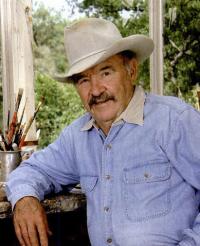
Born 1932. Known for: Sculptor, wood cowboy caricature.
Gene Zesch grew up during the Depression on a hard scrabble central Texas ranch working cattle, shoeing and breaking horses, milking cows and building fence in between riding horseback four miles to... Read full biography
Gene Zesch grew up during the Depression on a hard scrabble central Texas ranch working cattle, shoeing and breaking horses, milking cows and building fence in between riding horseback four miles to school. His experiences with ranching provided the inspiration for his famous carvings which... Read full biography
Gene Zesch grew up during the Depression on a hard scrabble central Texas ranch working cattle, shoeing and breaking horses, milking cows and building fence in between riding horseback four miles to school. His experiences with ranching provided the inspiration for his famous carvings which portrayed the witty and rich irony of that life. Honored by numerous awards and publications, Gene’s long and illustrious career distinguishes him as the nation’s premiere cowboy woodcarving caricaturist.... Read full biography
Gene Zesch grew up during the Depression on a hard scrabble central Texas ranch working cattle, shoeing and breaking horses, milking cows and building fence in between riding horseback four miles to school. His experiences with ranching provided the inspiration for his famous carvings which portrayed the witty and rich irony of that life. Honored by numerous awards and publications, Gene’s long and illustrious career distinguishes him as the nation’s premiere cowboy woodcarving caricaturist. Gene first received national recognition when President Johnson bought some of his carvings. Publicity about this event resurfaced in 1993-1994 when the Smithsonian Portrait Gallery included one of Zesch’s carvings. Then in 1996-1997 he was one of 12... Read full biography
Gene Zesch grew up during the Depression on a hard scrabble central Texas ranch working cattle, shoeing and breaking horses, milking cows and building fence in between riding horseback four miles to school. His experiences with ranching provided the inspiration for his famous carvings which portrayed the witty and rich irony of that life. Honored by numerous awards and publications, Gene’s long and illustrious career distinguishes him as the nation’s premiere cowboy woodcarving caricaturist. Gene first received national recognition when President Johnson bought some of his carvings. Publicity about this event resurfaced in 1993-1994 when the Smithsonian Portrait Gallery included one of Zesch’s carvings. Then in 1996-1997 he was one of 12 artists used by the National Archives in their show “Tokens and Treasures of 12 Presidents”. Photos and stories of th... Read full biography
Artist Biography
Biography page for Gene Zesch ((Born 1932)), known for Sculptor, wood cowboy caricature. Showing 5 biographical entries and 0 sample artworks.
Gene Zesch - Artist Info
About Gene Zesch
Biography from the Archives of askART
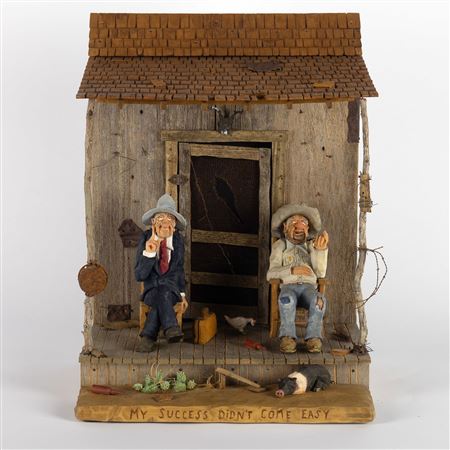 Gene Zesch grew up during the Depression on a hard scrabble central Texas ranch working cattle, shoeing and breaking horses, milking cows and building fence in between riding horseback four miles to school. His experiences with ranching provided the inspiration for his famous carvings which portrayed the witty and rich irony of that life.
Honored by numerous awards and publications, Gene’s long and illustrious career distinguishes him as the nation’s premiere cowboy woodcarving caricaturist.
Gene first received national recognition when President Johnson bought some of his carvings.
Publicity about this event resurfaced in 1993-1994 when the Smithsonian Portrait Gallery included one of Zesch’s carvings.
Then in 1996-1997 he was one of 12 artists used by the National Archives in their show “Tokens and Treasures of 12 Presidents”.
Photos and stories of these pieces were widely distributed by the National Geographic, New York Times, UPI etc.
Gene started carving in 1954. He had just married his high school sweetheart, Patsy, and entered the Army as a pilot.
While on leave they passed through Santa Fe and watched a man on the Plaza carving a likeness of President Eisenhower. He had never seen a sculpture with the bold cuts that gave it character. He was literally smitten by this medium and told his wife “I believe I can do this”.
After his stint as a pilot he returned home to the ranch and started carving, selling first in gift shops then small art galleries and finally to some of the top Western art galleries in the U. S.
His first one man show was at the Witte Museum in San Antonio. He didn’t realize how prestigious it was to have a one man show at such an early age.
His next one man show was in 1988 in the Institute of Texan Cultures in San Antonio. According to Al Lowman, Director, “it is by far the most popular exhibit we’ve ever had”.
He then had a one man show at Texas A&M University, which he says was an “art free zone” when he attended.
By far, his one man show at the National Cowboy and Western Heritage Museum has been his most important show. It was held September 2005 to January 2006. It was one of the best attended one man shows in the history of the Museum. They now have seven pieces in their permanent collection.
Professor and sculptor, Umlaf, advised Gene not to take lessons but to keep developing his own style.
Even though he has flown airplanes, ridden motorcycles all over the world, and skied, his greatest pleasure has been to part time ranch with his sons and grandsons.
EARLY LIFE ON RANCH
GENE & AGNESGene was born in 1932 during the great depression on a ranch in Mason, Texas. Because of the relatively high cost of gasoline he rode a horse four miles to school beginning with his first day.
As he grew older he milked a cow before going to school. Later he learned to shoe horses and then to break them. All ranch boys were expected to round up and work cattle, build fences, etc. any time they were not in school. A friend once told Gene “Our fathers want us to inherit this land so we can suffer like they did”.
He later ranched in Texas and in Durango, Mexico where his friend Ace Reid, said, and “other than a million dollars of experience, I never made a dime”.
He feels that he is recording ranch life, as he has know it. Most of his work is an exaggeration of experiences he or his friends have had. All art is exaggerated to some degree, but caricature gives Gene more to “play” with.
Later he learned about the lost wax method of casting which dates back over 6000 years. When the process was refined a bronze was so exact that some sculptors marked their pieces with a thumbprint.
Most of the pre-Columbian, Greek and Romanesque bronzes were also painted. After the rubber mold was invented multiple pieces could be cast. Frederick Remington cast over 200 pieces of some of his bronzes.
Artist who painted bronzes included the well-known French caricaturist, Honoré Daumier (1808-1879) and the few castings by Picasso. Charlie Russell painted all of his originals.
Gene casts his bronzes directly from his woodcarvings. He then paints them just as many were done thousands of years ago.
[envira-gallery id=”814?]
MUSEUMS
National Cowboy & Western Heritage Museum (7 works)
LBJ Library & Museum, Austin (8 works)
Eddie Basha Museum, Tempe AZ (13 works)
National Ranching Heritage center, Lubbock TX (12 works)
A&M University MSC Forsyth Center Galleries (10 works)
Favell Museum, Oregon (8 works)
Pearce Museum, Corsicanna TX (8 works)
Booth Western Art Museum, Cartersville GA (7 works)
Leanin’ Tree Museum, Colorado (1 work)
SHOWS
One-man Show, National Cowboy & Western Heritage Museum (one of the best attended in their 50-yr history)
One-man Show, Institute of Texan Cultures (best attended)
One-man Show, A&M University MSC Forsyth Center Galleries
Smithsonian Instutition – Hall of Presidents
Witte Museum
National Archives
COLLECTORS
President Lyndon B. Johnson
Texas Governor John Connally
Lynda Bird Johnson Robb
Representative Frank Ikard
Senator Mershon
Humble Oil Company
Roscoe Fawcett, Fawcett Publishing Co.
J.H. Long, President, US Steel
Richard Rogers, Mary Kay Cosmetics
King Ranch
Fred Gipson, Author of Old Yeller
Jodie Thompson, 7-11 Corp.
Alan Hirschfield, V.P. 20th Centgury Fox
Eddy Basha
Snuff Garrett
Ed Bass, Ft. Worth
Speaker Jim Wright
Clayton Williams
John Ritter
Randy Owens, “Alabama” lead singer
Don Reo
Wally Shirra, Astronaut
Senator Alan Simpson
President of American Airlines
Forest Fenn
Laura Keith
FELLOW ARTIST COLLECTIONS
Nick Eggenhoffer
Byron Wolfe
John Hampton
James Reynolds
James Boren
Ray Swanson
Joe Beeler
Kent Ullberg
Tommy Lewis
Vell Miller
Jodie Boren
Donald Yena
Herman Walker
Clay Dahlberg
Ted Long
Joni Falk
Richard D. Thomas
TELEVISION & RADIO
Tumbleweed Smith
Cactus Pryor
Texas Country Reporter
Eyes of Texas
KENS, San Antonio
KTBC, Austin
KLST, San Angelo
PUBLICATIONS
Persimmon Hill Magazine
New York Times
Washington Post
National Geographic
Artists of the Rockies
Boston Globe
UPI Nationwide Article
Texas Monthly
Southwest Art
ART-WEST
Comtemporary Western Artists
Western Horseman
Texas Highways
Vernon Calendar Co.
Artists of Renown
Texas Parade
The Cattleman
Arizona Galleries & Their Artists
How To Feed A Starving Artist
Independent Cattleman
Ranch Magazine
Southwest Airlines Magazine
Ranch Magazine
Art of the West
Leanin’ Tree Publishing Co.
American Artists
Country Magazine
Source: Gene Zesch, 2021Biography from the Archives of askART
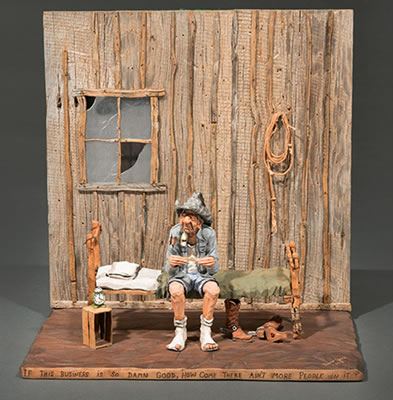 Raised on a ranch in the hill country near Mason, Texas and still working from a studio on that property, Gene Zesch is a wood carver of caricatures of the American West. His figures tell the story of the people of dying ranches in that area, and he gets at these truths through humor.
His first exposure to wood carving was a visit to Santa Fe during his Army service, and his first carving was an old camp cook and the second a sad-looking soldier. The demand for his wood carving became so great that he sent the molds to a foundry so he also had them in bronze. Unlike many wood carvers, he ended up in some of the best galleries of the West, and he attributes the interest in his work to the detailing of the faces.
Gene Zesch has a workbench thirty-seven inches high and fifteen feet long, and he carves his figures sitting in a draftsman chair with his feet up on the work bench. The wood for his figures comes from the many old oak trees on his ranch land.
He is a man who rides horse and a Harley Davidson and has become nationally known while remaining in his home town.
Source:
Vicki Stavig, 'The Studio', Art of the West, December 2004Biography from Broadmoor Galleries
If Mark Twain had carved instead of written books, they would probably look like this." Texas Monthly CAREER Gene first received national recognition when President Johnson bought some of his carvings. Publicity about this event resurfaced in 1993-1994 when the Smithsonian Portrait Gallery included one of Zesch's carvings. Then in 1996-1997 he was one of 12 artists used by the National Archives in their show "Tokens and Treasures of 12 Presidents". Photos and stories of these pieces were widely distributed by the National Geographic, New York Times, UPI etc.
Gene started carving in 1954. He had just married his high school sweetheart, Patsy, and entered the Army as a pilot. While on leave they passed through Santa Fe and watched a man on the Plaza carving a likeness of President Eisenhower. He had never seen a sculpture with the bold cuts that gave it character. He was literally smitten by this medium and told his wife "I believe I can do this". After his stint as a pilot he returned home to the ranch and started carving, selling first in gift shops then small art galleries and finally to some of the top Western art galleries in the U. S. His first one man show was at the Witte Museum in San Antonio. He didn't realize how prestigious it was to have a one man show at such an early age.
His next one man show was in 1988 in the Institute of Texan Cultures in San Antonio. According to Al Lowman, Director, "it is by far the most popular exhibit we've ever had". He then had a one man show at Texas A&M University, which he says was an "art free zone" when he attended. By far, his one man show at the National Cowboy and Western Heritage Museum has been his most important show. It was held September 2005 to January 2006. It was one of the best attended one man shows in the history of the Museum. They now have seven pieces in their permanent collection. Professor and sculptor, Umlaf, advised Gene not to take lessons but to keep developing his own style.r Even though he has flown airplanes, ridden motorcycles all over the world, and skied, his greatest pleasure has been to part time ranch with his sons and grandsons.
EARLY LIFE: Gene was born in 1932 during the great depression on a ranch in Mason, Texas. Because of the relatively high cost of gasoline he rode a horse four miles to school beginning with his first day. As he grew older he milked a cow before going to school. Later he learned to shoe horses and then to break them. All ranch boys were expected to round up and work cattle, build fences, etc. any time they were not in school. A friend once told Gene "Our fathers want us to inherit this land so we can suffer like they did". He later ranched in Texas and in Durango, Mexico where his friend Ace Reid, said, and "other than a million dollars of experience, I never made a dime".
He feels that he is recording ranch life, as he has know it. Most of his work is an exaggeration of experiences he or his friends have had. All art is exaggerated to some degree, but caricature gives Gene more to "play" with. Later he learned about the lost wax method of casting which dates back over 6000 years. When the process was refined a bronze was so exact that some sculptors marked their pieces with a thumbprint. Most of the pre-Columbian, Greek and Romanesque bronzes were also painted. After the rubber mold was invented multiple pieces could be cast. Frederick Remington cast over 200 pieces of some of his bronzes. Artist who painted bronzes included the well-known French caricaturist, Honoré Daumier (1808-1879) and the few castings by Picasso. Charlie Russell painted all of his originals. Gene casts his bronzes directly from his woodcarvings. He then paints them just as many were done thousands of years ago.
Gene Zesch is an American sculptor, who gained national recognition in the 1960s when prominent figures such as Lyndon Johnson and John Connally started collecting his woodcarvings. Born in 1932, he grew up on a Texas ranch in Mason County and also ranched in Durango, Mexico. Mr. Zesch started working as an artist in 1954 and has made a living out of carving caricature figurines of Texas cowboys and cattlemen. The characteristic expression of the subjects of his work is an eyed rolling resignation.
He still lives in Mason County on his family ranch. He hand paints bronze castings of his more notable carvings and sells signed prints of photos of his work. Mr. Zesch's work has been featured in one-man shows at the National Cowboy & Western Heritage Museum (2005), the Institute of Texan Cultures (1988), the Witte Museum (1967), and the Forsyth Gallery at his alma mater, Texas A&M University (1997). His work has also been displayed in special exhibits at the Smithsonian Institution's National Portrait Gallery (United States) (1993), the Museum of Western Art (2004), and HemisFair '68 (1968).Biography from Trailside Galleries
Gene Zesch grew up on a Texas ranch in Mason County, a place he still calls home. He started woodcarving as a young man and gained national recognition in the 1960's when prominent figures, such as Lyndon Johnson and John Connally, started collecting his woodcarvings.
Zesch concentrates on the hardships facing contemporary cowboys with a humorous approach. His figures, firmly grounded in modern reality, are drawn from his own experiences in ranching. He focuses on facial expressions, using bold knife cuts to capture the roughness of his subject matter.
Throughout his career, Gene has chosen to interpret the American west by chronicling the hopes and frustrations of his own generation of cowboys. Many of Gene's woodcarvings have been cast into bronze using the lost wax process. His woodcarvings and bronzes have been featured at such prestigious venues as the Witte Museum, The Institute of Texas Cultures at the University of Texas, the Smithsonian Institution and The National Cowboy Hall of Fame.Biography from Whistle Pik Galleries
Gene Zesch grew up on a Texas ranch in Mason County, a small place he still calls home. He started woodcarving as a young man and gained national recognition in the 1960's when prominent figures such as Lyndon Johnson and John Connally started collecting his work.
Zesch concentrates on the hardships facing contemporary cowboys and approaches them with humor rather than sentiment. His figures are firmly grounded in modern reality, drawn from his experiences in a ranching community.
He focuses on facial expressions, using bold knife cuts to capture the roughness of his subject matter. Throughout his career, Gene has chosen to interpret the American West by chronicling the hopes and frustrations of his own generation of cowboys rather than by escaping into an idealized past.
Many of Gene's woodcarvings have been cast into bronze using the lost wax process. Each limited edition bronze is hand painted by the artist.
Feature articles on Zesch have appeared in Southwest Art, Western Horseman, Art Of The West, Artists Of The Rockies, Art West, and a biography appears in Contemporary West Artists.
When he is not working on a new project, Gene can most likely be found on one of his two means of transportation: his horse or his Harley.