Page loaded successfully. Showing biography for George Benjamin Luks.
George Benjamin Luks BIOGRAPHY
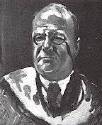
1866 Williamsport, Pennsylvania - 1933 New York City. Known for: Urban genre and portrait painting, illustration.
George Luks was born on August 13, 1867 in Williamsport, Pennsylvania. Luks received his first art instruction from his parents who pursued painting as a hobby. At seventeen he entered the... Read full biography
George Luks was born on August 13, 1867 in Williamsport, Pennsylvania. Luks received his first art instruction from his parents who pursued painting as a hobby. At seventeen he entered the Pennsylvania Academy of Fine Arts. Later he went to Düsseldorf where he lived with a distant relative, a... Read full biography
George Luks was born on August 13, 1867 in Williamsport, Pennsylvania. Luks received his first art instruction from his parents who pursued painting as a hobby. At seventeen he entered the Pennsylvania Academy of Fine Arts. Later he went to Düsseldorf where he lived with a distant relative, a retired lion-tamer. He abandoned Düsseldorf for the more stimulating spheres of London and Paris. When he returned to America he worked as an artist for Philadelphia newspapers. In 1896 he was sent to Cuba... Read full biography
George Luks was born on August 13, 1867 in Williamsport, Pennsylvania. Luks received his first art instruction from his parents who pursued painting as a hobby. At seventeen he entered the Pennsylvania Academy of Fine Arts. Later he went to Düsseldorf where he lived with a distant relative, a retired lion-tamer. He abandoned Düsseldorf for the more stimulating spheres of London and Paris. When he returned to America he worked as an artist for Philadelphia newspapers. In 1896 he was sent to Cuba as a war artist; rumor had it he was captured by the Spaniards and condemned to death as a spy, but he was deported instead and landed in New York, cold, hungry and broke. In 1894 he joined the staff of the "Philadelphia Press" as an illustrator. He... Read full biography
George Luks was born on August 13, 1867 in Williamsport, Pennsylvania. Luks received his first art instruction from his parents who pursued painting as a hobby. At seventeen he entered the Pennsylvania Academy of Fine Arts. Later he went to Düsseldorf where he lived with a distant relative, a retired lion-tamer. He abandoned Düsseldorf for the more stimulating spheres of London and Paris. When he returned to America he worked as an artist for Philadelphia newspapers. In 1896 he was sent to Cuba as a war artist; rumor had it he was captured by the Spaniards and condemned to death as a spy, but he was deported instead and landed in New York, cold, hungry and broke. In 1894 he joined the staff of the "Philadelphia Press" as an illustrator. He moved into a one-room flat with fellow illustrator, Everett Shinn. Through his illustration work, Luks became acquain... Read full biography
Artist Biography
Biography page for George Benjamin Luks ((1866 - 1933)), known for Urban genre and portrait painting, illustration. Showing 6 biographical entries and 0 sample artworks.
George Benjamin Luks - Artist Info
About George Benjamin Luks
Name variants
George Luks
Biography from the Archives of askART
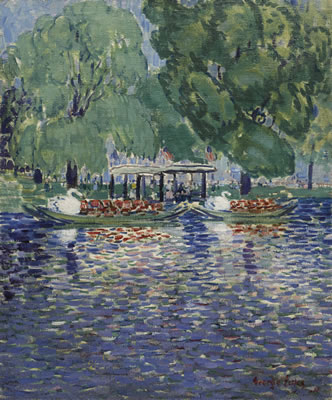 George Luks was born on August 13, 1867 in Williamsport, Pennsylvania. Luks received his first art instruction from his parents who pursued painting as a hobby. At seventeen he entered the Pennsylvania Academy of Fine Arts. Later he went to Düsseldorf where he lived with a distant relative, a retired lion-tamer. He abandoned Düsseldorf for the more stimulating spheres of London and Paris.
When he returned to America he worked as an artist for Philadelphia newspapers. In 1896 he was sent to Cuba as a war artist; rumor had it he was captured by the Spaniards and condemned to death as a spy, but he was deported instead and landed in New York, cold, hungry and broke.
In 1894 he joined the staff of the "Philadelphia Press" as an illustrator. He moved into a one-room flat with fellow illustrator, Everett Shinn. Through his illustration work, Luks became acquainted with William Glackens, John Sloan and eventually Robert Henri and these artists including Shinn later became known as the Philadelphia Five.
In April of 1896, after serving as a war correspondent in Cuba, Luks moved to New York City where he joined the staff of the "New York World" and began to draw a comic strip. He spent some time doing comic strips and then gave up newspaper work to devote his full energies to painting. His early experience as a newspaper artist had stimulated his interest in the American scene. Choosing the sidewalks of New York City as his province he proceeded to paint the subjects he saw there with a frankness that dismayed the academicians. He turned to landscape painting with enthusiasm.
Luks taught at the Art Students League from 1920 through 1924 and he later conducted his own classes in his own studio. Luk's personality was as famous as his paintings. A loud, boastful but purportedly good-humored man, he was also a heavy drinker. On October 29, 1933, he was found dead on the streets of New York City, a casualty of a barroom brawl.
Written and submitted by Jean Ershler Schatz, artist and researcher from Laguna Woods, California.
Sources include:
The Metropolitan Museum of Art exhibition: Miniatures: The Eight
From the internet, AskART.comBiography from the Archives of askART
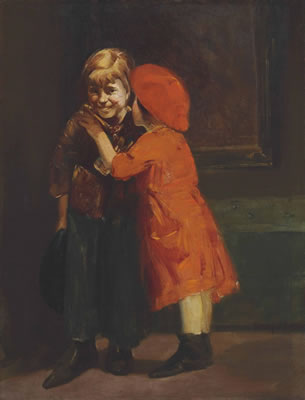 Known as a 'real character', full of life both in reality and in his painting, George Luks was a leading figure in the New York art world in the early part of the 20th century. He did lively portraits and genre paintings of everyday people engaged in activity rather than self consciously posed.
He was born in Williamsport, Pennsylvania, and his parents encouraged his obvious art talent. They also supported a group called the Molly Maguires, a secret-organization of Irish-Americans that tried to improve conditions for area miners. This exposure had an obvious influence on his later subject matter, which quite often showed "down and out" people.
He studied in Europe for several years and was much influenced by the paintings of Rembrandt and Frans Hals. He then worked for the Philadelphia Press, doing quick, accurate reportorial sketches, a method that became his forte. He tried to study at the Pennsylvania Academy, but his rebellious nature resisted the discipline of formal study and he withdrew after one month.
In Philadelphia, Luks became an illustrator with the Philadelphia Press and covered the Cuban war as an artist-correspondent. He also did comic strips and caricature. Among his close friends were John Sloan, Robert Henri, William Glackens and Everett Shinn. By 1896, with that group, Luks became a resident of New York City.
There he began painting the people he saw on the street and joined with the Henri circle in depicting social realism, which became known as the Ash Can School. Also with Henri and Sloan and others, he was part of a highly controversial exhibition called The Eight at the Macbeth Gallery, which was a rebellion against the strictures of the National Academy.
Source:
Michael David Zellman, 300 Years of American ArtBiography from The Lusher Gallery LLC
GEORGE BENJAMIN LUKS, born on August 13, 1867, in Williamsport, Pennsylvania, was a leading figure in the New York art world in the early part of the 20th century. Known primarily for his social-realist paintings and illustrations, he advocated, along with several of his contemporaries, a philosophy of painting which challenged the traditional approaches advanced at the time by the National Academy of Design and the established art-circles in America.
Luks’ parents were amateur painters, and encouraged their son’s innate talent, providing him with his earliest artistic instruction. The family moved to Pottsville, in southern Pennsylvania’s coal-mining territory, when Luks was still a child, and he learned at a young age about the effects of poverty on its victims. His parents (his father was a physician) tried to help the coal-miners’ families, going so far as to support a group known as the ‘Molly Maguires’, a secret organization of Irish-Americans that tried to improve conditions for the area’s miners. This exposure presumably had an effect on Luks’ work, which often displayed ‘down and out’ people in naturalistic settings.
Luks’ earliest job was in vaudeville. He and his brother played the Pennsylvania and New Jersey vaudeville circuits while still in their teens. But he left performing to pursue a career as an artist, having known from a young age that art was the direction toward which he was headed. At the age of seventeen he enrolled in the Pennsylvania Academy of Fine Arts, studying under Thomas Anshutz, but his rebellious nature resisted the rigors of formal study, and he withdrew after a short stay. Traveling to Europe, he attended several art schools, including the Dusseldorf (Germany) School of Art, before abandoning Dusseldorf for what he considered to be the more stimulating spheres of Paris and London. While in Europe he became inspired by the work of Valazquez, Manet, Rembrandt, Van Steen, Renoir, and particularly the Dutch Master, Frans Hals.
In 1894 Luks returned to America, eventually joining the staff of the Philadelphia Press as an illustrator. He moved into a one-room flat with fellow illustrator Everett Shinn. Working at that newspaper, Luks also met the artists John Sloan and William Glackens. These men began to gather for weekly meetings, social as well as intellectual, at the studio of Robert Henri, a noted painter who was several years their senior, and who encouraged his younger friends to consider the need for a new style of painting, one that would speak to the needs of their own time and experience. Chafing at the limitations imposed by the conservative art establishment, Henri was a persuasive advocate for the vigorous depiction of ordinary life; he believed American painters needed to shun genteel subjects and academic polish and learn to paint more rapidly. He also believed artists of this period needed to expand the breadth of their knowledge by familiarizing themselves with certain types of literature, and encouraged the group to read the work of writers such as Whitman, Emerson, Zola, and Ibsen, as well as William Morris Hunt’s Talks on Art and George Moore’s Modern Painting. Henri and his acolytes, replete with their new, radical ideas for the direction of American art, collectively became known as the Philadelphia Five.
In 1896, the Press sent Luks to Cuba to cover the Spanish-American War as a correspondent/war artist. Upon returning to America he moved to New York City, where he joined the staff of the New York World and began to draw the comic strips, The Yellow Kid and Hogan’s Alley. While drawing the strips Luk began to devote more time to developing his painting skills, and in 1902 he abandoned newspaper work to devote all his energies to painting. Most of the canvases from this period specialize in portraits of members of the working class (though they include docks and bridges as well), his interest in this subject-matter certainly influenced by the dynamics of his Philadelphia Five experience, and perhaps piqued by his childhood rearing in coal-mining country, as well as his experiences as a newspaper illustrator. These social-realist paintings, consisting mainly of depictions of street urchins, rag-pickers, wrestlers, peddlers, shopkeepers, and beggars, are executed with an immediacy, honesty, and richness that has been compared to the work of Frans Hals. Some of Luks’ best-known work from this era captures the lives of the occupants of the tenement districts of New York, particularly the Lower East Side of Manhattan. Paintings such as Hester Street (1905, in the collection of the Brooklyn Museum), Allen Street (1905) and Houston Street (1917) fall into this category. Two other famous works also come from this period; the year 1905 saw Luks produce The Spielers and The Wrestlers. In The Spielers (in the collection of the Addison Gallery of American Art) two young girls dance frenetically, their joyous faces forming a contrast to their grimy hands; In The Wrestlers (in the collection of the Museum of Fine Arts in Boston), one beefy man has been pinned to the mat by another, the paint reflecting the sweat and strain of the match. As Luks’ friend Everett Shinn put it: “Sentimental or otherwise, he always painted the truth, as he saw it.” This dedication to the truth, to an art more directly related to everyday experience, and to depicting in a realistic fashion the rougher and grittier aspects of modern life, was the object of a group which grew out of the original precepts of The Five, and of which Luks became a member; collectively known as The Eight, it was comprised of the original Philadelphia Five, with the addition ofArthur B. Davies, Ernest Lawson, and Maurice Prendergast. Their works, by and large, adopted rich, dark tonalities inspired by the art and techniques of Rembrandt, Manet, and Franz Halls. Because of their dark palettes and preference for what at the time was considered to be ‘coarser’ subject-matter, The Eight eventually became known as the Ashcan School. The rejection of many of their paintings, including works by Luks, from the exhibitions of the powerful, conservative National Academy of Design motivated The Eight to form their own short-lived exhibiting group. Their exhibition at the MacBeth Galleries in New York in January, 1908 was a significant event in the promotion of twentieth-century American art. The group was unified by a belief in exhibition opportunities free of the jury system, as well as a belief in content and painting techniques not necessarily sanctioned by the Academy. The show challenged the artistic status-quo and created a sensation among conservative and official art circles in America. Following the New York show John Sloan organized a traveling exhibition that brought their paintings to Chicago, Indianapolis, Toledo, Cincinnati, Pittsburgh, Bridgeport, and Newark, and which helped promote a national debate about the new realism that the Ashcan School represented. Luk’s paintings Feeding the Pigs and Mammy Groody were seen as examples of this new ‘earthiness’ that many art lovers were not yet ready to accept. Ultimately, though, the Ashcan School successfully challenged academic art institutions, and during the 1910s the authority of the National Academy of Design as a cultural arbiter began to decline. At a time when the realist fiction of Theodore Dreiser and Frank Norris was gaining a wider audience, and when muckraking journalists were calling attention to slum conditions in American cities, the Ashcan painters played a vital role in enlarging the nation’s sense of what were to be considered suitable topics for free artistic expression.
In addition to the Macbeth show, Luks’ works were exhibited at other contemporaryvenues, including the National Arts Club (1904) and the famous Armory Show of 1913, where six of his paintings were displayed. After his death in 1933, many exhibitions followed, including a solo show at the Newark Museum (1933), the Whitney Museum (1937, The New York Realists), the Brooklyn Museum of Art (1943, The Eight), the Brooklyn Museum (1992, Painters of a New Century: The Eight and American Art), the Canton Museum of Art (1994, George Luks: The Watercolors Rediscovered), the National Museum of American Art (1995, Metropolitan Lives: The Ashcan Artists and Their New York), the Owen Gallery (New York, 1997), the Metropolitan Museum of Art (2000, City Life Around The Eight), the New York Historical Society (2007, Life’s Pleasures: The Ashcan Artists Brush with Leisure, 1895-1925), and the Milwaukee Art Museum (2009, The Eight andAmerican Modernisms).
Although Luks is most well known for his depictions of New York City life, he also painted landscapes and portraits and was an accomplished watercolorist. In later years he painted society portraits (e.g., Society Girl). His style was not entirely uniform throughout his career; The Cafe Francis (1906) contains more impressionist touches than his usual dark scenes of lower-class urban life, and there are several landscapes of the Berkshire Mountains in Massachusetts that are executed in the Impressionist tradition. In addition to the Berkshires, Luks, primarily a city dweller, traveled to the island of Bermuda (ca. 1915), where he may have produced a watercolor of a moongate and gardens that was exhibited in 1916 at the New York Watercolor Club. His interest in Bermuda extended to his execution of a pen and pencil drawing that depicts a scene on the famous Pier 47 on the Hudson River in New York, in which a sign in the foreground belonging to the Quebec Steamship Company advertises the destination “Bermuda & the West Indies”, while a steamship waits in preparation in the background.
Like his mentor Henri and friend Sloan, Luks was also a teacher, first at the Art Students League on West 57th Street in Manhattan and, later, across the street at a school he established himself, which remained open until the time of his death. One student, the painter Elsie Dreggs, remembered him as a charismatic force in the classroom. He enjoyed the adulation of his pupils and was reputedly quite a raconteur. He was not interested in preaching the tenets of Modernism; his commitment was to realism and direct observation. Given to hyperbolic statements and often intentionally vague about autobiographical details, he preferred to maintain an aura of self-mythologizing mystery. He was equally at home at a prize fight or a tavern as at a museum or a gallery. Always a heavy drinker, his friend and one-time roommate William Glackens often had to undress him and put him into bed following a night of drunken debauchery. Yet he was also known as a man with a kind heart who befriended people living on the edge, often using them as subjects for his paintings. Some examples of this tendency are the Widow McGee (1902) and The Old Duchess and The Rag Picker (both of 1905), in which Luks depicted elderly, down-and-out women who were victims of ‘life on the street’. He was a true paradox: a man of enormous egotism, but with a great generosity of spirit. Ironically, he himself ultimately became a victim of ‘the street’, beaten to death on the night of October 29, 1933 following a bar room brawl. He was buried in an eighteenth century embroidered waistcoat - one of his most valued possessions - at Fernwood Cemetery in Royersford, Pennsylvania.
Today, Luks’ work is found in many important private and public collections, including the Addison Gallery of American Art (Andover, Massachusetts), the Barnes Museum (Merion, Pennsylvania), the Brooklyn Museum, the Chattanooga Art Association (Tennessee), the Cleveland Art Museum, the Delgado Museum (New Orleans), the Detroit Art Institute, the Metropolitan Museum of Art (New York), the Milwaukee Art Institute, the Munson-Williams-Proctor Institute (Utica, New York), the Museum of Fine Arts (Boston), the National Gallery of Art (Washington, D.C.), the Smithsonian Institution (Washington, D.C.), the New York Public Library, the Phillips Gallery (Washington, D.C.), and the Whitney Museum of American Art (New York).
Written November 2014 by Brian Flon, author of "Hell's Kitchen Requiem" (2014), available as an e-book at Amazon, ITunes, and Barnes & Noble.
Permission to reproduce on askART provided by Lusher Gallery LLC on August 22, 2019.
Copyright note: ©The Lusher Gallery LLC 2014. This biography may NOT be reproduced in whole or in part without the prior written consent of The Lusher Gallery LLC.Biography from Spanierman Gallery
A member of The Eight, George Luks created works in vivid bravura manner that captured the spirited energy of the tenement districts of New York and their occupants. As Milton Brown wrote: "In his art and in his character he symbolized the spirit of American dynamism; as aggressive as a tycoon, as brash and boastful as a 'drummer'. . . he was a swashbuckler in paint. This was not, of course, the cultured tradition of American life; it was rather the expression of a cruder side of America, an echo of the frontier." 1
Born in Williamsport, Pennsylvania, in 1867, Luks was the son of a doctor. In 1884 he began to study art at the Pennsylvania Academy of the Fine Arts, where he was a student of Thomas Anshutz. Luks continued his training in Dusseldorf, Paris, and London. Returning to America in 1894, he began a career as a newspaper artist, working for the Philadelphia Press and the Philadelphia Evening Bulletin. In addition to illustrations, he created comic strips and caricatures.
In the early twentieth century, Luks joined with Glackens, Robert Henri, Ernest Lawson, Maurice Prendergast, Everett Shinn, and John Sloan to form the Eight. Reacting against the genteel subject matter painted by academic and Impressionist gilded age artists, this group sought an art more directly related to everyday experience, and they turned to depicting the vitality and rougher aspects of modern life. Most members of the Eight worked in a realist manner and adopted rich, dark tonalities inspired by the art and techniques of Franz Hals, Rembrandt, and Manet. Because of their dark palettes and preference for the coarser subjects, the Eight became popularly known as the Ashcan School.
During the early years of the Eight, Luks continued to work as a newspaper artist, but he gradually developed his painting skills. He specialized in portraits of street urchins, wrestlers, peddlers, and shopkeepers, although he also painted occasional urban scenes of docks and streets. These subjects expressed to him the romance, freedom, and joyfulness that he felt epitomized America. Luks' particular talent was the capturing of the character of his subjects and the essence of a moment using a succinct artistic vocabulary and a spontaneous technique.
Luks exhibited with other members of the Eight for the first time at New York's Macbeth Gallery in 1908. This show challenged the artistic status quo and created a sensation among conservative and official art circles in America. Luks also exhibited at the Armory Show in 1913, where the works of the early twentieth-century realists, which had so recently seemed radical, were overshadowed by the modernism of abstract movements.
Luks taught at the Art Students League in the 1910s, and later founded his own school. A solo show of his work was held at the Newark Museum following his death in 1933.
Luks's works are found in numerous important private and public collections including the Addison Gallery of American Art, Andover, Massachusetts; the Barnes Museum, Merion, Pennsylvania; the Brooklyn Museum; the Chattanooga Art Association, Tennessee; the Cleveland Art Museum; the Delgado Museum, New Orleans; the Detroit Art Institute, Michigan; the Metropolitan Museum of Art, New York; the Milwaukee Art Institute; the Munson-Williams-Proctor Institute, Utica, New York; the Museum of Fine Arts, Boston; the National Gallery of Art, Washington, D.C.; the National Museum of American Art, Smithsonian Institution, Washington, D.C.; the New York Public Library; the Phillips Gallery, Washington, D.C.; and the Whitney Museum of American Art, New York.
LNP
© The essay herein is the property of Spanierman Gallery, LLC and is copyrighted by Spanierman Gallery, LLC, and may not be reproduced in whole or in part without written permission from Spanierman Gallery, LLC, nor shown or communicated to anyone without due credit being given to Spanierman Gallery, LLC.
1 Milton Brown, American Painting from the Armory Show to the Depression (Princeton, New Jersey: Princeton University Press, 1955), p. 14.Biography from The Johnson Collection
GEORGE BENJAMIN LUKS (1866-1933)
Considered an exemplar of the Ashcan School, George Benjamin Luks was known for his spirited character which was reflected in his energetic brushwork. A critic described him this way: “As for the personality of the man… He is Puck. He is Caliban. He is Falstaff. He is a tornado. He is sentimental. He can sigh like a lover, and curse like a trooper.” As a revered teacher at the Art Students League in New York, Luks hired William H. Johnson as a studio assistant, which helped enable Johnson to afford to go abroad; he also mentored Eugene Thomason with whom he had an enduring friendship.
Luks was born in Williamsport, Pennsylvania, but moved as a child to nearby Pottsville where he observed the desperate lives of coal miners. As a teenager he performed vaudeville, and toured with his brother in a minstrel act called “Buzzey and Anstock.” However, he decided he would rather be an artist. For a short period, he attended the Pennsylvania Academy of the Fine Arts before going abroad where he encountered the influential work of old masters, such as Frans Hals and Diego Velasquez. He took classes at the Düsseldorf School of Art in Germany. Returning to the States, he settled in Philadelphia in 1893 where he began as an illustrator for the Philadelphia Press. He associated with other members of the Ashcan School, so-called because of their dark palettes and gritty subject matter.
In 1896 Luks moved to New York and was employed by the New York World for whom he did comic strips, including, for a time, The Yellow Kid. Some maintain that the satirical cartoon led to the concept of “yellow journalism,” the practice of sensationalizing events and personalities to gain readership. Fellow artists urged Luks to focus on his painting, and eventually, in 1908, he exhibited with them in a group known as The Eight. He chose urban subjects—often crowded street scenes of downtrodden people—rendered unidealized with a loaded brush. In his figure studies he usually posed his sitters frontally against a dark background.
In 1924 Luks accompanied Thomason on a trip to the Carolinas, and The Charlotte Observer took note of the visit, unfortunately misspelling Thomason’s name: “Famous Artist, Guest of Edgar Thomason, Tells of Human Ills and Whims; Man Who Has Painted Portraits of World-Famous Folks Likes Charlotte, Says He Will Come Again, Goes Hunting in Game Paradise Near Georgetown, S.C., and Kills Wild Cats Instead of Ducks.” Thomason was an accomplished outdoorsman which Luks was not. Throughout the interview Luks regaled the reporter with anecdotes, jokes, aphorisms, and praised southern hospitality and cornbread with honey.
Despite his own rather modest training in art, Luks was a popular instructor for a while at the Art Students League, which had been established by artists in opposition to the more academic National Academy of Design. He often took his students to the Metropolitan Museum of Art and Thomason recounted his mentor’s reaction to a portrait by John Singer Sargent: “[he] usually gave Sargent the raspberry—weak hands on portraits. …Guards were glad to see him leave, always a crowd following him like a circus parade, very witty.”
The administration of the League was not always pleased with Luks’s antics, and in 1924 dismissed him for drunkenness. Undeterred, Luks founded his own school which was described in a promotional brochure as “a virile school of Living American Art. … It is George Luks’ policy to develop the individuality of the student and to give him a sound knowledge of the craft of painting, building up each student with sympathetic and wise counsel so that they see and think for themselves.” Another southern painter, Lamar Dodd, attended the school alongside Thomason and described it in glowing terms: “[It] had a group of painters probably second to none in the city—at the time. I could write a book about Luks and my experiences there.”
The Johnson Collection, Spartanburg, South Carolina
thejohnsoncollection.orgBiography from Owen Gallery
On August 13th, 1867, George Luks was born to Emil Charles Luks and Bertha Amalia von Kraemer Luks in Williamsport, Pennsylvania. After short stints at the Pennsylvania Academy of Fine Arts and the Dusseldorf Academy, Luks traveled to Paris and London around 1890, where he admired the work of Rembrandt, van Steen, Hals, and Renoir. Again in 1892, Luks traveled to Europe.
In 1894, he joined the staff of the Philadelphia Press as an illustrator. He moved into a one-room flat with fellow illustrator, Everett Shinn. Through his illustration work, Luks became acquainted with William Glackens and John Sloan and eventually Robert Henri, and these artists including Shinn later became known as the Philadelphia Five.
In April of 1896, after serving as a war correspondent in Cuba, Luks moved to New York, where he joined the staff of the The New York World and began to draw the comic strip, The Yellow Kid. By 1902, Luks abandoned newspaper work in order to devote his energy to painting.
In 1908, The Eight formed from the pre-existing Philadelphia Five with the addition of Maurice Prendergast, Arthur Bowen Davies, and Ernest Lawson. They exhibited at the Macbeth Gallery in New York from February 3rd through February 15th.
Luks employment as a newspaper illustrator may have led to his interest in the everyday people and scenes which dominate many of his early canvases. Street urchins, beggar women, rag pickers, and the working class are painted with an immediacy, honesty, and richness reflective of Dutch Master, Frans Hals.
Luk's personality is as famous as his painting. A loud, boastful but purportedly good-humored man, Luks was also a heavy drinker. On October 29, 1933, he was found dead on the streets of New York, a casualty of a bar-room brawl.
Owen Gallery credits The Eight: Bridging the Art of the Nineteenth and Twentieth Centuries by Brian Paul Clamp.