Page loaded successfully. Showing biography for George Henry Bogert.
George Henry Bogert BIOGRAPHY
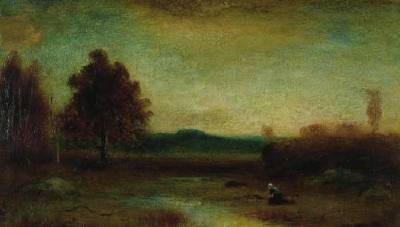
1864 New York City - 1944 New York City. Known for: Landscape, marine-Venice views.
From the New York Times, December 14, 1944. GEORGE H. BOGERT. George H. Bogert, landscape painter whose work is represented by six paintings in the Metropolitan Museum of Art and two in the National... Read full biography
From the New York Times, December 14, 1944. GEORGE H. BOGERT. George H. Bogert, landscape painter whose work is represented by six paintings in the Metropolitan Museum of Art and two in the National Gallery of Art in Washington, died at the Flower and Fifth Avenue Hospitals after a brief illness.... Read full biography
From the New York Times, December 14, 1944. GEORGE H. BOGERT. George H. Bogert, landscape painter whose work is represented by six paintings in the Metropolitan Museum of Art and two in the National Gallery of Art in Washington, died at the Flower and Fifth Avenue Hospitals after a brief illness. He was 80 years old. Mr. Bogert was born in New York City, the son of Henry Bogert and Helen Anderson Evans Bogert. His father was a paper manufacturer, and an uncle, J. August Bogert, was a noted wood... Read full biography
From the New York Times, December 14, 1944. GEORGE H. BOGERT. George H. Bogert, landscape painter whose work is represented by six paintings in the Metropolitan Museum of Art and two in the National Gallery of Art in Washington, died at the Flower and Fifth Avenue Hospitals after a brief illness. He was 80 years old. Mr. Bogert was born in New York City, the son of Henry Bogert and Helen Anderson Evans Bogert. His father was a paper manufacturer, and an uncle, J. August Bogert, was a noted wood engraver. Among the Bogert family’s ancestors was Sarah Rapalje, the first female child born to European parents in New Netherland. After studying under Thomas Eakins at the National Academy of Design, Mr. Bogert went to Paris at the age of 20,... Read full biography
From the New York Times, December 14, 1944. GEORGE H. BOGERT. George H. Bogert, landscape painter whose work is represented by six paintings in the Metropolitan Museum of Art and two in the National Gallery of Art in Washington, died at the Flower and Fifth Avenue Hospitals after a brief illness. He was 80 years old. Mr. Bogert was born in New York City, the son of Henry Bogert and Helen Anderson Evans Bogert. His father was a paper manufacturer, and an uncle, J. August Bogert, was a noted wood engraver. Among the Bogert family’s ancestors was Sarah Rapalje, the first female child born to European parents in New Netherland. After studying under Thomas Eakins at the National Academy of Design, Mr. Bogert went to Paris at the age of 20, where he studied with Raphael Collin, Aimé Morot, and Puvis de Chavannes. He was elected an Associate of the National Acad... Read full biography
Artist Biography
Biography page for George Henry Bogert ((1864 - 1944)), known for Landscape, marine-Venice views. Showing 2 biographical entries and 0 sample artworks.
George Henry Bogert - Artist Info
About George Henry Bogert
Biography from the Archives of askART
 From the New York Times, December 14, 1944
GEORGE H. BOGERT
George H. Bogert, landscape painter whose work is represented by six paintings in the Metropolitan Museum of Art and two in the National Gallery of Art in Washington, died at the Flower and Fifth Avenue Hospitals after a brief illness. He was 80 years old.
Mr. Bogert was born in New York City, the son of Henry Bogert and Helen Anderson Evans Bogert. His father was a paper manufacturer, and an uncle, J. August Bogert, was a noted wood engraver. Among the Bogert family’s ancestors was Sarah Rapalje, the first female child born to European parents in New Netherland.
After studying under Thomas Eakins at the National Academy of Design, Mr. Bogert went to Paris at the age of 20, where he studied with Raphael Collin, Aimé Morot, and Puvis de Chavannes. He was elected an Associate of the National Academy of Design in 1899.
His awards included an honorable mention at the Pennsylvania Academy of the Fine Arts in 1892; the Webb Prize from the Society of American Artists in 1899; a bronze medal at the Paris Exposition of 1900; and gold medals from the American Society of Art in 1902 and 1904.
Mr. Bogert’s landscapes are included in the collections of the Corcoran Gallery of Art, Washington; the Pennsylvania Academy of the Fine Arts; the Buffalo Fine Arts Academy; the Museum of Fine Arts, Boston; the Brooklyn Institute Museum; the Huntington Museum, California; the Minneapolis Institute of Arts; the St. Louis Art Museum; the Art Institute of Chicago; the Edinburgh Museum, Scotland; and the Shanghai Club, China. His work was also represented in the private collections of Andrew Carnegie, George A. Hearn, Thomas B. Clarke, and Clarence H. Mackay.
He was a member of the Society of Landscape Painters of New York, the Pennsylvania Academy of the Fine Arts, and the Salmagundi Club, and a life member of the Lotos Club, where four of his paintings were to be included in a members’ exhibition this week.
Mr. Bogert lived at 18 West Seventy-fourth Street, New York City. He is survived by a daughter, Mrs. C. Bradford Welles of North Haven, Connecticut, and two grandsons.
Submitted by: Jacob FrankBiography from the Archives of askART
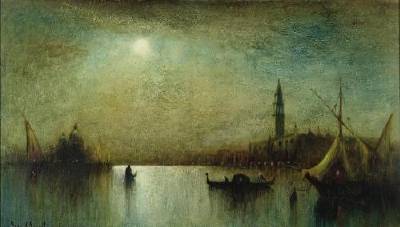
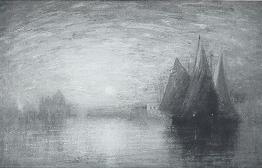 Born in New York City, George Henry Bogert (often confused with George Hirst Bogert 1864-1923) became known for landscapes, seascapes of Venice and urban subjects and is especially aligned with the style of Tonalism* and the Barbizon School* of painting.
In his signature work, he used "cool blue tones to achieve blurred form and soft half-light effects, further accentuated by the application of dense impasto." (Zellman 385). Much of this work seemed related to the popular turn-of-the-century soft focus photography.
In the early 1880s, he studied at the National Academy of Design* and then went to Paris where his teachers were Puvis de Chavannes, Raphael Collin and Aime Morot.
From 1884 to 1888, he spent four years in Europe, primarily in Paris with teachers including Puvis de Chavannes and Aime Morot. Returning to the United States, he was in New York as a student of Thomas Eakins.
In the 1890s, he returned to Europe where he traveled widely for subject matter including to Venice and the Isle of Wight. In Northern France, he came under the influence of Eugene Boudin and his plein-air landscape painting methods.
Bogert received numerous awards including the First Hallgarten Prize by the National Academy of Design in 1899 to which he was elected to membership that year.
Little is known of him after 1900, except that he returned to Europe and finally settled at the artists' colony of Old Lyme, Connecticut*.
Source:
Michael David Zellman, 300 Years of American Art
* For more in-depth information about these terms and others, see AskART.com Glossary http://www.askart.com/AskART/lists/Art_Definition.aspx