Page loaded successfully. Showing biography for George Horne Russell.
George Horne Russell BIOGRAPHY
.jpg)
1861 Banff, Scotland - 1933 St. Stephen, New Brunswick. Known for: Society portraits, landscape and coastal view painting, drawing.
George Horne Russell RCA (1861 - 1933). George Horne Russell (AKA: G. Horne Russell) was a painter, draftsman and a President of the Royal Canadian Academy of Arts*. He was born in Banff, Scotland... Read full biography
George Horne Russell RCA (1861 - 1933). George Horne Russell (AKA: G. Horne Russell) was a painter, draftsman and a President of the Royal Canadian Academy of Arts*. He was born in Banff, Scotland and emigrated to Montreal, Quebec, Canada in 1890. He lived there and at his summer home in St.... Read full biography
George Horne Russell RCA (1861 - 1933). George Horne Russell (AKA: G. Horne Russell) was a painter, draftsman and a President of the Royal Canadian Academy of Arts*. He was born in Banff, Scotland and emigrated to Montreal, Quebec, Canada in 1890. He lived there and at his summer home in St. Andrews, New Brunswick for the rest of his life. After a brief illness he died at Chipman Memorial Hospital in St. Stephen, New Brunswick, a town about 15 miles north of St. Andrews. (1). His primary medium... Read full biography
George Horne Russell RCA (1861 - 1933). George Horne Russell (AKA: G. Horne Russell) was a painter, draftsman and a President of the Royal Canadian Academy of Arts*. He was born in Banff, Scotland and emigrated to Montreal, Quebec, Canada in 1890. He lived there and at his summer home in St. Andrews, New Brunswick for the rest of his life. After a brief illness he died at Chipman Memorial Hospital in St. Stephen, New Brunswick, a town about 15 miles north of St. Andrews. (1). His primary medium was oil on canvas and his primary subject was commissioned society portraits. He is also famous for several monumental paintings of the Rocky Mountains commissioned by the Canadian Pacific Railway and the Grand Trunk Railway [now the Canadian... Read full biography
George Horne Russell RCA (1861 - 1933). George Horne Russell (AKA: G. Horne Russell) was a painter, draftsman and a President of the Royal Canadian Academy of Arts*. He was born in Banff, Scotland and emigrated to Montreal, Quebec, Canada in 1890. He lived there and at his summer home in St. Andrews, New Brunswick for the rest of his life. After a brief illness he died at Chipman Memorial Hospital in St. Stephen, New Brunswick, a town about 15 miles north of St. Andrews. (1). His primary medium was oil on canvas and his primary subject was commissioned society portraits. He is also famous for several monumental paintings of the Rocky Mountains commissioned by the Canadian Pacific Railway and the Grand Trunk Railway [now the Canadian National Railway]. (2). His other mediums included watercolor, pen & ink, charcoal, pencil and mixed mediums.... Read full biography
Artist Biography
Biography page for George Horne Russell ((1861 - 1933)), known for Society portraits, landscape and coastal view painting, drawing. Showing 1 biographical entries and 0 sample artworks.
George Horne Russell - Artist Info
About George Horne Russell
Biography from the Archives of askART
 George Horne Russell RCA (1861 - 1933)
George Horne Russell (AKA: G. Horne Russell) was a painter, draftsman and a President of the Royal Canadian Academy of Arts*.
He was born in Banff, Scotland and emigrated to Montreal, Quebec, Canada in 1890. He lived there and at his summer home in St. Andrews, New Brunswick for the rest of his life. After a brief illness he died at Chipman Memorial Hospital in St. Stephen, New Brunswick, a town about 15 miles north of St. Andrews. (1)
His primary medium was oil on canvas and his primary subject was commissioned society portraits. He is also famous for several monumental paintings of the Rocky Mountains commissioned by the Canadian Pacific Railway and the Grand Trunk Railway [now the Canadian National Railway]. (2)
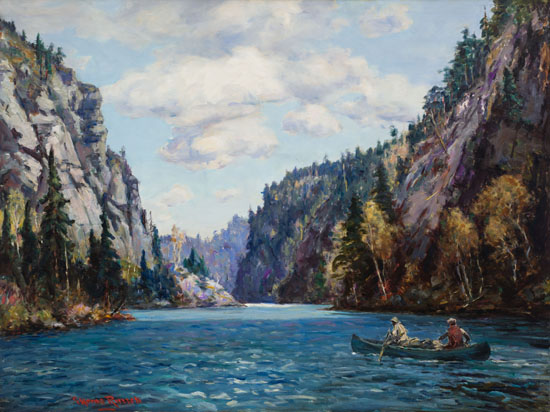
His other mediums included watercolor, pen & ink, charcoal, pencil and mixed mediums. His other subjects included landscapes, seascapes, harbors, snowscapes, farm animals, still life and genre*. His styles were Realism* and Impressionism*. AskART have some good illustrations of his work. (3)
Russell studied at the Aberdeen School of Art, Scotland; and the South Kensington School of Art*, London, England [now the Royal College of Art] under Alphonse Legros [see AskART]. (4)
His travels include the Rocky Mountains and the Skeena River district of British Columbia (c.1900 to 1909) on commissions from the above mentioned railway companies. He also frequently visited Grand Manan Island, New Brunswick; Lunenburg, Nova Scotia; and Eastport and Monhegan, Maine. (5)
He became a member of the Royal Canadian Academy of Arts* [RCA] in 1909 (Academician - 1918) and served as its President from 1922 to 1926. He was also a member of the Pen and Pencil Club of Montreal (1912). (6)
He exhibited with the RCA almost every year from 1893 to 1933. He also exhibited with the Art Association of Montreal [now the Montreal Museum of Fine Arts] from 1895 to 1933 and with the Ontario Society of Artists* in 1910 and 1918. (7)
His works were exhibited at the Brussels International Exposition in 1897; the Canadian National Exhibition, Toronto in 1918, 1919 and 1923; the Central Canada Exhibition, Ottawa in 1926; the "British Empire Exhibition", Buenos Aires, Argentina in 1931; and in "Scottish Painting in Canada", at the Art Gallery of Nova Scotia, Halifax in 1978. (8)
A portrait Russell did of fellow RCA council member Edmond Dyonnet [see AskART] is one of Russell's most famous works. Since 1974 it has been in the collection of the National Gallery of Canada. Its exhibition provenance includes the RCA in 1922 and 1923; the Canadian National Exhibition, Toronto in 1923; "Portraits", at the Art Gallery of Toronto [now the Art Gallery of Ontario] in 1927; "Exhibition of Paintings, Drawings, Engravings and Sculpture by Artists Resident in Great Britain and the Dominions", Imperial Institute, London, England in 1928; and "The Group of Seven - Art for a Nation", at the National Gallery of Canada in 1995. It's also illustrated in the books The Fine Arts in Canada (1925), by Newton MacTavish [opposite page 22]; and The Group of Seven: Art for a Nation (1995), by Charles C. Hill [page 131]; as well as on Edmond Dyonnet's biography page in AskART. (9)
Russell's works are actively traded on the Canadian auction market, they are in many private collections, and they are in several major public collections.
According to the Canadian Heritage Information Network* and individual museum websites, there are George Horne Russell works in the permanent collections of the Agnes Etherington Art Centre (Kingston, Ontario), Art Gallery of Greater Victoria (B.C.), Art Gallery of Hamilton (Ontario), Art Gallery of Nova Scotia (Halifax), Art Gallery of Ontario (Toronto), Beaverbrook Art Gallery (Fredericton, New Brunswick), Canadian War Museum (Ottawa), Glenbow Museum (Calgary, Alberta), Leonard & Bina Ellen Art Gallery (Concordia University, Montreal), McCord Museum of Canadian History (Montreal), Montreal Museum of Fine Arts (Quebec), Quebec Museum of Fine Arts (Quebec City), Ross Memorial Museum (St. Andrews, New Brunswick), The Market Gallery (Toronto), Whyte Museum of the Canadian Rockies (Banff, Alberta), Winnipeg Art Gallery (Manitoba) and the National Gallery of Canada (Ottawa).
Footnotes:
(1.1) Sources: The Fine Arts in Canada (1925), by Newton MacTavish; The National Gallery of Canada: Catalogue of Paintings and Sculpture, Volume III (1960), by R.H. Hubbard; and Art Gallery of Ontario - The Canadian Collection (1970), by Helen Pepall Bradfield (see AskART book references).
(1.2) A few sources, including A Dictionary of Canadian Artists" (1974), by Colin S. MacDonald; and The Collector's Dictionary of Canadian Artists at Auction (2001), by Anthony R. Westbridge and Diana L. Bodnar (see AskART book references) say Russell arrived in Canada in 1889.
(2) Source: The Mountains and the Sky (1974), by Lorne E. Render (see AskART book references).
(3) Sources: Ibid; AskART Images; and museum illustrations and descriptions of mediums in the Canadian Heritage Information Network* data base.
(4.1) Sources: The Fine Arts in Canada (1925), by Newton MacTavish; The National Gallery of Canada: Catalogue of Paintings and Sculpture, Volume III (1960), by R.H. Hubbard; and Art Gallery of Ontario - The Canadian Collection (1970), by Helen Pepall Bradfield (see AskART book references).
(4.2) Andrew Burnett (?) and Sir George Reid [see AskART] are also listed as Russell's teachers; some sources note one or both at the South Kensington School of Art*. Unfortunately, no biographical information could be found on Burnett to confirm where he would have taught Russell. Reid on the other hand was a very prominent Scottish artist. He was President of the Royal Scottish Academy and he was born in Aberdeen and lived there until 1892. However none of his biographies mention a teaching career, either privately or in one of the schools attended by Russell. Additional sources: Scottish Painting, 1620 - 1908 (reprinted 1975), by James L. Caw; Kingsmead Reprints, Bath (503 pgs, B&W); and The Dictionary of British Artists, 1880 - 1940 (1976), compiled by J. Johnson and A. Greutzner; Antique Collectors Club (567 pgs).
(5.1) Sources: "The Mountains and the Sky" (1974), by Lorne E. Render; A Dictionary of Canadian Artists (1974), by Colin S. MacDonald (see AskART book references); the dates on paintings; and a biographical sketch by William R. Watson (Watson Galleries, Montreal) posted by Galerie Walter Klinkhoff, Montreal - http://www.klinkhoff.com/canadian-artist/G-Horne-Russell.
5.2) Monhegan Island, Maine has been an art colony since the mid 19th century. Its residents have included Robert Henri, George Bellows, Rockwell Kent, Reuben Tam, Elena Jahn and Jamie Wyeth [see all in AskART]. Source: Monhegan Artists' Residency - http://www.monheganartistsresidency.org/index.html.
(6.1) Source: Art Gallery of Ontario - The Canadian Collection (1970), by Helen Pepall Bradfield; and Passionate Spirits: A History of the Royal Canadian Academy of Arts, 1880 - 1980 (1980), by Rebecca Sisler (see AskART book references).
(6.2) 'The Pen and Pencil Club of Montreal was founded on March 5, 1890 with a mandate to promote arts and letters in Montréal. Its founding members were the artists and writers R. W. Boodle [writer], William Brymner, J. Try Davies [writer], Robert Harris, William Hope and John E. Logan [poet]. The presidency was filled by each member in turn based on an alphabetical rotation. According to the constitution, the positions of president, vice-president and secretary-treasurer were held for one year. Its artist members included, among others, Henri Beau, Maurice Cullen, Edmond Dyonnet, Joseph-Charles Franchère, Clarence Gagnon, Louis-Philippe Hébert, Charles Huot, A. Y. Jackson, Henri Julien, James M. Morrice and A. Suzor-Côté [see all artists in AskART]. The club was disbanded in 1966.' Source: McCord Museum of Canadian History - http://www.mccord-museum.qc.ca/scripts/explore.php?Lang=1&tableid=18&tablename=fond&elementid=42__true.
(6.3) The most controversial and far reaching effect of Russell's presidency of the RCA concerned the 1924 and 1925 British Empire Exhibitions at Wembley, England. Here, Russell failed in a struggle, with the National Gallery of Canada, for control of the selection of paintings for the event. Which lead to a partial boycott by RCA members and consequently an increased presence in the exhibition by Modernists* and Fauvists* like the members of the Group of Seven*. As a result, the art in the Canadian Pavilion stood out from that of most of the other countries, whose submissions tended to be more academic. The difference, for better or worse, was noted in the British and Canadian press and described as the Canadian artistic identity, "…no other factor contributed so swiftly to arousing awareness of modern Canadian art as the debate around the British Empire Exhibitions…" Source: Pages 142 - 151, "The Group of Seven: Art for a Nation" (1995), by Charles C. Hill (see AskART book references).
(7) Sources: Royal Canadian Academy of Arts: Exhibitions and Members, 1880 - 1979 (1981), by Evelyn de R. McMann; Montreal Museum of Fine Arts - Spring Exhibitions 1880 - 1970 (1988), by Evelyn de R. McMann; Art Gallery of Ontario - The Canadian Collection (1970), by Helen Pepall Bradfield (see all previous in AskART book references); and the Centre for Contemporary Canadian Art* (for 1910 OSA date).
(8.1) Sources: The National Gallery of Canada: Catalogue of Paintings and Sculpture, Volume III (1960), by R.H. Hubbard; Art Gallery of Ontario - The Canadian Collection (1970), by Helen Pepall Bradfield; The Group of Seven: Art for a Nation (1995), by Charles C. Hill; and Art and Architecture in Canada (1991), by Loren R. Lerner and Mary F. Williamson (see AskART book references).
(8.2) Note: Most of the exhibitions are taken from the provenance of works in the collections of the National Gallery of Canada and the Art Gallery of Ontario. There are most likely more exhibitions but our sources do not list them.
(9) Source: The Fine Arts in Canada (1925), by Newton MacTavish; and The Group of Seven: Art for a Nation (1995), by Charles C. Hill (see AskART book references).
* For more in-depth information about these terms and others, see AskART.com Glossary http://www.askart.com/AskART/lists/Art_Definition.aspx.
Prepared and contributed to askART by M.D. Silverbrooke.