Page loaded successfully. Showing biography for Gerard Dillon.
Gerard Dillon BIOGRAPHY
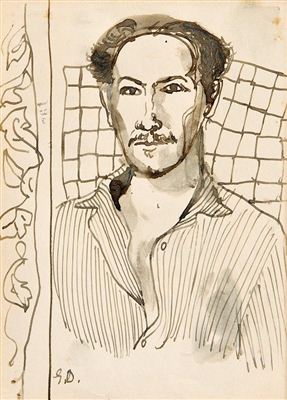
1916 Belfast, Ireland - 1971. Known for: Naive style landscape and figurative painting, sculpture.
Gerard Dillon (1916-1971). A landscape artist and figure painter, the Irish artist Gerard Dillon was born in Belfast the youngest of eight children. He left school at 14 and for seven years worked as... Read full biography
Gerard Dillon (1916-1971). A landscape artist and figure painter, the Irish artist Gerard Dillon was born in Belfast the youngest of eight children. He left school at 14 and for seven years worked as a painter and decorator, mostly in London. From an early age he was interested in art, cinema, and... Read full biography
Gerard Dillon (1916-1971). A landscape artist and figure painter, the Irish artist Gerard Dillon was born in Belfast the youngest of eight children. He left school at 14 and for seven years worked as a painter and decorator, mostly in London. From an early age he was interested in art, cinema, and theatre. As a result, and inspired by the paintings of Marc Chagall and Sean Keating, Dillon gave up decorating about 1936 and started out as an artist, to which end he attended some classes at the... Read full biography
Gerard Dillon (1916-1971). A landscape artist and figure painter, the Irish artist Gerard Dillon was born in Belfast the youngest of eight children. He left school at 14 and for seven years worked as a painter and decorator, mostly in London. From an early age he was interested in art, cinema, and theatre. As a result, and inspired by the paintings of Marc Chagall and Sean Keating, Dillon gave up decorating about 1936 and started out as an artist, to which end he attended some classes at the Belfast College of Art. Dan O'Neill was a painting acquaintance at this time, as were George Campbell and Arthur Armstrong. Dillon was also encouraged by Mainie Jellett who staged his first solo exhibition at The Country Shop, St. Stephen's Green,... Read full biography
Gerard Dillon (1916-1971). A landscape artist and figure painter, the Irish artist Gerard Dillon was born in Belfast the youngest of eight children. He left school at 14 and for seven years worked as a painter and decorator, mostly in London. From an early age he was interested in art, cinema, and theatre. As a result, and inspired by the paintings of Marc Chagall and Sean Keating, Dillon gave up decorating about 1936 and started out as an artist, to which end he attended some classes at the Belfast College of Art. Dan O'Neill was a painting acquaintance at this time, as were George Campbell and Arthur Armstrong. Dillon was also encouraged by Mainie Jellett who staged his first solo exhibition at The Country Shop, St. Stephen's Green, after he moved to Dublin in 1941. In 1943, he exhibited his first painting ("Disused Brickfield") at the Royal... Read full biography
Artist Biography
Biography page for Gerard Dillon ((1916 - 1971)), known for Naive style landscape and figurative painting, sculpture. Showing 5 biographical entries and 0 sample artworks.
Gerard Dillon - Artist Info
About Gerard Dillon
Biography from the Archives of askART
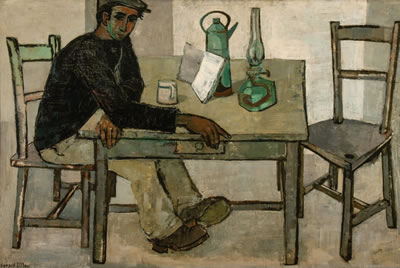 Gerard Dillon (1916-1971)
A landscape artist and figure painter, the Irish artist Gerard Dillon was born in Belfast the youngest of eight children. He left school at 14 and for seven years worked as a painter and decorator, mostly in London. From an early age he was interested in art, cinema, and theatre. As a result, and inspired by the paintings of Marc Chagall and Sean Keating, Dillon gave up decorating about 1936 and started out as an artist, to which end he attended some classes at the Belfast College of Art. Dan O'Neill was a painting acquaintance at this time, as were George Campbell and Arthur Armstrong.
Dillon was also encouraged by Mainie Jellett who staged his first solo exhibition at The Country Shop, St. Stephen's Green, after he moved to Dublin in 1941. In 1943, he exhibited his first painting ("Disused Brickfield") at the Royal Hibernian Academy (RHA), and began showing at the Irish Exhibition of Living Art, becoming a regular contributor. Also during this period, he exhibited his paintings several times with the Water Colour Society of Ireland.
However, in spite of his growing reputation money was scarce. In 1944, he returned to London to see work among the bomb-clearance and demolition gangs.
Luckily, after the war, his reputation rose further with a succession of shows and other activities. In 1946, the Council for the Encouragement of Arts and Music (the forerunner of the Arts Council of Northern Ireland) gave him solo exhibitions in 1946 and 1950. In addition, his paintings were among those shown at the Associated American Artists' galleries in New York. His paintings began to sell and he had more solo shows in Dublin at the Victor Waddington Galleries in 1950 and 1953. In 1953, his oil painting Island People was purchased by the Crawford Gallery in Cork. His artwork appeared in most Oireachtas exhibitions between 1949 and 1970, and he had ten shows at the Dawson Gallery in Dublin between 1957 and 1970.
During the 1950s, Dillon's primitive-type painting style was gaining attention and he had several exhibitions. In 1958 he represented Ireland at the Guggenheim International, and Great Britain at the Pittsburg International Exhibition. He traveled widely in Europe and taught for brief spells at London art schools. In 1967, Gerard Dillon had a stroke which, in addition to the premature deaths of three of his brothers, made him foresee his own demise. As a result his work began to include a wealth of images and paintings intimating his death. Four years later he suffered a second fatal stroke at the age of 55. At his request, his grave, in Belfast's Milltown Cemetery remains unmarked.
His paintings are frequently reactions not just depictions of people or places. They often portray autobiographical images of interior domestic scenes, while his landscape and figure painting was inspired by the countryside around Connemara, his Belfast home and his London flat.
Dillon was a member of the Dublin Painters Group and a senior member of the Irish Exhibition of Living Art for twenty years. He lectured at NCAD and the Hugh Lane Municipal Gallery of Modern Art, Dublin. His paintings are represented in several public collections, including:
Arts Council of Ireland. Crawford Municipal Gallery, Cork. Drogheda Municipal Art Collection. Hugh Lane Municipal Gallery, Dublin. Irish Museum of Modern Art (IMMA), Dublin. Limerick City Gallery of Art. National Gallery of Ireland, Dublin. Ulster Museum, Belfast. Waterford Municipal Art Collection.
Source:
Online Encyclopedia of Irish and World Art
http://www.visual-arts-cork.com/irish-artists/gerard-dillon.htmBiography from the Archives of askART
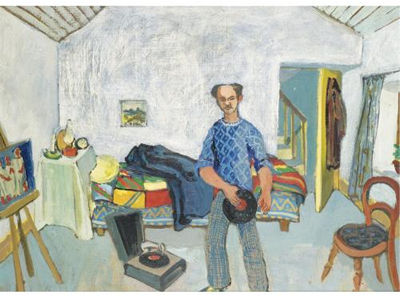 Self-trained as an artist, Belfast Gerard Dillon worked as a house-painter and decorator in his early years, though an interest in the arts was apparent even as a teenager. In 1939 he and a friend went on a cycling holiday in the Connemara, an event which his biographer James White has since labeled "the most important development of his life" (Gerard Dillon: An Illustrated Biography, Wolfhound Press, Dublin, 1994).
The imagery of the land, criss-crossed as it was by stone walls and dotted with cottages, and of the people in their brightly coloured home-spun clothes, remained with him for life and reappeared in many of his works.
Dillon's first solo exhibition was held in 1942 in the Country Shop on St Stephen's Green, Dublin, and was opened by the champion of modern art in Ireland, Mainie Jellet. In 1943 Dillon showed his first work at the Royal Hibernian Academy. During the 1940s and '50s he became the rising star of the Irish avant-garde, his works widely exhibited and written about.
His career has commonly been characterized as a succession of different phases, from his early naïve landscapes, to his final dream-scapes, populated by harlequins. Dillon died of a stroke in 1971. A retrospective was held the following year at the Ulster Museum and later at the Hugh Lane Gallery of Art, Dublin.Biography from De Veres Art Auctions
Gerard Dillon (1916-1971)
Influenced by Seán Keating's illustrations in J.W. Synge's Playboy of the Western World, Dillon first visited Connemara before War broke out in 1939 holidaying with a close companion, Ernie Atkins. Unable to return to London due to travel restrictions, he remained in Ireland till the end of the War encouraging friends, George and Madge Campbell and later James MacIntyre, Thomas McCreanor and Arthur Armstrong to travel to the West to depict their own vision of the people and the landscape. Living in London, Dillon continued to visit the area throughout the 1950's and 60's. The lives of the people in the West evoked strong feeling for the artist, and he expressed this throughout his life in a style that was both personal and idiosyncratic. Walking - Evening may have been inspired following Dillon's commission in 1957 to create illustrations for Stephen Rynne's Walking The Farm in the summer edition of Ireland of the Welcomes (Vol. 6 No.2). Exhibited at the Dawson Gallery several months later this work was one of several Dillon was working on for two exhibitions in 1957. In a letter to John Hewitt, dated 17th July 1957, Dillon stated "At the moment I'm working hard getting ready two shows one in the Dawson Gallery in October, and the other with CEMA (The Council for the Encouragement for Music and The Arts) in November. I have enough work for both."
From 1955, Dillon's work developed as he began to experiment with other mediums. The busier narrative theme was stripped away and replaced with a two-dimensional representation of space with the focus on a single figure. In a letter dated 10th May 1955 to his friend, James White, the artist explained how his work was changing "…They are all new and I think my work has changed a bit-more spacious-more breathing room. At least that is what I'm trying to do." Influenced by Van Gogh's sun-drenched landscapes, Dillon also liked to capture the essence of rural life. In another work from the exhibition in 1957, My Delight, cottages are depicted with a single girl and an orange moon. Following the exhibition, a critic in The Irish Times remarked, "the new vein of calm, almost placid contemplation of patterns… has crept in his work…" The single male figure may symbolize the artist. In between visits from his friends, Dillon was isolated and alone. Cottages in villages were more expensive to rent so Dillon often found accommodation in remote areas. In 1955, Gerard Dillon penned a letter, "Dear Tourist" for Ireland of the Welcomes. Concluding his letter he remarked, "One could live here forever, but being neither a fisherman nor farmer but only a painter, I'm forced to come back to city life to sell work - and hope to save enough to come back to Connemara. You don't know the wonderful holiday in store for you, over here. Why don't you come over and give your eyes a thrill?"
Karen Reihill is currently researching Gerard Dillon & Friends.Biography from De Veres Art Auctions
In the late 1960's, Dillon introduced complex symbolism into his masked Pierrot images to evoke messages that are ambiguous and are open to interpretation. Anxiety of his mortality following a heart attack in 1967 after the death of his three brothers may have caused the artist's preoccupation with Carl Jung's dream theory to find answers to these traumatic events. The artist commented, "I have been able to use my subconscious and yet control it. It's poetic, and yet more colorful…" (Belfast Newsletter, 21/4/67). In a letter circa 1969 to Patrick Kelly, Dillon stated, "As you can imagine I'm well, or well enough. And I'm happy - contented - and still don't want to die yet. Tho' the other night-the anniversary of Joe's death I lay all night thinking it's 7 years ago …poor Joe!" Executing several works in memory of his brother, Joe's Bog and The Time Passes, this dream may have offered a solution to Dillon's anxiety in his waking life. Seven years older than Gerard, Joe Dillon was an aspiring tenor singer who also shared his brother's interest in music, drama and the visual arts. Unable to succeed in the musical world, Joe Dillon was forced to seek out alternative work to supplement his income. In the early 1960's, on a cold and wet November night, Joe Dillon went out in search for his missing dog, 'Heine'. Living alone, the Dachshund offered him physical, emotional and social canine companionship. Becoming ill, Joe was admitted to Victoria Hospital in Belfast where he died of a heart attack on the 1st December 1962 with his nephew, Gerard Dillon junior by his bedside.
Dillon often divided his compositions into sections to convey a message. He adapted this technique over time initially seen years earlier from the figurative stone carvings on Muirdeach High Cross, Monasterboice.Biography from Ross's (John Ross & Co)
Gerard Dillon was a landscape and figure painter born in Belfast. He was educated at Raglan Street Public Elementary School and the Christian Brothers School, but then left at the age of fourteen and became a house painter. After several years at this profession he went to the Belfast College of Art for only a few months. His independence took over and in 1934 he moved to London. Here his job varied whether it was a painter or a decorator but he tried to use all of his earnings to purchase art materials and visit galleries in order to teach himself.
In 1939, the war years had caused Dillon to return to Ireland and he ended up spending a lot of time in Connemara with George Campbell painting the landscape. Gerard’s first exhibition was at the Country Shop, St Stephen’s Green, Dublin and then in 1943 at the Contemporary Picture Galleries, Dublin, the Royal Hibernian Academy and at the Irish Exhibition of Living Art. He then traveled back to London when his work began to be exhibited worldwide.
James White wrote a book on Dillon and said, ‘it is hard to imagine that any other artist ever got more out of his art than Gerard did. Through it he discovered the full joy of creativity.’ Hanging in the National Gallery of Ireland is a self-portrait of Gerard as well as a landscape of the west of Ireland. When he died, the Arts Councils of Belfast and Dublin set up an exhibition with 104 works which consisted of oil, watercolour, collage, tapestry, mixed media and etching. His painting of the ‘Black Lake’ was also selected by the Irish Post Office for their fourth stamp.