Page loaded successfully. Showing biography for Gino Severini.
Gino Severini BIOGRAPHY

1883 Cortona, Italy - 1966 Paris, France. Known for: Futurist, cubist figure painting and sculpture.
Gino Severini was born in Cortona, Italy on 7 April 1883. In 1899 the Italian painter, graphic artist and sculptor went to Rome in 1899 to attend evening classes at the Villa Medici. After a decisive... Read full biography
Gino Severini was born in Cortona, Italy on 7 April 1883. In 1899 the Italian painter, graphic artist and sculptor went to Rome in 1899 to attend evening classes at the Villa Medici. After a decisive encounter with Giacomo Balla and Umberto Boccioni, he began working as an artist in 1901. Balla... Read full biography
Gino Severini was born in Cortona, Italy on 7 April 1883. In 1899 the Italian painter, graphic artist and sculptor went to Rome in 1899 to attend evening classes at the Villa Medici. After a decisive encounter with Giacomo Balla and Umberto Boccioni, he began working as an artist in 1901. Balla introduced him to the divisionistic colour technique of the Neo-Impressionists*. Gino Severini moved to Paris in 1906 where he studied the Impressionists*, was fascinated with Seurat's paintings and met... Read full biography
Gino Severini was born in Cortona, Italy on 7 April 1883. In 1899 the Italian painter, graphic artist and sculptor went to Rome in 1899 to attend evening classes at the Villa Medici. After a decisive encounter with Giacomo Balla and Umberto Boccioni, he began working as an artist in 1901. Balla introduced him to the divisionistic colour technique of the Neo-Impressionists*. Gino Severini moved to Paris in 1906 where he studied the Impressionists*, was fascinated with Seurat's paintings and met Signac. Beside Modigliani, Picasso, Braque and Gris he further encountered various well-known poets and thinkers of his time. Marinetti and Boccioni invited him to join the Futurist* movement. On 11 February 1910 Severini signed the 'Manifesto of... Read full biography
Gino Severini was born in Cortona, Italy on 7 April 1883. In 1899 the Italian painter, graphic artist and sculptor went to Rome in 1899 to attend evening classes at the Villa Medici. After a decisive encounter with Giacomo Balla and Umberto Boccioni, he began working as an artist in 1901. Balla introduced him to the divisionistic colour technique of the Neo-Impressionists*. Gino Severini moved to Paris in 1906 where he studied the Impressionists*, was fascinated with Seurat's paintings and met Signac. Beside Modigliani, Picasso, Braque and Gris he further encountered various well-known poets and thinkers of his time. Marinetti and Boccioni invited him to join the Futurist* movement. On 11 February 1910 Severini signed the 'Manifesto of Futurist Painting' and thus became a co-founder of this style. In contrast to his artist colleagues, Severini was bare... Read full biography
Artist Biography
Biography page for Gino Severini ((1883 - 1966)), known for Futurist, cubist figure painting and sculpture. Showing 2 biographical entries and 0 sample artworks.
Gino Severini - Artist Info
About Gino Severini
Biography from the Archives of askART
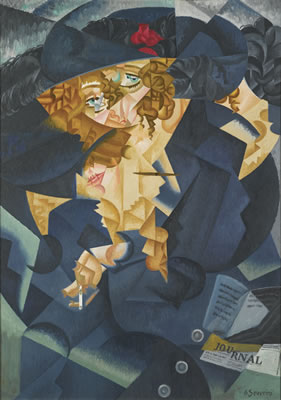 Gino Severini was born in Cortona, Italy on 7 April 1883. In 1899 the Italian painter, graphic artist and sculptor went to Rome in 1899 to attend evening classes at the Villa Medici. After a decisive encounter with Giacomo Balla and Umberto Boccioni, he began working as an artist in 1901. Balla introduced him to the divisionistic colour technique of the Neo-Impressionists*.
Gino Severini moved to Paris in 1906 where he studied the Impressionists*, was fascinated with Seurat's paintings and met Signac. Beside Modigliani, Picasso, Braque and Gris he further encountered various well-known poets and thinkers of his time.
Marinetti and Boccioni invited him to join the Futurist* movement. On 11 February 1910 Severini signed the 'Manifesto of Futurist Painting' and thus became a co-founder of this style.
In contrast to his artist colleagues, Severini was barely interested in the dynamic of machines, but in the depiction of human bodies in motion. His cabaret scenes and depictions of dancers were made during his period. Works such as Blue Dancer (1912) show the typical Futurist principles of faceting and simultaneous effects.
Severini exhibited works in 1912 at the Futurist exhibitions in Paris, London and Berlin and developed relationships between Italy and France. The artist's work became Cubist* after 1915. From now on the artist increasingly focused on the harmony of geometric constructions such as the golden section. His favourite subjects were the still lifes with musical instruments and scenes from the Commedia dell' Arte.
Between 1924 and 1935 Severini was commissioned with numerous murals and mosaics. He led an exciting life between Rome and Paris and published theoretical texts and books on art. Severini was awarded the Grand Prize of the Venice Biennale* in 1950. The divisionist concept of the picture, together with a Cubist-Futurist style, which was adopted by Balla, is typical of Severini's entire oeuvre*.
He analyzed light, movement and events, which happened after one another but are linked by memory.
Gino Severini died in Paris on 26 February 1966. Important works by the artist are today exhibited in Milan (Collection Gianni Mattioli) and Rotterdam (Museum Boymans-van-Beuningen).
Source:
Art Directory, http://www.gino-severini.com/
* For more in-depth information about these terms and others, see AskART.com Glossary http://www.askart.com/AskART/lists/Art_Definition.aspxBiography from Dorotheum, Vienna
Gino Severini, an artist who transitioned from the dynamic themes of Futurism to a more traditional focus on family and nature, marked a new artistic phase before the outbreak of another World War. This shift is evident in his works, where the stillness of the subjects contrasts with the movement principles of Futurism. Severini's exploration of more traditional values reflected a departure from the loudness and technology-centric themes of his earlier Futurist works.