Page loaded successfully. Showing biography for Gladys Nelson Smith.
Gladys Nelson Smith BIOGRAPHY
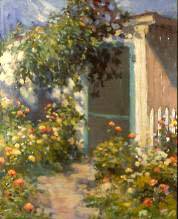
1890 Chelsea, Kansas - 1980 Kensington, Maryland. Known for: Landscape, child portrait and figure and genre p-ainting.
Born near Chelsea, Aug. 15, 1890; died Kensington, MD, Sept. 15, 1980. Painter, specialized in children. landscapes, portraits. Attended high school in El Dorado. In 1912, enrolled at the University... Read full biography
Born near Chelsea, Aug. 15, 1890; died Kensington, MD, Sept. 15, 1980. Painter, specialized in children. landscapes, portraits. Attended high school in El Dorado. In 1912, enrolled at the University of Kansas, Lawrence under W. A. Griffith. She dropped out of University of Kansas, Lawrence for two... Read full biography
Born near Chelsea, Aug. 15, 1890; died Kensington, MD, Sept. 15, 1980. Painter, specialized in children. landscapes, portraits. Attended high school in El Dorado. In 1912, enrolled at the University of Kansas, Lawrence under W. A. Griffith. She dropped out of University of Kansas, Lawrence for two years to teach in Jetmore High School, then returned to University of Kansas, Lawrence and graduated in 1918. After graduation she moved to New York where she attended the Art Students League. Lived... Read full biography
Born near Chelsea, Aug. 15, 1890; died Kensington, MD, Sept. 15, 1980. Painter, specialized in children. landscapes, portraits. Attended high school in El Dorado. In 1912, enrolled at the University of Kansas, Lawrence under W. A. Griffith. She dropped out of University of Kansas, Lawrence for two years to teach in Jetmore High School, then returned to University of Kansas, Lawrence and graduated in 1918. After graduation she moved to New York where she attended the Art Students League. Lived briefly in Minneapolis, MN and Chicago, IL where she studied at the Art Institute of Chicago. Moved to Washington, DC in 1924 where she studied at Corcoran School of Art with Edmund C. Tarbell, Richard S. Merryman and Burtis Baker. 200 She established... Read full biography
Born near Chelsea, Aug. 15, 1890; died Kensington, MD, Sept. 15, 1980. Painter, specialized in children. landscapes, portraits. Attended high school in El Dorado. In 1912, enrolled at the University of Kansas, Lawrence under W. A. Griffith. She dropped out of University of Kansas, Lawrence for two years to teach in Jetmore High School, then returned to University of Kansas, Lawrence and graduated in 1918. After graduation she moved to New York where she attended the Art Students League. Lived briefly in Minneapolis, MN and Chicago, IL where she studied at the Art Institute of Chicago. Moved to Washington, DC in 1924 where she studied at Corcoran School of Art with Edmund C. Tarbell, Richard S. Merryman and Burtis Baker. 200 She established a studio in Washington with a weekend retreat in Frederick County, MD. Moved to Chevy Chase, MD in 1941. SOURCES:. Susan Craig, "Biographical... Read full biography
Artist Biography
Biography page for Gladys Nelson Smith ((1890 - 1980)), known for Landscape, child portrait and figure and genre p-ainting. Showing 4 biographical entries and 0 sample artworks.
Gladys Nelson Smith - Artist Info
About Gladys Nelson Smith
Biography from the Archives of askART
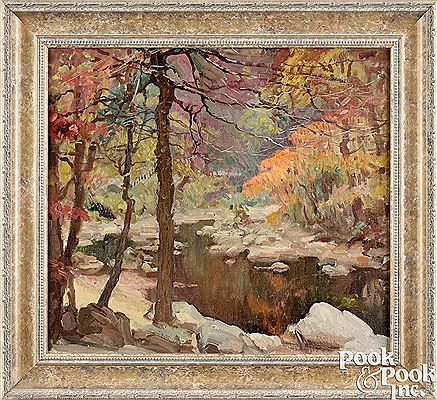 Born near Chelsea, Aug. 15, 1890; died Kensington, MD, Sept. 15, 1980. Painter, specialized in children. landscapes, portraits. Attended high school in El Dorado. In 1912, enrolled at the University of Kansas, Lawrence under W. A. Griffith. She dropped out of University of Kansas, Lawrence for two years to teach in Jetmore High School, then returned to University of Kansas, Lawrence and graduated in 1918. After graduation she moved to New York where she attended the Art Students League. Lived briefly in Minneapolis, MN and Chicago, IL where she studied at the Art Institute of Chicago. Moved to Washington, DC in 1924 where she studied at Corcoran School of Art with Edmund C. Tarbell, Richard S. Merryman and Burtis Baker. 200 She established a studio in Washington with a weekend retreat in Frederick County, MD. Moved to Chevy Chase, MD in 1941.
Biography from Charleston Renaissance Gallery
A painter of landscapes, portraits and genre pictures, Gladys Nelson Smith was raised on a farm near Chelsea, Kansas. One of ten children, she began to draw at an early age. In 1912, she enrolled at the University of Kansas in Lawrence, where she majored in fine arts. The faculty, headed by William A. Griffith, had an Impressionist orientation, and Smith adopted their bright palette and broad brushwork, applying it to her early landscapes and portraits.
Following her graduation in 1918, the artist married Errett Smith, a lawyer and fellow University of Kansas alumnus, and moved with him to Iowa while he trained with the United States Army. After the armistice, she awaited his return from Europe in New York City. There, Smith matriculated at the Art Students League and, at one point during her course of study, attended a lecture given by the New York Realist, John Sloan, whose work seems to have had an influence on her development.
Smith's New York classwork was cut short when she succumbed to the dreaded influenza of 1918. She developed pneumonia and returned to Kansas to recuperate. In 1919, Errett Smith was discharged from the Army, and the young couple moved to Minneapolis. They subsequently lived in Chicago in 1923, where Smith studied briefly at the Art Institute; in 1924, they took up permanent residence in Washington, D.C. From 1924 until 1930, Smith honed her skills at the Corcoran School of Art under the tutelage of various artists, including the Boston Impressionist Edmund C. Tarbell. The Corcoran classes concluded her formal artistic training.
Smith's exhibition activities began in 1921, when she submitted eight paintings to the Kansas Free Fair in Topeka. During the 1920s, she was chiefly admired for her paintings of children. These young subjects are usually posed with their mothers and are shown chasing butterflies, flying kites, picking flowers and falling asleep. Motherhood was a popular subject for a female artist, and Smith's works were well received by the critics. "Her composition is exquisite," wrote one, "while the theme (child life), which she appears to have chosen for her life's work, has a freshness, originality and appeal to the masses, and is interpreted with so much understanding and tenderness, that she certainly will, one day, be a sensation in American art circles" (Simmons, p. 15).
Smith exhibited a figurative work entitled Autumn, "showing the radiance of light through frosty atmosphere" (Simmons, p. 9) at the Corcoran Gallery of Art in 1927. A year later, two other figurative works, Holiday and Morning Sun, were included in the Society of Washington Artists exhibition at what is now called the National Museum of American Art.
Smith continued to receive good reviews throughout the 1920s. In 1930, the Topeka Daily Capital noted: "Her ability as a landscape painter is second only to that of painting children. She loves to portray in her own special way the moods of nature, those subtle qualities in the coming storm, the roaring wind and the beautiful sunset, which most of us feel but cannot express" (Simmons, p. 9).
In December 1930, the Smiths departed on a two-month tour of European museums and galleries, affording the artist a first-hand view of Old Master paintings.
Although Smith spent her early years in the Midwest, she came to artistic maturity in the nation's capital, and her paintings are strongly linked to that city's life and landscape. From 1924 until 1930, while attending classes at the Corcoran, Smith lived in a small apartment in Washington's northwest section and maintained a studio at the school. When the weather permitted, she roamed the city, recording the quaint charms of Georgetown, old Alexandria and scenes along the C & O Canal and the farmer's market. Many of these plein-air sketches were incorporated into finished paintings. In 1933, the Smiths moved to a renovated carriage house in Washington's "Latin Quarter." The new house was large enough to accommodate a studio, and Smith soon embarked upon her best and most productive period.
Smith had begun her art training at a time when the academic tradition was severely threatened, not only by the Ashcan school, but more significantly, by the Abstractionists after the revolutionary Armory Show of 1913. For Smith, steeped in the traditions of the previous generation, it was natural to continue painting ordinary people, her relatives and friends.
She had become convinced that portraits were her forte and "gained a reputation for [genre] portraits of children, which, although difficult, she found the most enjoyable to create. 'A child is such [that] I can put the best of myself in the painting,'" she once told a dealer (Simmons, p. 10). A work entitled Boy (Boy With a Drum) won the popular prize at the forty-eighth Anniversary Exhibition of the Society of Washington Artists in 1939. Lila Mechlin, art critic for the Washington Star, singled the picture out for praise. "It has dignity, grace and finish, but it is vital and atmospheric at the same time" (Simmons, p. 11).
An eighty-six acre, Frederick County, Maryland farm purchased as a weekend retreat in 1939 became a source for many of Smith's mid-century paintings. The Frederick landscapes, executed in a palette of mossy greens, gray violets and salmon pinks, faithfully capture the spirit of the land. They are not, however, spontaneous. According to the artist's sister, Smith sketched the landscapes in the country, but completed them in her Washington studio: "She would paint briefly, perhaps for weeks, on one canvas, put it in a frame and hang it on the wall, then study it from all angles in order to decide what more needed doing. The practice-since she might launch a new painting next morning-explains why so many of her canvases are unsigned. The signature was seldom added unless a painting was going to exhibition or was sold" (Nelson, p. 28). The practice also explains why Smith's works are rarely, if ever, dated.
In 1941, the Smiths left their downtown address and moved to the suburbs. Though Smith's studio was downsized as a result, the house in Chevy Chase, Maryland offered more space for living and a neighborhood replete with beautiful trees. Smith's new life involved more social commitments, but she still found time to paint: back yards, front yards, neighbor's houses, trees in every season. An avid gardener, Smith had a particular interest in flowers and became known in the 1940s for her floral still lifes, often created in her own garden.
During this time, Smith exhibited to increasingly mixed reviews. "She attributed her lack of recognition to the growing influence of Modernists," who she felt were crowding the more traditional artists out of the market (Simmons, p. 13). In 1953, convinced that her work had "no chance til this madness [modern art] is over" (Nelson, p. 29), Smith set her brushes aside and turned her attention to writing, an interest she had nurtured since her teens. She completed a number of short stories and poems, none of which were ever published.
Apparently reinspired, Smith built a large studio with a skylight onto the north side of her Chevy Chase home and resumed painting in 1966. A series of accidents and illnesses followed, however, and by the fall of 1971, she was an invalid. The loss of her beloved husband in 1973 left Smith, childless and suffering from glaucoma and Parkinson's disease, alone. She died in 1980 at the age of ninety.
Two one-woman exhibitions at commercial galleries in Washington, D.C. and Frederick, Maryland distinguished Smith's final year. In summarizing Smith's accomplishments, one critic wrote: "Her landscape compositions tend toward an Impressionist palette, and her figure compositions, which comprise the best of her work, toward a more classical use of colors. Some of her still lifes are very bold and larger than life. . . . She is one of the finest American Realists I have seen, of the last fifty years" (Simmons, p. 14).
Nancy Rivard Shaw, 2000© Robert M. Hicklin Jr., Inc.
Sources:
Falk, Peter Hastings. Who Was Who in American Art, 1564-1975. New York City: Sound View Press, 1999.
McMahan, Virgil E. Artists Born Before 1900: A Biographical Directory. Washington, D.C.: 1976.
Simmons, Linda Crocker, with an appreciation by Josephine Nelson. Gladys Nelson Smith. Washington, D.C.: Corcoran Gallery of Art, 1984.Biography from The Johnson Collection
GLADYS NELSON SMITH (1890-1980)
Gladys Nelson Smith emerged from the nation’s heartland to study at three of the country’s leading art academies, eventually earning critical acclaim for her Impressionist canvases with a decidedly feminine sensibility. Her paintings of children, motherhood, and gardens were praised for their exquisite composition, classical use of color, and eloquence: “Her ability as a landscape painter is second only to that of painting children,” one reviewer wrote. “She loves to portray in her own special way the moods of nature, those subtle qualities in the coming storm, the roaring wind and the beautiful sunset, which most of us feel but cannot express.”
Having grown up with nine siblings on a Kansas farm, Gladys Nelson pursued her early passion for art as an undergraduate student in the fine arts program at the University of Kansas at Lawrence. Her college efforts reflect her teachers’ Impressionist bent, a style she followed for the rest of her active career. Soon after her marriage, her husband was drafted into military service, and Smith relocated to New York City to study at the Art Students League while she awaited his return from the European front. A series of moves prompted by Errett Smith’s legal career gave Smith the opportunity to study at the Art Institute of Chicago and, finally, at the Corcoran School of Art in Washington, D.C. where her instructors included Edmund Tarbell and Richard Meryman. Settling permanently in the Washington area, Smith took classes at the Corcoran through 1930.
Smith’s earliest exhibition opportunities came in her native state, beginning in 1921 when her paintings won prizes at the Kansas Free Fair and were noted for their “masterful sweep of color.” Her subject matter throughout the next two decades focused largely on children and mothers, much like better-known Impressionists such as Mary Cassatt. Her participation in area exhibitions, including the Corcoran’s 1937 Biennial Exhibition of Contemporary American Oil Paintings, grew, as did the number of commissions for portraits.
In 1936, the Smiths purchased a farm in the Maryland countryside, a weekend retreat that served as the backdrop for many of Smith’s landscapes and genre scenes. Often working en plein air, Smith would execute weekend sketches which she would then finish at her studio in the city. She developed her paintings sporadically, working on them for a while and then hanging them before taking up her brush to address them again, a habit that explains why very few of her canvases are signed or dated. An enthusiastic gardener, many of Smith’s later still lifes feature flowers from her own garden.
Demand for Smith’s paintings diminished over time, a trend she attributed to the growing popularity of Modernism. Though she continued to paint for her own pleasure, she withdrew from the public art scene in the mid-1950s. In 1980, Smith was given two one-woman shows, where her paintings were lauded as fine examples of American Realism. She passed away later that year at the age of ninety. Reflecting on her career, Smith wrote that “the very great reward in the work is the habit of seeing beauty and pattern in common things.” Her paintings can be found in the collections of her alma mater, the Corcoran Gallery of Art, as well as the Los Angeles County Museum of Art, Butler Institute of Art, Hirshhorn Museum and Sculpture Garden, and Morris Museum of Art.
The Johnson Collection, Spartanburg, South Carolina
www.thejohnsoncollection.orgBiography from Newman Galleries
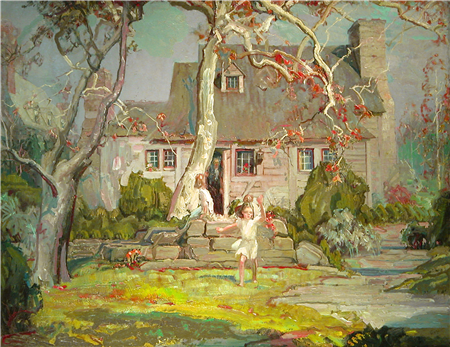 A painter of landscapes, portraits, and genre pictures, Gladys Nelson Smith was raised on a farm near Chelsea, Kansas. She began to draw at an early age, and in 1912 matriculated at the University of Kansas, where she majored in fine art. In 1918 she married a fellow classmate and followed him to various locations. In 1924, the couple settled in Washington, D.C., and Smith refined her skills at the Corcoran School of Art.
Although Smith spent her early life in the Midwest, she came to artistic maturity in the nation's capital, and her paintings are strongly identified with its life and landscape. In the 1920s, she was chiefly admired for her paintings of children. In the 1930s she recorded the quaint charms of Georgetown and other local scenery. In 1936 the Smiths bought an 86-acre farm in Frederick County, Maryland, which became their weekend retreat. It was used in many of Smith's subsequent landscapes.
An avid gardener, Smith had a particular interest in flowers and became known in the 1940s for her floral still lifes, often studied in her own garden.