Page loaded successfully. Showing biography for Harold Bugbee.
Harold Bugbee BIOGRAPHY
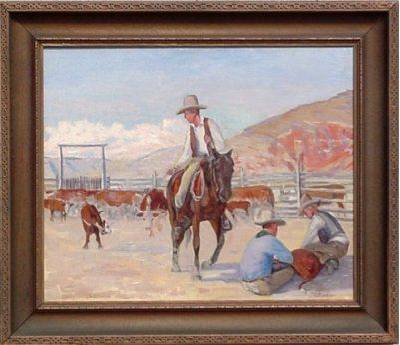
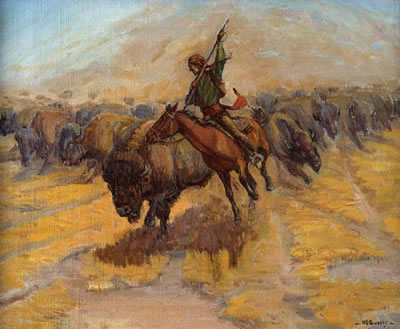
1900 Lexington, Massachusetts - 1963 Clarendon, Texas. Known for: Ranch-life genre, illustrator, murals.
Harold Dow Bugbee is best known for his portrayals of ranch life, a subject . reflected in his paintings as well as his book and magazine illustrations. Bugbee was born in Lexington, Massachusetts.... Read full biography
Harold Dow Bugbee is best known for his portrayals of ranch life, a subject . reflected in his paintings as well as his book and magazine illustrations. Bugbee was born in Lexington, Massachusetts. In 1912, he went West to live on a. ranch near Clarendon, Texas. He attended public school in... Read full biography
Harold Dow Bugbee is best known for his portrayals of ranch life, a subject . reflected in his paintings as well as his book and magazine illustrations. Bugbee was born in Lexington, Massachusetts. In 1912, he went West to live on a. ranch near Clarendon, Texas. He attended public school in Clarendon and attended in 1917 attended Clarendon College. The following year he attended Texas A&M College and then graduated from the Charles Cumming School of Art, Des Moines, Iowa, in 1921.Following... Read full biography
Harold Dow Bugbee is best known for his portrayals of ranch life, a subject . reflected in his paintings as well as his book and magazine illustrations. Bugbee was born in Lexington, Massachusetts. In 1912, he went West to live on a. ranch near Clarendon, Texas. He attended public school in Clarendon and attended in 1917 attended Clarendon College. The following year he attended Texas A&M College and then graduated from the Charles Cumming School of Art, Des Moines, Iowa, in 1921.Following graduation, Bugbee studied in New York City and then returned to Clarendon in 1922. Bugbee traveled regularly to Taos, New Mexico to paint with members of the Taos art colony. Drawing from his experiences living on a ranch, he did illustrations for books... Read full biography
Harold Dow Bugbee is best known for his portrayals of ranch life, a subject . reflected in his paintings as well as his book and magazine illustrations. Bugbee was born in Lexington, Massachusetts. In 1912, he went West to live on a. ranch near Clarendon, Texas. He attended public school in Clarendon and attended in 1917 attended Clarendon College. The following year he attended Texas A&M College and then graduated from the Charles Cumming School of Art, Des Moines, Iowa, in 1921.Following graduation, Bugbee studied in New York City and then returned to Clarendon in 1922. Bugbee traveled regularly to Taos, New Mexico to paint with members of the Taos art colony. Drawing from his experiences living on a ranch, he did illustrations for books and magazines. He illustrated J. Evetts Haley's "Charles Goodnight, Cowman and Plainsman" (New York: Houghton Mifflin, 1936). Bugbe... Read full biography
Artist Biography
Biography page for Harold Bugbee ((1900 - 1963)), known for Ranch-life genre, illustrator, murals. Showing 2 biographical entries and 0 sample artworks.
Harold Bugbee - Artist Info
About Harold Bugbee
Biography from the Archives of askART
 Harold Dow Bugbee is best known for his portrayals of ranch life, a subject
reflected in his paintings as well as his book and magazine illustrations.
Bugbee was born in Lexington, Massachusetts. In 1912, he went West to live on a
ranch near Clarendon, Texas. He attended public school in Clarendon and attended in 1917 attended Clarendon College. The following year he attended Texas A&M College and then graduated from the Charles Cumming School of Art, Des Moines, Iowa, in 1921.Following graduation, Bugbee studied in New York City and then returned to Clarendon in 1922.
Bugbee traveled regularly to Taos, New Mexico to paint with members of the Taos art colony. Drawing from his experiences living on a ranch, he did illustrations for books and magazines. He illustrated J. Evetts Haley's "Charles Goodnight, Cowman and Plainsman" (New York: Houghton Mifflin, 1936). Bugbee's illustrations were found on the covers of "Country Gentleman", "Quarter Horse Journal", "Progressive Farmer", "The Cattleman", "Field and Stream", and "Panhandle-Plains Historical Review".
In 1951, he became part-time curator of the Panhandle-Plains Historical Museum in
Canyon, Texas. Bugbee died in Clarendon, survived by his second wife, Olive Vandruff.
Bugbee's studio has been recreated and on permanent exhibit at the Panhandle-
Plains Historical Museum.
He was a member of the Amarillo art Association, and exhibitions include the Fort
Worth Frontier Centennial Exposition (1936), Annual Texas Artists Exhibition, Fort
Worth (1937), Nita Stewart Haley Library, Midland, Texas, and the Panhandle-Plains
Historical Museum, Canyon, Texas.
Source:
John and Deborah Powers, "Texas Painter, Sculptors, and Graphic Artists"Biography from Panhandle-Plains Historical Museum
At the suggestion of his cousin, cattleman T. S. Bugbee, Harold Dow Bugbee came to the Texas panhandle from Lexington, Massachusetts, in 1914 with his parents Charles H. and Grace Dow Bugbee. He attended high school at Clarendon and, showing an interest in sketching, took his first art training in a course on architectural drawing at Texas A & M College in 1917.
Bugbee showed great promise as an artist and in 1919 traveled to Taos, New Mexico, to seek the advice of W. Herbert Dunton one of the founding members of the Taos Society of Artists and an artist whom he admired greatly. Although Dunton did not accept students he and Bugbee remained friends until Dunton's death in 1936. Following the advice of Bert G. Phillips, another Taos founder, Bugbee enrolled at the Cumming School of Art in Des Moines, Iowa, in 1920.
After graduating in two years from the four-year school, Bugbee returned to Texas and resumed his artwork. Under the watchful eyes of cattlemen Frank Collinson and Charles Goodnight, Bugbee rendered the landscape and wildlife of the Texas panhandle, as well as nostalgic paintings of Indians and cowboys.
Each fall, until the late 1930s, the artist traveled to Taos to paint with his fellow artists "Buck" Dunton, Frank Hoffman, Leon Gaspard, and Ralph Meyers, often packing into the mountains to paint with either Meyers or Dunton. Bugbee learned much from this annual contact with some of the greatest artists of the Western genre, and these artistic exchanges were reflected in the high quality of his work at that time.
By the mid-1920s Bugbee had galleries in Denver, Chicago, Kansas City, and New York. With the Depression and decreasing picture sales, in 1933 Bugbee turned to magazine illustration, a practice he maintained for some eighteen years. He did pen-and-ink illustrations for Ranch Romances, Western Stories, Country Gentleman, and Field and Stream, among others. Additionally, Bugbee was asked to illustrate a number of significant books on Western history including J. Evetts Haley's Charles Goodnight: Cowman and Plainsman, Willie N. Lewis's Between Sun and Sod, and S. Omar Barker's Songs of the Saddleman and others. He also continued to make easel paintings.
Bugbee exhibited at the Tri-State Fair at Amarillo, Fort Worth Frontier Centennial Exposition in 1936, the Greater Texas and Pan-American Exposition at Dallas in 1937, and in the annual West Texas art exhibitions at Fort Worth. He also had numerous solo exhibitions in Texas and exhibited at Taos.
In 1951 the Panhandle-Plains Historical Society asked Bugbee to serve as Curator of Art at the Museum. Bugbee agreed to work part-time in that position in order to devote his time to painting as well. However, in order to justify his salary in his own mind, Bugbee created paintings for the Society's collection. He also continued illustrating the front cover of the Panhandle- Plains Historical Review, a practice he maintained from 1930 through 1962.
Over two-hundred fifty Bugbee works are part of the Museum's art collection including five murals, which grace the museum's Pioneer Hall, and a reconstruction of his studio.
Bugbee's work can also be found in the Smithsonian's American Art Museum; the Amon Carter Museum; Cattleman's Museum, Fort Worth; American Quarter Horse Heritage Center and Museum, Amarillo; the National Cowboy Hall of Fame, Oklahoma City; J. Evetts Haley History Center, Midland, Texas.