Page loaded successfully. Showing biography for Hattie Klapp Brunner.
Hattie Klapp Brunner BIOGRAPHY
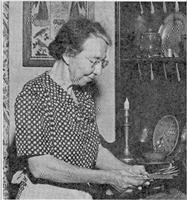
1889 Reinholds, Pennsylvania - 1982 Pennsylvania. Known for: Primitive-style paintings of Pennsylvania Dutch country life.
Hattie Klapp Brunner (Nov 27, 1889-Aug 2, 1982) - Renowned as the "Grandma Painter of Pennsylvania" or the "Pennsylvania-German Grandma Moses" . Hattie Brunner was born in Reinholds, East Cocalico... Read full biography
Hattie Klapp Brunner (Nov 27, 1889-Aug 2, 1982) - Renowned as the "Grandma Painter of Pennsylvania" or the "Pennsylvania-German Grandma Moses" . Hattie Brunner was born in Reinholds, East Cocalico Township, Lancaster County, Pennsylvania, the daughter of Abiram/Biram (b. ca 1846) and Mary Weinhold... Read full biography
Hattie Klapp Brunner (Nov 27, 1889-Aug 2, 1982) - Renowned as the "Grandma Painter of Pennsylvania" or the "Pennsylvania-German Grandma Moses" . Hattie Brunner was born in Reinholds, East Cocalico Township, Lancaster County, Pennsylvania, the daughter of Abiram/Biram (b. ca 1846) and Mary Weinhold (b. June 1853) Klapp; Hattie Brunner became nationally known and respected as a self-taught painter. A farmer's daughter and one of eight children, Hattie started working at age seven to support... Read full biography
Hattie Klapp Brunner (Nov 27, 1889-Aug 2, 1982) - Renowned as the "Grandma Painter of Pennsylvania" or the "Pennsylvania-German Grandma Moses" . Hattie Brunner was born in Reinholds, East Cocalico Township, Lancaster County, Pennsylvania, the daughter of Abiram/Biram (b. ca 1846) and Mary Weinhold (b. June 1853) Klapp; Hattie Brunner became nationally known and respected as a self-taught painter. A farmer's daughter and one of eight children, Hattie started working at age seven to support herself after her father died, taking a job caring for an old woman and then was hired on a farm in return for room, board and $1.00 a month. In 1900, Hattie W. Klapp, at ten years old, was a house servant in West Cocalico Township for Henry and Mary J.... Read full biography
Hattie Klapp Brunner (Nov 27, 1889-Aug 2, 1982) - Renowned as the "Grandma Painter of Pennsylvania" or the "Pennsylvania-German Grandma Moses" . Hattie Brunner was born in Reinholds, East Cocalico Township, Lancaster County, Pennsylvania, the daughter of Abiram/Biram (b. ca 1846) and Mary Weinhold (b. June 1853) Klapp; Hattie Brunner became nationally known and respected as a self-taught painter. A farmer's daughter and one of eight children, Hattie started working at age seven to support herself after her father died, taking a job caring for an old woman and then was hired on a farm in return for room, board and $1.00 a month. In 1900, Hattie W. Klapp, at ten years old, was a house servant in West Cocalico Township for Henry and Mary J. Foltz. Henry was a Cigar manufacturer. By 1910, she was a boarder with 75-year old James Brunner and his family of West... Read full biography
Artist Biography
Biography page for Hattie Klapp Brunner ((1889 - 1982)), known for Primitive-style paintings of Pennsylvania Dutch country life. Showing 1 biographical entries and 0 sample artworks.
Hattie Klapp Brunner - Artist Info
About Hattie Klapp Brunner
Biography from the Archives of askART
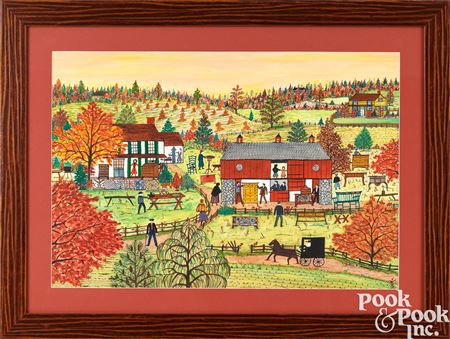 Hattie Klapp Brunner (Nov 27, 1889-Aug 2, 1982) - Renowned as the "Grandma Painter of Pennsylvania" or the "Pennsylvania-German Grandma Moses"
Hattie Brunner was born in Reinholds, East Cocalico Township, Lancaster County, Pennsylvania, the daughter of Abiram/Biram (b. ca 1846) and Mary Weinhold (b. June 1853) Klapp; Hattie Brunner became nationally known and respected as a self-taught painter.
A farmer's daughter and one of eight children, Hattie started working at age seven to support herself after her father died, taking a job caring for an old woman and then was hired on a farm in return for room, board and $1.00 a month. In 1900, Hattie W. Klapp, at ten years old, was a house servant in West Cocalico Township for Henry and Mary J. Foltz. Henry was a Cigar manufacturer.
By 1910, she was a boarder with 75-year old James Brunner and his family of West Cocalico Township. There she worked in the General Merchandise store of the Brunner family. Later she found a job as a waitress in an Asbury Park, New Jersey hotel, where at the age of 18, she started buying antiques. She later worked in a shirt factory to put herself through the Philadelphia Academy of Music. While at the Academy she became friends with the daughter of Richard Wagner, the famous German composer.
When she returned to Reinholds, PA, Hattie Brunner taught piano and became the organist at the Swamp United Church of Christ (1912-1918), of which she was still a member at the time of her death.
Hattie Brunner did not take up painting until she was 67. Her style was primitive or "ingenuous." Previous to that period in her life she acquired and eventually sold antiques. Part of her dealings included selling numerous decorated Pennsylvania German pieces to Henry Francis du Pont, as he went about acquiring the valuable ceramics, corner cupboards and dressers that are now part of the collection of the prestigious Winterthur Museum, his estate in Delaware. One of those pieces, a secretary, was found floating in a river in Reading, PA, by a fisherman.
At the age of 29, Hattie married one of her former playmates, Raymond S. Brunner, who died in 1952. They operated a general merchandise store in Reinholds, PA, from 1930 to 1939.
It was through her antique dealing that Mrs. Brunner accidentally became a noted artist. Her first piece was a snow scene she painted to surprise her grandson who was fond of drawing sketches with crayons. He did one in crayon, handed it to her and said "Grandma, you paint this one." She finished it, framed it, and hung it next to her grandson's seat at the dinner table. The next day a New York artist came to buy antiques, saw the painting and wanted to buy it. An active antiques dealer even after she began painting, Hattie found that she had to paint at night after the shop closed or in the early morning hours before it opened. Hattie worked out of her ironing/sewing/painting room where she rendered her watercolors which brought top bids at auctions. She once said her works were "results of having lived a while." Her paintings reflected the life of happy optimism she lived. Serenity and happiness were the main characteristics of her work.
Hattie Brunner's primitive-style paintings, vividly splashed with reds, yellows and greens, are warm scenes of auction sales, ice skating, horse-drawn sleighs racing through the snowblanketed country-side, apple butter making, smoking chimneys, and the blacksmith at work. At times her paintings were in such demand that she couldn't keep up with orders.
Her first exhibit was in 1972 in Reading, PA. A year later, her work was shown at the Community Gallery at Franklin and Marshall College, Lancaster, PA. Though her first paintings sold for $10 in 1957, by 1975 a single Hattie Brunner watercolor brought $1, 125 of the $7,000 raised at a benefit auction for the Fulton Opera House, Lancaster, PA. Though she was often compared to Grandma Moses, she disliked the comparison and said her style was "entirely different." Hattie Brunner painted more than 600 watercolors until her eyesight failed.
Speaking with a rich Pennsylvania Dutch accent, Hattie Brunner once said "papier est gedulich - paper is patient - you can put anything on it." She was surprised at her success. On her 83 birthday she said, "I just live one day at a time. I don't backtrack. I always say, the things you can't change you just have to live with. Old people live too much in the past. Some old people still think the astronauts aren't up there. I like to think I'm 83 years young, as opposed to someone who's 40 years old."
In 2005, a Hattie Brunner winter farm scene sold for $3,450.
At the time of her death, Hattie Brunner was survived by a grandson, a sister, and nieces and nephews.
Schaefferstown, Pennsylvania artist Barbara Strawser is a great niece of Hattie Brunner.
[Note: Hattie's father's name is variously shown as Abiram or Biram - Census Records
show both. Hattie's brother, however, was named Biram Weinhold Klapp and signed his name that way on his World War II draft registration, indicating that he was a self-employed carpenter, and giving Mrs. Hattie Brunner, Reinholds, PA, as his nearest relative who would always know his address. Therefore it would appear that Biram is correct.]
Compiled and submitted by Gary Hawbaker