Page loaded successfully. Showing biography for Helen Orr LaFrance.
Helen Orr LaFrance BIOGRAPHY
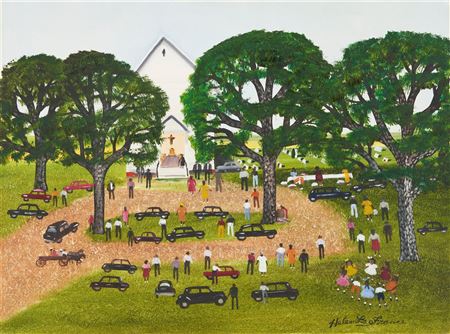
1919 Graves County, Kentucky - 2020 Mayfield, Kentucky. Known for: Folk art memory and rural genre paintings, wood carving.
"Helen LaFrance, Folk Artist of Rural Kentucky, Dies at 101," Online Obituary, The New York Times, by Penelope Green, Dec. 8, 2020. Her vibrant “memory paintings,” which drew comparisons to the work... Read full biography
"Helen LaFrance, Folk Artist of Rural Kentucky, Dies at 101," Online Obituary, The New York Times, by Penelope Green, Dec. 8, 2020. Her vibrant “memory paintings,” which drew comparisons to the work of Grandma Moses and other regional artists, brought her renown late in life. Helen LaFrance, a... Read full biography
"Helen LaFrance, Folk Artist of Rural Kentucky, Dies at 101," Online Obituary, The New York Times, by Penelope Green, Dec. 8, 2020. Her vibrant “memory paintings,” which drew comparisons to the work of Grandma Moses and other regional artists, brought her renown late in life. Helen LaFrance, a self-taught artist whose vibrant and intimate “memory paintings” of scenes from her childhood in rural Kentucky brought her renown late in life, died on Nov. 22 at a nursing home in Mayfield, Ky. She was... Read full biography
"Helen LaFrance, Folk Artist of Rural Kentucky, Dies at 101," Online Obituary, The New York Times, by Penelope Green, Dec. 8, 2020. Her vibrant “memory paintings,” which drew comparisons to the work of Grandma Moses and other regional artists, brought her renown late in life. Helen LaFrance, a self-taught artist whose vibrant and intimate “memory paintings” of scenes from her childhood in rural Kentucky brought her renown late in life, died on Nov. 22 at a nursing home in Mayfield, Ky. She was 101. Her death was announced by Wanda Whittemore-Stubblefield, a longtime friend. In glowing colors and sharp brush strokes, Ms. LaFrance painted church picnics and river baptisms; tobacco barns; backyard gardens with geese and children racing... Read full biography
"Helen LaFrance, Folk Artist of Rural Kentucky, Dies at 101," Online Obituary, The New York Times, by Penelope Green, Dec. 8, 2020. Her vibrant “memory paintings,” which drew comparisons to the work of Grandma Moses and other regional artists, brought her renown late in life. Helen LaFrance, a self-taught artist whose vibrant and intimate “memory paintings” of scenes from her childhood in rural Kentucky brought her renown late in life, died on Nov. 22 at a nursing home in Mayfield, Ky. She was 101. Her death was announced by Wanda Whittemore-Stubblefield, a longtime friend. In glowing colors and sharp brush strokes, Ms. LaFrance painted church picnics and river baptisms; tobacco barns; backyard gardens with geese and children racing through them; kitchens with bushels of apples and jars of preserves shining like stained-glass windows. Her exuberant scene... Read full biography
Artist Biography
Biography page for Helen Orr LaFrance ((1919 - 2020)), known for Folk art memory and rural genre paintings, wood carving. Showing 4 biographical entries and 0 sample artworks.
Helen Orr LaFrance - Artist Info
About Helen Orr LaFrance
Name variants
Helen La France, Helen Orr
Biography from the Archives of askART
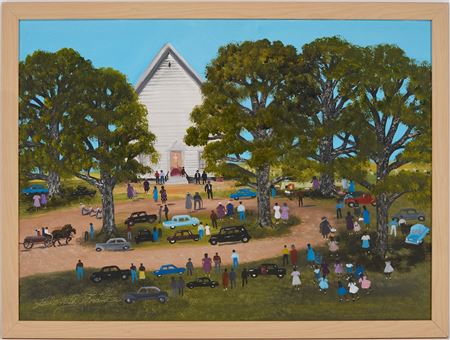 "Helen LaFrance, Folk Artist of Rural Kentucky, Dies at 101," Online Obituary, The New York Times, by Penelope Green, Dec. 8, 2020
Her vibrant “memory paintings,” which drew comparisons to the work of Grandma Moses and other regional artists, brought her renown late in life.
Helen LaFrance, a self-taught artist whose vibrant and intimate “memory paintings” of scenes from her childhood in rural Kentucky brought her renown late in life, died on Nov. 22 at a nursing home in Mayfield, Ky. She was 101.
Her death was announced by Wanda Whittemore-Stubblefield, a longtime friend.
In glowing colors and sharp brush strokes, Ms. LaFrance painted church picnics and river baptisms; tobacco barns; backyard gardens with geese and children racing through them; kitchens with bushels of apples and jars of preserves shining like stained-glass windows. Her exuberant scenes of rural life invited comparisons to Grandma Moses, Horace Pippin and other regional painters who drew from their memories to tell stories about a vanished time and place.
“It’s just a way of reliving it all again,” Ms. LaFrance told a television interviewer in 2010. The next year she told another interviewer, “If I do something somebody likes, well, I’m satisfied because somebody liked what I did, but I don’t think it’s important.”
The author Kathy Moses Shelton, who, with the gallerist Bruce Shelton wrote “Helen LaFrance: Folk Art Memories” (2011), called Ms. LaFrance “an American treasure.”
“She’s a self-taught Black artist who paints her memories of a particular time and place,” Ms. Moses Shelton said in a phone interview. “She grew up under Jim Crow. She was 10 when the Great Depression hit.
“Her art doesn’t reflect the pain of that era,” Ms. Moses Shelton continued. “Instead what comes through is joy, and the values of family and work. Her family owned and farmed their own land when sharecropping was the norm, and they were self-sufficient and lived in dignity. Her blend of personal experience, Black American culture and heritage and her skill all come into play to make her work unlike anybody else’s. She’s an authentic American voice.”
Helen LaFrance Orr was born on Nov. 2, 1919, in Graves County, Ky., the second of four daughters. Her parents, James Franklin Orr and Lillie May (Ligon) Orr, known as Bud and Hon, grew tobacco and corn.
Helen did not attend much school. Her parents instructed her in reading and math, and her mother taught her to paint, guiding her hand and helping her mix colors from dandelions, berries and Bluette laundry detergent. She and her sisters worked in their family’s fields, and Helen drew after her chores were done. She recalled loving the smell of the crayons her mother would bring her.
Ms. LaFrance lived and worked most of her life no more than 10 miles from her birthplace. She worked in a tobacco barn and in a hospital as a cook. She also made custom whiskey decanters for a local ceramics company and worked as a retoucher in a photography studio. She owned property, commercial spaces and land.
She always painted, but she did not do it full time until the 1980s, when she started selling her work to neighbors and at local art shows and country fairs. She also made wood carvings and quilts. She lived in a double-wide mobile home and used an old school bus that was parked on her property as a studio before moving into a house in Mayfield.
Gus Van Sant Sr., a Mayfield native and the father of the filmmaker, discovered her there in the early 1990s; about a decade earlier, his wife, Betty had bought him a Helen LaFrance painting of a tobacco barn, and the couple looked her up when they moved back to Kentucky.
Mr. Van Sant was taken with her work and concerned that she was not getting the value she deserved from sales of her paintings. He and a friend reached out to folk art galleries and institutions around the country on her behalf, and helped her set up a bank account so she would be paid directly. Mr. Shelton also began selling her work and last year made a short documentary film about her life.
In 2011, Ms. LaFrance received Kentucky’s Folk Art Heritage Award. Oprah Winfrey, Bryant Gumbel and the collector Beth Rudin DeWoody have all bought her work, which is in the permanent collections of the Saint Louis Art Museum and the Owensboro Museum of Fine Art in Owensboro, Ky.
Soft-spoken, modest and religious, Ms. LaFrance was not given to long expositions about her life or her motivations. She liked to say, when pressed for details, “Some things should be left alone.”
She was married five times: twice to Elvis Lynn (back to back, as Ms. Whittemore-Stubblefield, said) and once each to Lynn Rhybon, Burt McCampbell and A.D. Whittemore, a preacher. All the marriages ended in divorce. She leaves no immediate survivors.
She was extremely self-sufficient, Ms. Whittemore-Stubblefield said, and not “the soothing homemaker type.” She said that when Ms. LaFrance left her last husband, the preacher, she waited until he had driven to his church on a Sunday, packed up her belongings, and was gone by the time he returned.
She once told an interviewer: “Think twice, say it once. If you think you’re right, know you’re right before you do something. If you don’t know what you’re doing, ask God about it.”
In addition to domestic and rural scenes, Ms. LaFrance made religious paintings of visions inspired by her knowledge of the Bible. That work was both terrifying and ecstatic, and markedly different in technique from her normal output, more Georgia O’Keeffe than Grandma Moses. While she was happy to elaborate on a painting of her local church’s homecoming picnic, describing how families would come once a year from all over the country, or to tell a tale about getting the spins from chewing tobacco, prompted by a scene she had painted of tobacco drying in a barn, she kept quiet about her religious work.
Mr. Shelton once brought a friend, Eugene Collins, a contractor and businessman from Nashville, to visit her. When he saw her school-bus studio, which she had long complained about — it was as hot as an oven, she said — he promised to return and build her a proper one, in exchange for some of the religious paintings. “Just keep painting,” he told her. He made her a spacious, airy building, setting it onto a rise on her land.
Ms. LaFrance worked on more than one canvas at time, a method she developed late in life that allowed her to keep painting instead of waiting for a piece to dry. Mr. Van Sant said she extended her practice further, onto tiny canvases, as a way of using up the paint on her brushes.
“They were really terrific,” he said. “I remember one was a kitchen with ornate wallpaper, maybe four by four inches, and Helen said she was selling it to a person she knew. I asked her what she was going to charge.
“When she would ponder something, she would alway let out this huge sigh. ‘Ooh,’ she said. Big sigh. ‘I was thinking about $20.’ I said, ‘Helen, don’t you let her get out of here without at least $100.’
“Later,” he continued, “I asked her how much she had sold it for, and there was the sigh. ‘Ooh,’ she said. ‘$99. I couldn’t say $100.’”Biography from The Johnson Collection
HELEN LAFRANCE (HELEN ORR) (1919-2020)
Helen LaFrance was a self-taught painter, woodcarver, and quiltmaker who spent most of her life in the small town of Mayfield, Kentucky. In her art?first produced in the restrictive interior of a converted school bus and, later, in a modest studio space?LaFrance transcribed childhood experiences and interpreted verses from the Bible. Her colorful painted images?which she described as “memory paintings”?reflect decades of collected memories spanning river baptisms, church picnics, traveling circuses, and Southern agricultural scenes. “It’s just a way of reliving it all again,” the artist said in a 2010 interview.
LaFrance’s parents, James Franklin Orr and Lillie May Orr, made a living growing various crops and raising livestock. Their status as self-sufficient landowners was relatively uncommon in the post-Reconstruction era, during which many African American farmers labored as sharecroppers and were afforded little agency. Formal schooling was sporadic for LaFrance and her siblings, given their farm responsibilities and the lack of educational opportunities available to black children at that time; her parents opted instead for home instruction, procuring books from town and distributing them to an enthusiastic daughter who required little instructional direction. LaFrance stated that she began painting before learning to write—a skill encouraged by her mother, who would often guide her daughter’s dexterous hand across the page. Following her mother’s oft-imparted wisdom to “paint what you know,” LaFrance sought out wildlife and gardens around the family farm.
Over her lifetime, LaFrance held an array of jobs, including working in a tobacco barn, decorating souvenir whiskey bottles, and providing childcare. It was not until she was in her 40s that she purchased art supplies from the grocery store and, following a day’s work, began painting late into the night. The vicissitudes and revolving fortunes of LaFrance’s long life—multiple marriages that “didn’t take,” an adopted child and eventual grandchildren, donating her time and financial resources to those in need, and owning a gallery and multiple rental properties––left few free hours for creative pursuits. In 1986, she was able to begin painting full-time.
LaFrance––who signed her canvases with that surname, but was known as “Ms. Orr” to friends and neighbors––likened her artistic process to preserving homegrown vegetables through canning: by documenting the rapidly changing culture and landscape of rural Kentucky and layering multiple memories onto a single canvas, she was able to encapsulate fleeting moments that might otherwise go unnoticed. Often compared to paintings executed by Grandma Moses, LaFrance’s works have been described as profoundly universal, each scene portraying an amalgamation of stories and memories unconnected to any specific location or single event. Viewers frequently find glimmers of their own upbringing or hometown in her images. In 2011, nine years before her death at the age of 101 in 2020, LaFrance received Kentucky’s Folk Art Heritage Award; today, her work is held in numerous private collections, as well as the permanent collection of the Saint Louis Art Museum.
The Johnson Collection, Spartanburg, South Carolina
thejohnsoncolletion.orgBiography from Case Auctions
Self-taught African American artist Helen LaFrance was born on a Kentucky farm and began painting in her 40's. She is known for her "memory paintings", drawn from her recollections of life growing up in the rural South.
Several museums and private collectors, including Oprah Winfrey, own examples of her work." (Source: "Helen LaFrance Folk Art Memories" by Kathy Moses).
Helen Lafrance died November 22, 2020, in a Mayfield, Kentucky nursing home at the age of 101.Biography from Case Auctions
Self-taught African American artist Helen LaFrance was born on a Kentucky farm in 1919 and began painting in her 40's. She is known for her "memory paintings", drawn from her recollections of life growing up in the rural South.
Several museums and private collectors, including Oprah Winfrey, own examples of her work. Now nearly 100 years old, she resides in a Kentucky nursing home.