Page loaded successfully. Showing biography for Herman Maril.
Herman Maril BIOGRAPHY
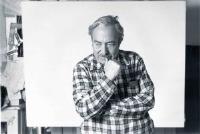
1908 Baltimore, Maryland - 1986. Known for: Mod seascapes, interiors, landscape and still life.
An American Regionalist painter and long-time teacher at the University of Maryland, he did paintings that emphasize clarity, simplicity and are created with broad, flat, color masses in a style... Read full biography
An American Regionalist painter and long-time teacher at the University of Maryland, he did paintings that emphasize clarity, simplicity and are created with broad, flat, color masses in a style related to Cubism. He was discovered in the 1930s in Washington D.C. art circles that included Duncan... Read full biography
An American Regionalist painter and long-time teacher at the University of Maryland, he did paintings that emphasize clarity, simplicity and are created with broad, flat, color masses in a style related to Cubism. He was discovered in the 1930s in Washington D.C. art circles that included Duncan Phillips of the The Phillips Collection. Maril was born in Baltimore, Maryland, and received his early training at the Maryland Institute of Fine Arts. He worked for the WPA artists program during the... Read full biography
An American Regionalist painter and long-time teacher at the University of Maryland, he did paintings that emphasize clarity, simplicity and are created with broad, flat, color masses in a style related to Cubism. He was discovered in the 1930s in Washington D.C. art circles that included Duncan Phillips of the The Phillips Collection. Maril was born in Baltimore, Maryland, and received his early training at the Maryland Institute of Fine Arts. He worked for the WPA artists program during the Depression, and his work is in numerous collections including the Metropolitan and Whitney Museums in New York; the National Museum of American Art, The Phillips Collection, the Corcoran Gallery in Washington D.C.; and in Baltimore, the Baltimore... Read full biography
An American Regionalist painter and long-time teacher at the University of Maryland, he did paintings that emphasize clarity, simplicity and are created with broad, flat, color masses in a style related to Cubism. He was discovered in the 1930s in Washington D.C. art circles that included Duncan Phillips of the The Phillips Collection. Maril was born in Baltimore, Maryland, and received his early training at the Maryland Institute of Fine Arts. He worked for the WPA artists program during the Depression, and his work is in numerous collections including the Metropolitan and Whitney Museums in New York; the National Museum of American Art, The Phillips Collection, the Corcoran Gallery in Washington D.C.; and in Baltimore, the Baltimore Museum of Art and the Walters Art Gallery.... Read full biography
Artist Biography
Biography page for Herman Maril ((1908 - 1986)), known for Mod seascapes, interiors, landscape and still life. Showing 3 biographical entries and 0 sample artworks.
Herman Maril - Artist Info
About Herman Maril
Biography from the Archives of askART
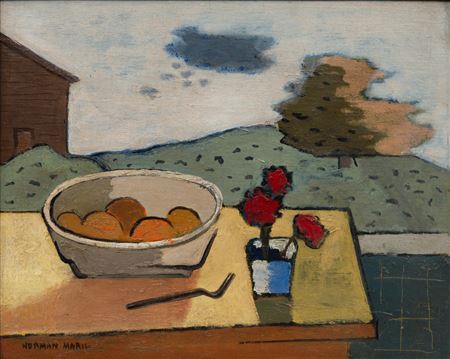 An American Regionalist painter and long-time teacher at the University of Maryland, he did paintings that emphasize clarity, simplicity and are created with broad, flat, color masses in a style related to Cubism. He was discovered in the 1930s in Washington D.C. art circles that included Duncan Phillips of the The Phillips Collection.
Maril was born in Baltimore, Maryland, and received his early training at the Maryland Institute of Fine Arts. He worked for the WPA artists program during the Depression, and his work is in numerous collections including the Metropolitan and Whitney Museums in New York; the National Museum of American Art, The Phillips Collection, the Corcoran Gallery in Washington D.C.; and in Baltimore, the Baltimore Museum of Art and the Walters Art Gallery.Biography from David Findlay Jr. Gallery
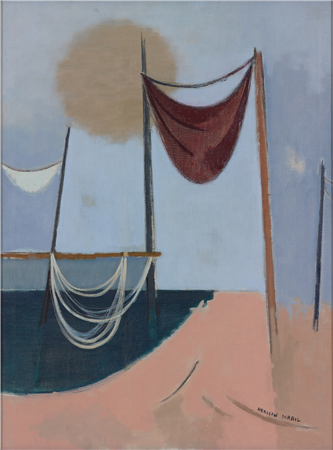 Herman Maril was a Baltimore-born artist who painted seascapes, interiors, and landscapes in a pure, lyrical, and profound style. From his teens, and throughout his life, he pursued his art single-mindedly.
"The sources of my work have been a response to nature and the world around me," Maril once said. "I am interested in the language of paint, and my ideas must be expressed in terms of space concept on the plane of the canvas. I want my paintings to have an organic 'oneness' which should be the result of a constantly growing understanding and feeling for the lyricism possible in the plastic units of the picture struggle."
Maril received early training at the Maryland Institute of Fine Arts, worked during the Depression years on federal projects, and painted as opportunity presented itself during his military service. After the war, he began his career as a teacher-painter at the University of Maryland. He exhibited widely, was represented by Washington, Baltimore, and New York galleries, and received numerous prizes and awards.
Maril's work today is included in over 60 museums, including the Baltimore Museum, Bronk Collection at Adirondack College, Butler Institute of American Art, Cape Museum of Fine Arts, Cleveland Museum, and Corcoran Gallery. Maril pieces can also be found at the Hyde Collection, the Phillips Collection, National Academy of Design, Provincetown Art Association, Smithsonian's National Museum of American Art, San Francisco Museum, Whitney Museum, Walters Art Museum, Wichita Art Museum, Worcester Art Museum, and many other museums throughout the United States and Europe.
"Herman Maril was an American artist of extraordinary stature," say Lou Zona, director of the Butler Institute of American Art. "I underscore the description 'American' because Maril personifies the art of this country at mid-century—highly individualistic, expressive, and rich in social reverence. Maril represents the innovative spirit of an American painter who, while fighting the overwhelming influence of Picasso's cubism and various European expressionistic modes, pounded out an American vision inspired by the uniqueness of this culture…. Our admiration for the talent of Herman Maril could not be greater for in him, we see the very best America has to offer."
Maril's art from the beginning showed a consistent development: it was nature based, abstractly organized, and simplified in form and content. The noted artist and critic Olin Dows, in a 1935 article on Maril in the American Magazine of Art, noted that although showing influences from Picasso and "modern geometric painters," the artist had already embarked on a highly personal style. Dows wrote about the 26-year-old artist: "Herman Maril's painting is reserved, and like most good painting it is simple. He is interested in the essentials. Each picture has its core; each is beautifully conceived and organized…Each is a distinct mood…The subject is 'brought out.' It is clothed in a certain poetry, a certain meaning that is essentially pictorial."
The late Howard Wooden, former director of the Wichita Museum, observed Dows warned of two dangers: the exaggeration of the understatement and the neglect of detail. Wooden added, "The features proved to be among the most distinguishing qualities and the greatest strengths throughout Maril's career. In retrospect, it is evident that the charm and excitement of Maril's work have to no small degree rested on his consistent use of understatement and his intentional elimination of superficial incidentals."
After the war, Herman Maril's very personal style continued to evolve, both restrained and daring, both understated and richly colorful. "In his later years, Maril's paintings became more effortless in appearance, broadly simpler, yet in detail more delicate and more balanced, and with color that is more functional in pattern as well as depth", said Charles Parkhurst, former deputy director of the National Gallery in 1977.
While Cape Cod and Baltimore were where Maril did much of his work, he was also influenced by trips to Mexico, California, the Adirondacks, the Southwest, Italy, Spain, and Portugal. It was, however, on Cape Cod that he received an early major break, getting discovered by the late Duncan Phillips, founder of the Phillips Collection, which currently owns 13 of Maril's works. Through that exposure, leading to exhibitions in New York, Maril was selected as a WPA artist and was commissioned to paint murals in the post offices of Scranton, Pennsylvania and Alta Vista, Virginia. He also had a painting selected by Eleanor Roosevelt to hang in the White House, and was included in exhibitions at the Museum of Modern Art, the Brooklyn Museum, and the Carnegie Institute. In 1967, the Baltimore Museum published a monograph book, entitled Herman Maril, in conjunction with a one man exhibition of his works. The Institute of Arts and Letters honored him in 1978.
"Throughout his entire career, Maril painted space and, always with the unique artist's sense of joy…for his subject and his art," said Sheldon Hurst, curator of the William Bronk collection at Adirondack College. Since 1930, Maril's work has been featured in over 50 one-man shows at galleries and museums around the country. "His rather quiet yet richly lyrical color and his always well composed compositions have great lasting quality," said the late Adelyn Breeskin, former director of the Baltimore Museum.
Art historian David A Scott, former director of the National Collection of Fine Arts and the Corcoran Gallery, says of Maril: "His early experiment with cubist devices gave him the ability to deal with landscape forms selectively and analytically. Building on this, after the war, he developed an increasingly personal style, expressed in direct, vigorous ink drawings and arrestingly simple, evocative oils. What meets the eye in his work is delightful but we realize the apparent simplicity is deceptive. The process of simplifying, a thoughtful and intuitive elimination of detail is important. Starting in his later painting with a motif in nature that moved him, Maril broadened the statement, simplified space and form, reconciled them to the picture plane, eliminated distracting elements and tensions, and achieved a harmony that focuses and enhances pictorial energy. The result, in his most successful work, conveys a deep sense of peace and harmony."Biography from Outer Cape Auctions (CLOSED)
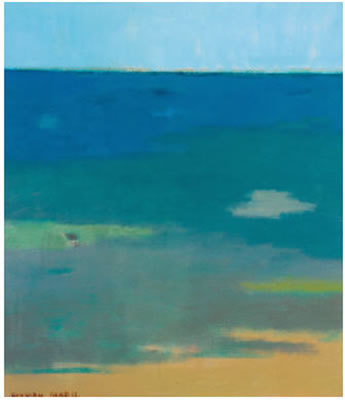 Studied at Baltimore Polytechnic Institute, MD Institute of Fine Arts. Member of Baltimore Artist's Guild, Washington Artist's Guild, Baltimore A. Un., American Artist's Congress, Baltimore Museum of Art (honorary trustee, 1972), PAAM (hon. vice pres, 1972), College AA, Artists Equity Association.
Exhibited at: Corcoran Gallery 1935-61, Pennsylvania Academy of the Fine Arts 1934-35, 39-42, 47-53, 60-62, Virginia Museum of Fine Arts 1940,42,44,46 , MacBeth Gallery, Carnegie Institute Ann, 1943-45, Art Institute of Chicago, Whitney Museum of American Art, Pasadena AI, California Palace of the Legion of Honor, World's Fair New York, Golden Gate Exposition, Baltimore Museum of Art (retrospective, 1967), Silvermine Guild, 1963 (1rst prize), Audubon Artists, 1972 (Stefan Hirshhorn Mem. Award), Forum Gallery, 1970's. Other awards include University of Maryland grant for creative and performing arts, 1966.
Works at: Whitney Museum of American Art, Metropolitan Museum of Art, Baltimore Museum of Art, San Francisco Museum of Art, National Museum of American Art, Peale Museum, Philips Memorial Gallery, Howard University Encyclopedia Britannica Coll.
Commissions include Works Progress Administration murals, United States Post Office, West Scranton, PA., 1939 and United States Post Office, Alta Vista, VA., 1940, Public Buildings Administration, US Treasury Department, White House and Labor Department Building, Washington DC, Jr. HS Baltimore, Cummington School Mass.
Taught at: PAM College Art 1955-56, professor of painting, University of Maryland 1947-70's.