Page loaded successfully. Showing biography for Hermann Nitsch.
Hermann Nitsch BIOGRAPHY
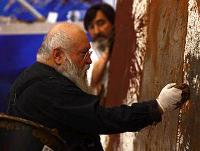
1938 Vienna, Austria - 2022 Mistelbach, Austria. Known for: Actionist, performance art.
BIOGRAPHY . Born 1938, Vienna, Austria. Lives and works in Austria . TIME LINE . 1957 Creates the concept of the Orgies Mysteries Theater, a six-day. event that continues to captivate him throughout... Read full biography
BIOGRAPHY . Born 1938, Vienna, Austria. Lives and works in Austria . TIME LINE . 1957 Creates the concept of the Orgies Mysteries Theater, a six-day. event that continues to captivate him throughout his career. 1960-66 Actions and exhibitions resulting in various court trials and three . prison... Read full biography
BIOGRAPHY . Born 1938, Vienna, Austria. Lives and works in Austria . TIME LINE . 1957 Creates the concept of the Orgies Mysteries Theater, a six-day. event that continues to captivate him throughout his career. 1960-66 Actions and exhibitions resulting in various court trials and three . prison sentences, Vienna, Austria . 1989 Teacher at the Academy of Visual Arts, Frankfurt . SELECTED SOLO EXHIBITIONS . 2010 Hermann Nitsch, Musée d'Art Moderne de Saint-Étienne, France (Forthcoming) . Hermann... Read full biography
BIOGRAPHY . Born 1938, Vienna, Austria. Lives and works in Austria . TIME LINE . 1957 Creates the concept of the Orgies Mysteries Theater, a six-day. event that continues to captivate him throughout his career. 1960-66 Actions and exhibitions resulting in various court trials and three . prison sentences, Vienna, Austria . 1989 Teacher at the Academy of Visual Arts, Frankfurt . SELECTED SOLO EXHIBITIONS . 2010 Hermann Nitsch, Musée d'Art Moderne de Saint-Étienne, France (Forthcoming) . Hermann Nitsch Masterpieces of the Duerckheim Collection, Museumszentrum, Mistlebach, Austria . 2009 The Past, the Present, and the Disciples of Nitsch, Box Art Galleria d'Arte, Verona, Italy . Mike Weiss Gallery.... Read full biography
BIOGRAPHY . Born 1938, Vienna, Austria. Lives and works in Austria . TIME LINE . 1957 Creates the concept of the Orgies Mysteries Theater, a six-day. event that continues to captivate him throughout his career. 1960-66 Actions and exhibitions resulting in various court trials and three . prison sentences, Vienna, Austria . 1989 Teacher at the Academy of Visual Arts, Frankfurt . SELECTED SOLO EXHIBITIONS . 2010 Hermann Nitsch, Musée d'Art Moderne de Saint-Étienne, France (Forthcoming) . Hermann Nitsch Masterpieces of the Duerckheim Collection, Museumszentrum, Mistlebach, Austria . 2009 The Past, the Present, and the Disciples of Nitsch, Box Art Galleria d'Arte, Verona, Italy . Mike Weiss Gallery.... Read full biography
Artist Biography
Biography page for Hermann Nitsch ((1938 - 2022)), known for Actionist, performance art. Showing 2 biographical entries and 0 sample artworks.
Hermann Nitsch - Artist Info
About Hermann Nitsch
Name variants
Hermann Nietzsch
Biography from the Archives of askART
 BIOGRAPHY
Born 1938, Vienna, Austria
Lives and works in Austria
TIME LINE
1957 Creates the concept of the Orgies Mysteries Theater, a six-day
event that continues to captivate him throughout his career.
1960-66 Actions and exhibitions resulting in various court trials and three
prison sentences, Vienna, Austria
1989 Teacher at the Academy of Visual Arts, Frankfurt
SELECTED SOLO EXHIBITIONS
2010 Hermann Nitsch, Musée d'Art Moderne de Saint-Étienne, France (Forthcoming)
Hermann Nitsch Masterpieces of the Duerckheim Collection, Museumszentrum, Mistlebach, Austria
2009 The Past, the Present, and the Disciples of Nitsch, Box Art Galleria d'Arte, Verona, Italy
Hermann Nitsch, Galleria Dant'Agostino Casa d'Aste, Turin, Italy
Dirimart Gallery, Istanbul, Turkey
Works of the 56. Action Painting by Hermann Nitsch, Museumszentrum Mistlebach, Austria
2008 Form as Strategy, Temple Hoyne Buell Center for the Study of American Architecture, Columbia University, New York
Opening, Museo Archivio Laboratorio Hermann Nitsch, Naples, Italy
2007 The Orgies Mysteries Theater, Galleria de' Foscherari, Bologna, Italy (Catalogue)
Galerie beaumontpublic + königbloc, Luxembourg (Catalogue)
Galeria Box Art in Verona, Italy. Curated by Dr. Danilo Eccher. (Catalogue)
Fondazione Morra, Naples, Italy
Selected Works, 1960 - Present, Hermann Nitsch Museum, Museums Zentrum Mistelbach, Mistelbach, Austria (Catalogue)
2006 Hermann Nitsch: New Paintings and Video, Mike Weiss Gallery, NY
Retrospective, Nationalgalerie Staaliche Museen zu Berlin, Germany (Catalogue)
Spac Villa Toppoflorio, Undine, Italy
Hermann Nitsch / Yango Shaobin, Alexanger Ochs - White Space, Beijing; Alexander Ochs, Berlin
2005 The Orgies Mysteries Theater, The Station Museum, Houston, TX (Catalogue)
2004 New Paintings, Mike Weiss Gallery, New York, NY (Catalogue)
2003 Art Scarplin, Merano, Italy
Fondazione Morra, Naples, Italy
Sammlung Essl, Klosterneuburg, Germany
2002 Fondazione Morra, Naples, Italy
Gallery Fortlaan, Ghent, Belgium
2001 Oberes Belevedere, Vienna, Austria
Hürlimannareal, Zürich, Switzerland
Haburger Bahnhof, Berlin, Germany
2000 Palazzo Steline, Milan, Italy
Galleria Communale D'Arte Moderna e Contemoranea, Rome, Itlay
1999 Mumok, Vienna, Austria
Kiscelli Museum, Budapest, Hungary
1998 Galerie Frank Hänel, Frankfurt, Germany
1997 Retrospective, Konsthallen Göteborg, Sweden
Retrospective, Musée D'Art et D'Histoire, Luxembourg
St. Peter an der Sperr, Wiener Neustadt, Austria
Galerie Beaumont, Luxembourg
Neue Galerie der Stadt, Linz, Austria
Underwoodstreet Gallery, London, England
Kunstraum, Innsbruck, Austria
Galerie Prantl, Oberlech, Austria
1996 Galerie Stefania Miscetti, Rome, Italy
Museum Moderner Kunst Stiftung Wörlen, Passau, Germany
Palazzo delle Exposizioni, Retrospective, Rome, Italy
Kunstverein Gmunden, Hipp-Halle, Austria
Retrospective, Sala Parpalló, Valencia, Spain
Malaktion U. Ausstellung, Schömerhaus, Klosterneuburg, Austria
Galerie Giuseppe Morra, Fondazione Morra, Naples, Italy
Retrospective, Casal Solleric, Palma de Mallorca, Spain
1995 Retrospektivausstellung, Künstlerhaus, Vienna, Austria
Galerie Barlach, Halle-K, Hamburg, Germany
Ausstellung und Aktion in der Trinitatiskirche, Köln, Germany
SELECTED PERMANENT COLLECTIONS
MoMA, New York
Guggenheim, New York
Metropolitan Museum of Art, New York
Walker Art Center, Minneapolis
Eileen S. Kaminsky Family Foundation, New York
Hudson Valley Center for Contemporary Art, Peekskill, NY
The Richard Massey Foundation, New York
Yale University; Art Gallery of Ontario, Toronto
Tate Gallery, London
Musée Centre George Pompidou, Paris
Stedelijk Van Abbe Museum, Eindhoven
Castello di Rivoli, Turin
Sammlung Nordrhein-Westfalen, Düsseldorf
Museum Ludwig Köln Lenbachhaus, Munich
Nationalgalerie, Munich
Graphische Sammlung, Munich
Staatsgalerie, Stuttgart
Kunsthalle, Hamburg
Museum Neue Galerie, Saarbrücken
Schloss Moorsbroich, Leverkusen
Museo Capodimonte, Naples
Kunstmuseum, Bern
Kunstmuseum, Winterthur
Museum Moderner Kunst-Stiftung Ludwig, Vienna
Wolfgang Gurlitt Museum, Linz
Rupertinum, Salzburg
Ferdinandeum, Innsbruck
Sammlung Essl, Klosterneuburg
Stedelijk Museum, Amsterdam
Galleria D'Arte Moderna, Bologna
The Marino Golinelli Collection, ItalyBiography from the Archives of askART
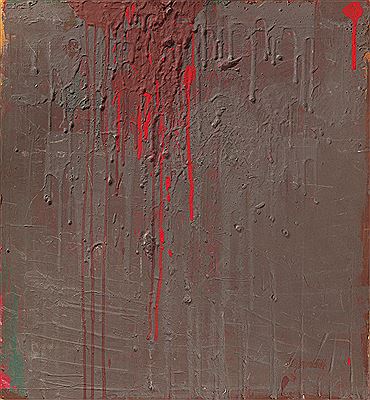 Hermann Nitsch is an Austrian actionist or performance artist who works in experimental and multimedia modes, and has become so controversial that he has been repeatedly charged with criminal acts and even condemned to prison.
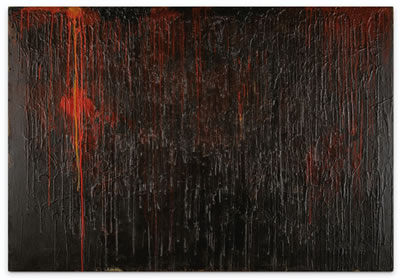
He was born in Vienna, and received training in painting during the time he studied at the Wiener Graphische Lehr-und Versuchanstalt. He is associated with the Vienna Actionists, and like them conceived his art outside traditional categories of genre. Nitsch's abstract splatter paintings, like his performance pieces, established a theme of controlled violence, using bright reds, maroons, and pale greys that communicate organic mutilation. In the 1950s, Nitsch conceived of the Orgien Mysterien Theater (which roughly translates as "Theatre of Orgies and Mysteries"), staging nearly 100 performances between 1962 and 1998.
Nitsch's work, which can be considered both ritualistic and existential, first drew attention in the early 1960s when he exhibited a skinned and mutilated lamb. The lamb was crucified against a white fabric-covered wall, with the entrails removed and displayed below a white table, splashed with blood and hot water. This was accompanied by Nitsch's "Geräuschmusik". Nitsch's subsequent work has incorporated many similar elements, often combining slaughtered animals, red fruits, music, dancing, and active participants. Nitsch juxtaposed slaughtered animal intestines with quasi-religious icons such as staged crucifixions, satirizing and questioning the moral ethics of atavistic religion and sacrifice.
Currently his work is often discussed in the context of our culture's fixation with violence seen on the news, movie screens, and in popular video games. Correlations have also been drawn to many instances of the intersection of violence and culture.3 These performance works, which have become known as "actions" have become more and more elaborate over the years. This highly elaborate work is exemplified by the 6-Day Play, which Nitsch considered to be his pinnacle piece.
In 1998, Nitsch staged his 100th performance (named the 6-Day Play after its length) which took place at his castle in Austria, Schloss Prinzendorf. In 2004, he held an abbreviated (2-day) version of the work.
By 1995 Nitsch had been so sufficiently embraced by the establishment, that the Vienna State Opera invited him to direct and design the sets and costumes for Jules Massenet's opera Hérodiade.
Nitsch continues to publish articles and release CDs.
In 2009 Nitsch was the central guest of the Incubate festival in Tilburg, Netherlands.
Source;
Wikipedia/Hermann Nitsch