Page loaded successfully. Showing biography for Hermann Ottomar Herzog.
Hermann Ottomar Herzog BIOGRAPHY
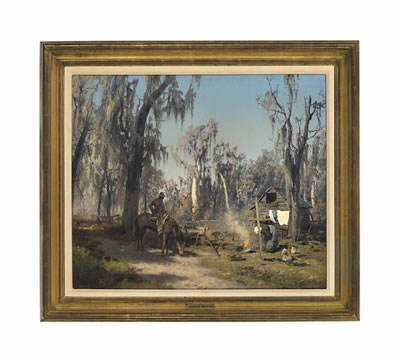
1832 Bremen, Germany - 1932 Philadephia, Pennsylvania. Known for: Landscape, marine, genre and nocturne painting.
A centenarian, Hermann Herzog was known for his landscapes and seascapes as well as many views of Norway. He was prominent during his lifetime, and among his collectors were Queen Victoria and Czar... Read full biography
A centenarian, Hermann Herzog was known for his landscapes and seascapes as well as many views of Norway. He was prominent during his lifetime, and among his collectors were Queen Victoria and Czar Alexander II. He was born in Bremen, Germany, and, intrigued by the potential offered by America, he... Read full biography
A centenarian, Hermann Herzog was known for his landscapes and seascapes as well as many views of Norway. He was prominent during his lifetime, and among his collectors were Queen Victoria and Czar Alexander II. He was born in Bremen, Germany, and, intrigued by the potential offered by America, he emigrated to the United States when he was in his late 20s and settled in Philadelphia. He was fascinated by the variety of the landscape and traveled widely in the East, West, and in the mid 1870's... Read full biography
A centenarian, Hermann Herzog was known for his landscapes and seascapes as well as many views of Norway. He was prominent during his lifetime, and among his collectors were Queen Victoria and Czar Alexander II. He was born in Bremen, Germany, and, intrigued by the potential offered by America, he emigrated to the United States when he was in his late 20s and settled in Philadelphia. He was fascinated by the variety of the landscape and traveled widely in the East, West, and in the mid 1870's to Mexico. He also made many trips to Florida where he visited his son, Herman Jr., a chemist in Gainesville, and painted the exotic landscape with towering palm trees. He was a wise investor of money, and because of the early purchase of shares in... Read full biography
A centenarian, Hermann Herzog was known for his landscapes and seascapes as well as many views of Norway. He was prominent during his lifetime, and among his collectors were Queen Victoria and Czar Alexander II. He was born in Bremen, Germany, and, intrigued by the potential offered by America, he emigrated to the United States when he was in his late 20s and settled in Philadelphia. He was fascinated by the variety of the landscape and traveled widely in the East, West, and in the mid 1870's to Mexico. He also made many trips to Florida where he visited his son, Herman Jr., a chemist in Gainesville, and painted the exotic landscape with towering palm trees. He was a wise investor of money, and because of the early purchase of shares in the Pennsylvania Railroad, did not strive to sell his work during his lifetime. His painting was nearl... Read full biography
Artist Biography
Biography page for Hermann Ottomar Herzog ((1832 - 1932)), known for Landscape, marine, genre and nocturne painting. Showing 10 biographical entries and 0 sample artworks.
Hermann Ottomar Herzog - Artist Info
About Hermann Ottomar Herzog
Biography from the Archives of askART
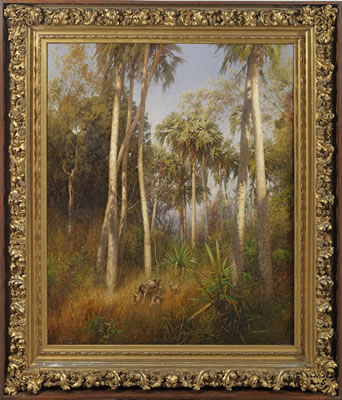 A centenarian, Hermann Herzog was known for his landscapes and seascapes as well as many views of Norway. He was prominent during his lifetime, and among his collectors were Queen Victoria and Czar Alexander II.
He was born in Bremen, Germany, and, intrigued by the potential offered by America, he emigrated to the United States when he was in his late 20s and settled in Philadelphia. He was fascinated by the variety of the landscape and traveled widely in the East, West, and in the mid 1870's to Mexico. He also made many trips to Florida where he visited his son, Herman Jr., a chemist in Gainesville, and painted the exotic landscape with towering palm trees.
He was a wise investor of money, and because of the early purchase of shares in the Pennsylvania Railroad, did not strive to sell his work during his lifetime. His painting was nearly forgotten until 1971 when one of his grandsons began releasing his paintings, and by 1992, a retrospective exhibition of his work was held.
Source:
Michael David Zellman, 300 Years of American ArtBiography from the Archives of askART
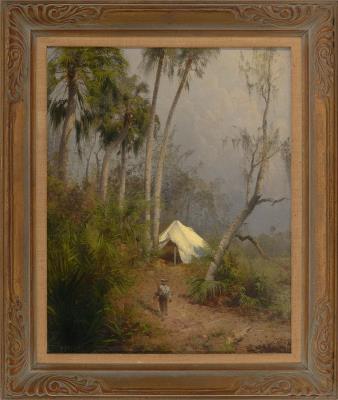 Born in Bremen, Germany on Nov. 16, 1832. Herzog studied at the Düsseldorf Academy in 1849 and established a reputation in Europe with sales to nobility such as Emperor Alexander of Russia and Queen Victoria. Leaving Bremen, he immigrated to Philadelphia in 1869. He began traveling the U.S. extensively and made his first trip to the West in 1873. On this trip he sketched in Yosemite. During the ensuing 32 years, several trips were made to the West including sketching expeditions to Los Angeles and the Coronado Islands. When Herzog died in Philadelphia on Feb. 6, 1932, he had cataloged 1,000 paintings done during his lifetime. Exh: Centennial Expo (Philadelphia), 1876 (medal); NAD, 1882; Ferargil Gallery (NYC), 1931 (with son Lewis). In: Oakland Museum; Bancroft Library (UC Berkeley); Philadelphia Museum; Crocker Museum (Sacramento); MM; Cincinnati Museum; Reading (PA) Museum; NY Public Library.
Biography from Edward and Deborah Pollack Fine Art, LLC
 An Accurate Biography of Hermann Herzog (1832-1932)
Hermann Ottomar Herzog was born in the city of Bremen, Germany, on November 16, 1832. By 1850 he had enrolled in the Düsseldorf Academy, where he received classroom instruction from J.W. Schirmer and Rudolph Wiegmann, and private lessons with Andreas Achenbach, C. F. Lessing, and the Norwegian artist, Hans Gude. Studying and revering nature in the Düsseldorf tradition, Herzog painted throughout Europe; for instance, in Germany, Italy, Switzerland, Holland, and Norway. By the mid 1850s he had established a reputation as a fine artist, with patrons including Queen Victoria and Grand Duke Alexander of Russia. Establishing a studio and home in Grafenberg, Düsseldorf, in the latter 1850s, Herzog continued his success there and became a sought after teacher, with such pupils as Henry Farny in 1868.
On March 3, 1864 Herzog married (Anna Gertrud) Hermine Brandt. The couple subsequently had two sons— Johann (or John) Robert Emil Hermann (later called Herman Jr.), born on January 4, 1865 in Ludenberg, Düsseldorf, and Lewis Edward (Eduard) Lorenz Herzog, born on October 15, 1870, in Ludenberg as well—not in Philadelphia, as reported by many. Shortly after Lewis’s birth, Herzog made the decision to emigrate, and arrived in Philadelphia in 1871—not in the 1860s and not in New Jersey as others have claimed. On August 14 of that year, he declared his intent for naturalization at the Philadelphia Court of Common Pleas.
While based in Philadelphia and before becoming an American citizen, Herzog traveled and painted extensively throughout the Northeast and from the spring of 1873 to 1874, the American West. Art halls, including the National Academy of Design in New York and the Pennsylvania Academy of the Fine Arts, displayed Herzog's paintings, largely on loan by his collectors, and he was well received by the critics of the nineteenth century. At the 1876 Centennial Exhibition in Philadelphia, Herzog won an award for "excellence in landscape painting" regarding Sentinel Rock, Yosemite, California, out-medaling Albert Bierstadt, who also exhibited a Yosemite scene as well as other works of California.
Herzog became a US citizen on September 4, 1876, and after bringing his family from Europe in 1877, he, Hermine, and their sons first lived in a rented Philadelphia row house. In 1879 Herzog purchased their permanent home at 4101 Pine Street in West Philadelphia. After his eldest son, Herman Jr. moved to Gainesville, Florida, in 1893, his father often visited him in the state. He fell so much in love with Florida’s beauty that he returned practically every winter, painting over 300 oils of its virgin terrain until around 1912. Not satisfied with merely staying in and around Gainesville, Herzog painted in the palmetto hammocks of the gulf and east coasts, and rendered the waters and forests of undeveloped and untamed interiors throughout the state.
He included the wildlife of these areas, depicting the deer, herons, razorbacks, bears and other denizens. The Philadelphia Times reported in 1899, “M. Thomas & Sons have placed on exhibition in their galleries a large and attractive collection of paintings by Herman [sic] Herzog, which is now being viewed by many interested visitors. The collection is in many respects the most important that Mr. Herzog has shown in Philadelphia in diversity as well as in extent. The Florida series embraces the most extensive canvases and these impressions of the semi-tropical beauty of Florida are in striking contrast to the sturdy landscape[s] of Norway.”
Herzog had by then increased his net worth to over three million dollars, roughly equivalent to $100 million in 2022. Financially set for the rest of his life, but still painting as prolifically as ever, at sixty-seven Herzog withdrew from the commercial art world to paint solely for his own enjoyment. He died on February 6, 1932 at the age of ninety-nine, not 100, as generally believed. His estate included 1,000 paintings but he had sold thousands more during his remarkable career.
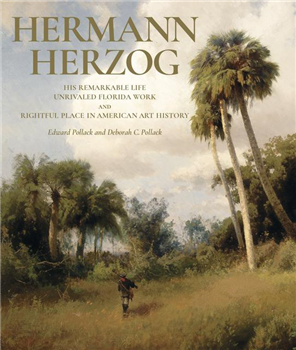
For more information, please see the definitive book about Hermann Herzog, Hermann Herzog: His Remarkable Life, Unrivaled Florida Work, and Rightful Place in American Art History, by Edward Pollack and Deborah C. Pollack (Blue Heron Press, 2023).
© Edward Pollack and Deborah C. Pollack
Sources: Hermann Herzog: His Remarkable Life, Unrivaled Florida Work, and Rightful Place in American Art History, by Edward Pollack and Deborah C. Pollack (Blue Heron Press, 2023); birth certificates for Hermann Herzog, Lewis Herzog, and Herman Herzog Jr. (Bremen and Düsseldorf archives); Düsseldorf marriage documents for Hermann Herzog; Düsseldorf Academy records; Hermann Herzog's naturalization records, ancestry.com; International Exhibition, Philadelphia, March 8, 1876, Report on Awards Citation; Herzog to Levi Mengel, January 4, 1918, Levi W. Mengel Papers, Reading Museum of Art.Biography from Charleston Renaissance Gallery
His faculty of catching, at a glance all that is characteristic in the motive before him, of choosing the most effective illumination, and even the most favorable season and time of day, assisted by a rapidity of execution which enables him to seize and fetter the most transient phenomena of light and shade . . . amounts to genius, and makes his pictures unique among landscapes. (1)
In these glowing words, a reviewer for the "Philadelphia Press" in 1885 reviewed the paintings of Herman Herzog. The anonymous writer singled out qualities that characterize the enduring appeal of Herzog's paintings.
Herzog was born on November 16, 1832, (2) in the Free Hanseatic State of Bremen, and entered the art academy in Dusseldorf at age seventeen. (3) The most influential of his teachers was Andreas Achenbach (1815-1910), who was well known for his dark, stormy seascapes as well as his scenes of Norway's water-choked, rocky gorges. While a student, Herzog traveled a great deal, visiting Norway, Belgium, Holland, Bavaria, Switzerland, and Italy. The memories of the rugged aspects of those places remained with him for many years, and he continued to paint them after his move to the United States.
While yet a young painter he was patronized by Queen Victoria, Grand Duke Alexander of Russia, the Grand Duke of Saxe-Coburg-Gotha, and the Countess of Flanders. Indeed, his work was praised in Europe long after he had settled in the United States. The "Bremen News" reported on March 19, 1886, "Quite apart in its individuality is a magnificent Norwegian Waterfall, by our countryman H. Herzog, whose works are, unfortunately, so rarely to be seen here." (4)
Herzog had moved to the United States in the late 1860s when it was certain that Bremen was to be annexed to Germany. After a brief residency in New Jersey, he settled in West Philadelphia. He found a wealth of subjects for his canvasses in both states. He was particularly fond of Dingman's Ferry, a picturesque spot in the Delaware Water Gap, but he also ventured to the West on several trips after 1880 as well as to the Chesapeake Bay and the rocky coast of Maine.
In the 1880s, Herzog began to visit Florida regularly. There bright yellows, sky blues, and cool greens entered his work, defining the sun-drenched, tropical environment.
Herzog did not exhibit his paintings much in his later years, though he continued to paint quite vigorously. After he began to reap the profits of his investment in Pennsylvania Railroad stock, he never sold another picture, a decision which removed the necessity of showing. (5) Hundreds of his paintings thus have remained in the hands of his children and grandchildren until quite recently.
His last exhibition, a joint show with his son Lewis, who was also a painter, was held at the Ferargil Galleries in New York, November 9 - 21, 1931. While the show was up Herzog celebrated his one-hundredth birthday. Three months later he died at his home at 4104 Pine Street in West Philadelphia.
Herzog is a prolific painter who is known to have painted well over 1,000 canvases. He was not a recorder of specific places; rather his paintings are artistic experiments in capturing the changing effects of light and atmosphere and varieties of terrain.
Credits:
(1) Philadelphia Press, March 15, 1885, as quoted in "Illustrated Catalogue of Paintings Works of Hermann Herzog to the Sold by Auction without Reserve on Wednesday, Thursday and Friday Evenings April 25th, 26th, and 27th. . .at the American Art Galleries . . . .," American Art Association, 1888.
(2) Herzog's year of birth has repeatedly been given as 1832, but this would be incorrect, if his obituary that appeared in "Art Digest " is accurate. It states that he died on February 6, 1932, having celebrated his 100th birthday the previous November. ("Herzog is Dead at 100, The Art Digest, vol. 6, no. 10, February 15, 1932, p. 8.)
(3) Herman Herzog, 1832-1932, American Landscape Painter, Baltimore, Md.: Phoenix Chase Galleries, n.d., p. 3.
(4) "Illustrated Catalogue of Paintings Works of Hermann Herzog to the Sold by Auction without Reserve on Wednesday, Thursday and Friday Evenings April 25th, 26th, and 27th... at the American Art Galleries...., American Art Association, 1888.
(5) Phoenix Chase Galleries, p. 4.
(6) Ibid. and "Herzog is Dead at 100," The Art Digest, vol. 6, no. 2, February 15, 1932, p. 8.
Cynthia Seibels
© 1991 Robert M. Hicklin Jr., Inc.Biography from Pierce Galleries
Herman Herzog (American, 1832-1932)
Herzog was born in Bremen, Germany in 1832. He studied landscape and figure paintings at the Dusseldorf Academy with Schirmer, Lessing, Achenbach and Gude (1849) and in Berlin (1867-1868) before moving to Philadelphia in 1869 where he set up a studio and exhibited at the Brooklyn Art Association.
Historical landscape painter Johann Wilhelm Schirmer and illustrious landscape artists Hans Frederick Gude and Andreas Achenback highly influenced Herzog's painting style and encouraged him to paint the rugged wilderness he loved with realistic detail and a high finish. Herzog traveled through Europe during the 1850s and 1860s painting the animals, waterfalls and stormy clouds over dramatic landscapes in luminous light, exhibited at the Paris Salon in 1863 (where he won a prize) and at the Pennsylvania Academy of Fine Arts (1863). In 1872 he painted in Yosemite and in Mexico.
By 1869, Herzog was a popular painter of means. He had sold paintings all over Europe and colleagues and critics alike were impressed that among his clientele were the the Countess of Flanders, Emperor Alexander of Russia, Queen Victoria, Duke Ernest of Saxe-Coburg-Gothe, and other members of royal families.
When Herzog died in West Philadelphia at 100, the prolific painter left over 1,000 canvases to his heirs. Always in pursuit of the most beautiful, idyllic view, Herzog extensively traveled in search of it. Although he never dated his work (thus, it is difficult to place them chronologically or stylistically), he painted landscapes, marines and pastorals that uplifted the Hudson River tradition, and his work is reminiscent of Albert Bierstadt and Worthington Whittredge (who also studied in Dusseldorf).
Collections: Metropolitan Museum of Art; National Museum of American Art; Museum of Fine Arts, Boston; New York Public Library; Crocker Museum (CA); Cincinnati Art Museum (OH); Reading Museum (PA); Hanover, Goth and Mulhouse Museums; Bancroft Library, UC Berkeley; Memorial Hall, Philadelphia (PA).
Submitted by Patricia Jobe Pierce, historianBiography from Altermann Galleries and Auctioneers, III
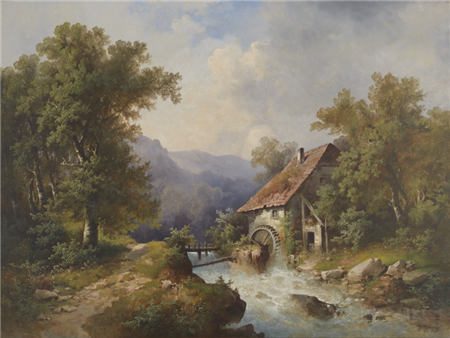 Hermann Herzog
Born: Bremen, Germany 1832
Died: West Philadelphia, Pennsylvania 1932
Eastern painter of mountain landscapes in California in the 1870s.
Herzog entered the Dusseldof Academy in 1849, the pupil of JW Schirmer, Lessing, A Achenbach, and H. Gude. He traveled to Norway, Switzerland, Italy, and the Pyrenees for the mountain landscapes he favored in his early paintings. He also painted some genre works, such as The Flag Swinging Festival in Switzerland. His patrons included Queen Victoria and Grand Duke Alexander of Russia.
In 1869, Herzog immigrated to Philadelphia, at the time his free Hanseatic State of Bremen was absorbed by Germany. He painted landscapes in Pennsylvania and along the Hudson River. He sketched in California's Yosemite Valley and Sierra Nevada in 1874-75. The painting of El Captain, Yosemite was called his masterpiece. A few months before his death in 1932, he held a joint New York City exhibition with his son Lewis Herzog.
Resource: SAMUELS' Encyclopedia of ARTISTS of THE AMERICAN WEST,
Peggy and Harold Samuels, 1985, Castle PublishingBiography from William A. Karges Fine Art - Carmel
Herman Herzog was born in Bremen, Germany, in 1832. He studied at the Dusseldorf Academy, and built a solid reputation for himself in his homeland before immigrating to Philadelphia in 1869.
Once in the U.S., Herzog traveled extensively, painting his was across the western states, arriving in California in 1873. His romantic-realist works from this trip included a series of Yosemite Valley paintings.
A wise investor, Herzog worked without the pressure to sell his paintings in his lifetime. Herman Herzog died in Philadelphia in 1932, at the age of 100.Biography from Thomas Nygard Gallery
HERMAN HERZOG (1832-1932)
Herman Ottomar Herzog was born in Bremen, Germany in 1832. He studied art at the Dusseldorf Academy, starting in 1848, under several classical landscape painters. In 1855, Herzog made his first visit to Norway. The trip was a milestone in Herzog's career as it exposed him to the rugged landscape of the Norwegian wilderness and instilled in him a lifelong sense of nature that was to show in all his work.
During the late 1850's and early 1860's, Herzog's fame spread throughout Europe. His paintings were collected for their dynamic realism and strong atmospheric effects. Among his patrons were several of Europe's royal families, including Queen Victoria of England and Grand Duke Alexander of Russia. He exhibited in the Paris Salon in 1863 and 1864, winning an Honorable Mention. While in Paris, it is thought that Herzog came into contact with the popular Barbizon School, whose adherents painted the grandeur and beauty of Nature in a romantic and realistic style. The effect of the Barbizon painters can also be seen in Herzog's poetic handling of mood and color. Although he was still in Europe, Herzog sent several paintings for exhibition at the Pennsylvania Academy from 1863 to 1869. He had several friends in the United States and they were developing a rather good demand for his work.
It is not known exactly when Herzog decided to come to America. Sometime in the late 1860's he settled in Philadelphia. Besides wanting a developing market for his work, Herzog left Bremen due to rising political agitation by Prussia, which had just absorbed Bremen into its domain. In America, Herzog continued to paint his romantic landscapes, finding the American wilderness well suited to his style. In 1871, he traveled up the Hudson River on a painting tour. In 1873, he took his first trip west, going to Yosemite, then to Wyoming, Oregon, and along the West Coast to the Coronado Island, near the Mexican border. Herzog made several journeys west, finding each trip more fruitful than the last. He became known for his depictions of Yosemite, receiving great acclaim for a fine El Capitan, much in the style of his fellow countryman and painter Albert Bierstadt. His last trip west was in 1905, at the age of 74.
In 1876, Herzog participated in the Centennial Exhibition in Philadelphia, showing a Norwegian scene and a Yosemite landscape, which earned him a Bronze Medal. In 1882, he exhibited two paintings of Pennsylvania at the National Academy Annual Exhibition.
As Herzog grew older, he continued to paint actively. He retained all his control and abilities even into his one hundredth birthday. In 1931, he participated in a gallery exhibition with his son, Lewis Herzog. Herman Herzog died on February 6, 1932, in his home in Philadelphia, at the age of 100.Biography from Newman Galleries
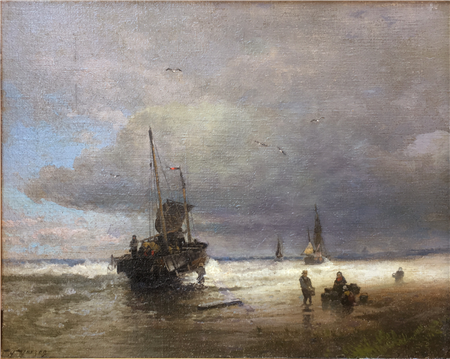 German Romanticist painter Herman Herzog was born in 1832. He studied at the Düsseldorf Academy in 1848, and then traveled extensively throughout Germany, Switzerland, Italy, and Norway. He was particularly interested in recording the natural wilderness of these countries and in depicting the changing atmospheric conditions of each time and place.
He came to the United States in 1870 and settled in Philadelphia. Herzog quickly established himself as a leading regional painter and exhibited at the Pennsylvania Academy of the Fine Arts. He journeyed to the South and West, sketching and painting the untrammeled scenery.
He first exhibited in 1858 in Berlin, where he had many subsequent shows. At the occasion of his one-hundredth year celebration and joint exhibition of his paintings, which his son, Lewis, held in 1931; Herman Herzog was referred to as the "Dean of American Landscape Painters."Biography from Southern Alleghenies Museum of Art (SAMA)
Hermann Herzog was born in Bremen, Germany, in 1832, studied at the Dusseldorf Academy with Schirmer, Lessing, Achenbach, and Gude in 1849. His works were exhibited in 1863 at the Paris Salon, and he continued to show his work throughout Europe, attracting Queen Victoria, the Grand Duke Alexander of Russia and other members of royalty as patrons. After studying in Berlin (1867-1868), Herzog emigrated to the United States in 1869, the same year he arrived in Philadelphia.
An untitled landscape in the museum's collection embodies 19th century Romanticism with its beautiful reflective light, a luminism also found in Hudson River School paintings and painting at the Pennsylvania Academy of the Fine Arts in Philadelphia in the 1880s.
Hermann Herzog died in West Philadelphia in 1932. His works are now part of the permanent collections of the New York Public Library, Memorial Hall in Philadelphia, Cincinnati Art Museum and the Reading Museum in the United States. His works are also found in museums in Hanover and Mulhouse in Germany.