Page loaded successfully. Showing biography for Hilary Knight.
Hilary Knight BIOGRAPHY
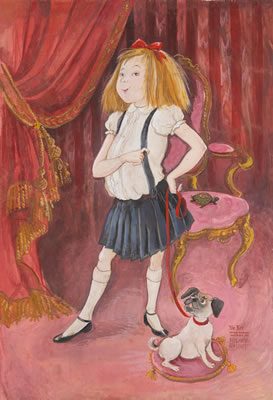
Born 1926 Hempstead, Long Island, New York. Known for: Children's book illustration, advertising and poster art.
"Remarkable. Extraordinary. Eccentric: The Man Who Drew Eloise Recalls His Muses," by Alexandra Jacos, June 29, 2017, Art & Design section, The New York Times. Long before there was millennial pink... Read full biography
"Remarkable. Extraordinary. Eccentric: The Man Who Drew Eloise Recalls His Muses," by Alexandra Jacos, June 29, 2017, Art & Design section, The New York Times. Long before there was millennial pink there was rose carthame, a chemical but warm paint hue favored by Katharine Sturges Dodge, mother of... Read full biography
"Remarkable. Extraordinary. Eccentric: The Man Who Drew Eloise Recalls His Muses," by Alexandra Jacos, June 29, 2017, Art & Design section, The New York Times. Long before there was millennial pink there was rose carthame, a chemical but warm paint hue favored by Katharine Sturges Dodge, mother of the artist Hilary Knight, and an artist herself. “She used it in cheeks, especially,” Mr. Knight said the other afternoon. “Think pink!” his most famous collaborator, Kay Thompson, belted in the 1957... Read full biography
"Remarkable. Extraordinary. Eccentric: The Man Who Drew Eloise Recalls His Muses," by Alexandra Jacos, June 29, 2017, Art & Design section, The New York Times. Long before there was millennial pink there was rose carthame, a chemical but warm paint hue favored by Katharine Sturges Dodge, mother of the artist Hilary Knight, and an artist herself. “She used it in cheeks, especially,” Mr. Knight said the other afternoon. “Think pink!” his most famous collaborator, Kay Thompson, belted in the 1957 movie Funny Face. And because of the blockbuster success of their fictional and widely franchised character Eloise, the 6-year-old girl who first appeared in Eloise: A Book for Precocious Grown-Ups in 1955 and has been running amok at (and raking it... Read full biography
"Remarkable. Extraordinary. Eccentric: The Man Who Drew Eloise Recalls His Muses," by Alexandra Jacos, June 29, 2017, Art & Design section, The New York Times. Long before there was millennial pink there was rose carthame, a chemical but warm paint hue favored by Katharine Sturges Dodge, mother of the artist Hilary Knight, and an artist herself. “She used it in cheeks, especially,” Mr. Knight said the other afternoon. “Think pink!” his most famous collaborator, Kay Thompson, belted in the 1957 movie Funny Face. And because of the blockbuster success of their fictional and widely franchised character Eloise, the 6-year-old girl who first appeared in Eloise: A Book for Precocious Grown-Ups in 1955 and has been running amok at (and raking it in for) the Plaza Hotel ever since, one might believe Mr. Knight not only thinks but bleeds pink ink. But... Read full biography
Artist Biography
Biography page for Hilary Knight ((Born 1926)), known for Children's book illustration, advertising and poster art. Showing 2 biographical entries and 0 sample artworks.
Hilary Knight - Artist Info
About Hilary Knight
Biography from the Archives of askART
 "Remarkable. Extraordinary. Eccentric: The Man Who Drew Eloise Recalls His Muses," by Alexandra Jacos, June 29, 2017, Art & Design section, The New York Times
Long before there was millennial pink there was rose carthame, a chemical but warm paint hue favored by Katharine Sturges Dodge, mother of the artist Hilary Knight, and an artist herself. “She used it in cheeks, especially,” Mr. Knight said the other afternoon.
“Think pink!” his most famous collaborator, Kay Thompson, belted in the 1957 movie Funny Face. And because of the blockbuster success of their fictional and widely franchised character Eloise, the 6-year-old girl who first appeared in Eloise: A Book for Precocious Grown-Ups in 1955 and has been running amok at (and raking it in for) the Plaza Hotel ever since, one might believe Mr. Knight not only thinks but bleeds pink ink.
But as two new exhibitions reveal, he is a many-shaded man, a chameleon, a “Joseph and the Amazing Technicolor Dreamcoat” — apparently one of the few musical stage shows for which he has not designed a poster.
Dozens of these (advertising, among others, Angela Lansbury in Gypsy, Eartha Kitt in Timbuktu! and Twiggy in My One and Only) adorn a lower floor at the New York Public Library for the Performing Arts at Lincoln Center, where Mr. Knight had arrived, dapper in pinstripes at 90, to give a tour of “Hilary Knight’s Stage Struck World,” devoted to his many eclectic creations and muses and curated by David Leopold with considerable input from the subject.
“You know, the walls were like this and I said we cannot have that,” Mr. Knight said, waving dismissively at a shelving area. “Perforated orange wood!”
Filled with enough plastic baubles, china, dioramas, feathers and fabric swatches to send the Etsy crowd into ecstasy, the bi-level exhibition complements “Eloise at the Museum,” which opens on Friday at the New-York Historical Society. Both supply a thoughtful counter-narrative to the teas, ballets and craft sessions un-spooling in somewhat saccharine perpetuity at the Plaza.
With her typical impishness, Eloise at times threatens to obscure Mr. Knight’s other work, like the Mrs. Piggle-Wiggle series written by Betty MacDonald; the I Hate to Cook Book and the I Hate to Housekeep Book with Peg Bracken; and the prescient Where’s Wallace? (years before Where’s Waldo?), for which he did text as well as illustrations.
During the golden age of magazines his drawings were published widely, in the dearly departed Mademoiselle and in Cricket for children, and they continue to appear in Vanity Fair.
Constitutionally au courant, he is working on a graphic novel with his twin nieces, Kitty and Lily Knight, as well as a memoir for St. Martin’s Press, Hilary Knight: Drawn From Life, scheduled for publication next spring.
“I’m trying to get it together,” Mr. Knight said. “There’s a lot to do.”
In his spare time he tinkers with a revue in which he plans to wear a sequined ensemble inspired by both the 1940s costume designer Adrian and the rapper LL Cool J. “I don’t like the word burlesque, but that’s what it is,” Mr. Knight said. “I’ve got it all planned, whether it happens or not. I mean, I have no qualifications!”
He does have a longstanding appreciation of theatrical women, beginning around 1937 with Connie De Pinna, of the defunct department store bearing the family name on Fifth Avenue. “She was going into town one day — we’re in Westport renting a house — and she has a black Persian lamb circular skirt in the summertime with black fingernails.
Pretty good.” Mr. Knight said.
He was born a decade before then, in Hempstead, N.Y., following a brother three years older, Joey. Their father, Clayton Knight, who had flown in the Royal Air Force, was also an illustrator, specializing in aviation, and after moving to Manhattan the Knights traveled widely: to Paris (where Eloise would later pop up with her nanny, as well as Moscow), Bermuda, South America.
Mr. Knight attended Friends Seminary, studied with George Grosz and Reginald Marsh at the Art Students League, and enrolled in the Navy at 17, painting ships with occasional flourish. “I was a little boy, so they felt sorry for me — they would give me all these cushy jobs,” he said. “It taught me a lot.”
Perhaps his most important education, though, occurred in movie palaces and at the lushly outfitted live entertainments that used to be Broadway staples. Vitrines at the library contain collaged homages to a chorus line of showbiz muses like Liliane Montevecchi (“the most remarkable person,” said Mr. Knight, a connoisseur of the appreciative adjective), Ann Miller (“like a steam engine”) and Dame Edna (“extraordinary”).
He is surely one of a very select number to have worked with both Lena Horne and Lena Dunham.
Displayed also is Mr. Knight’s affinity for members of the fashion world: the magazine editor Isabella Blow (“eccentric but very sweet and touching”), who committed suicide a decade ago; the mogul Tommy Hilfiger (“terrific”), for whom he did a living-room mural; and the clothing designer Norman Norell. “He was a fascinating man,” Mr. Knight said of Norell, after nimbly clambering into a taxicab with minimal help from a cane. “He loved going to Schrafft’s; he had a black standard poodle and they would sit up at the counter. You remember Schrafft’s? God, we need Schrafft’s.”
No kidding.
At the historical society, Mr. Knight was welcomed by the curator Jane Bayard Curley, who along with rare publishing artifacts, like sketches for an abortive project with Truman Capote (Can a Pig Fly?), has installed crowd-pleasing special effects like old-fashioned black house telephones over which the actress Bernadette Peters can be heard reading the books, and a gramophone playing a 1956 novelty record: “Eloise, Eloise....”
“Is this going to drive the guards nuts?” Ms. Curley wondered.
“What’s interesting about the book surviving all this time is that there’s so much that’s not in it, like cellphones,” said Mr. Knight, who recently, gingerly snapped his first selfie. “I always felt guilty about the TV set, that we shouldn’t really be encouraging that.”
In a nod to “the department of shameless commerce,” Ms. Curley said, the show culminates in a gift shop, though she had the wit to theme it to a work that Thompson — who tired of the character even as she reaped most of the profits through an exploitative contract — suppressed until after her death in 1998: Eloise Takes a Bawth.
Mr. Knight was reminiscing about the Plaza’s various owners, who have included Conrad Hilton and, for a stretch, Donald J. Trump. “I loved Ivana — I had a great time with her,” he said of the president’s first wife. “I will never forget her walking through the lobby. She said: ‘I see this painting, and I said, “Who is this?” They told me Eloise. I never heard of her.’”
He smiled like a Cheshire cat. “She knew exactly who she was.”
"Hilary Knight’s Stage Struck World?," Through Sept. 1, 2017 at the New York Public Library for the Performing Arts at Lincoln Center, ManhattanBiography from the Archives of askART
 Hilary Knight (born November 1, 1926) is an American writer-artist who is the illustrator of more than 50 books and the author of nine books. He is best known as the illustrator of Kay Thompson's Eloise (1955) and others in the Eloise series.
Knight has illustrated for a wide variety of clients, creating artwork for magazines, children's fashion advertisements, greeting cards, record albums and posters for Broadway musicals, including Gypsy, Irene, Half A Sixpence, Hallelujah Baby! and No, No Nanette.
The son of artist-writers Clayton Knight and Katharine Sturges, Hilary Knight was born on Long Island in Hempstead. His father illustrated aviation books, and his mother was a fashion and book illustrator. Living in Roslyn, New York as a child, Hilary was age six when he moved to Manhattan with his family. Knight recalled: "As a child, I loved to look at a set of books which belonged to my mother. They were illustrated by Edmund Dulac in a romantic, wonderful, detailed manner. I know he has influenced my style."
After study with George Grosz and Reginald Marsh at the Art Students League, Knight labored as a ship painter while serving in the Navy from 1944 to 1946. Returning to New York, he studied architectural drafting (at Delahanty Institute), interior design and theatre design, working for one summer as an assistant designer at an Ogunquit, Maine theater.
He painted murals in private homes and entered the field of magazine illustration, starting with Mademoiselle in 1952, followed by House & Garden, Gourmet, McCalls and Woman's Home Companion. His work as a humorous illustrator was strongly influenced by the British cartoonist Ronald Searle.
In 1955, he collaborated with Kay Thompson to create the whimsical black/white/pink look of Eloise. The live CBS television adaptation on Playhouse 90 (1956) with Evelyn Rudie as Eloise received such negative reviews that Kay Thompson vowed never to allow another film or TV adaptation.
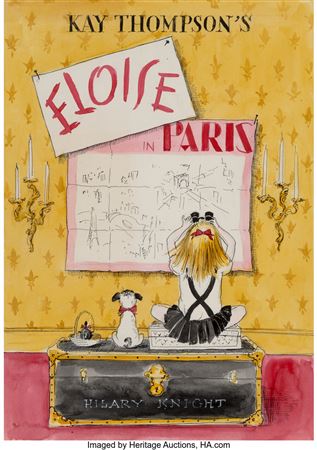
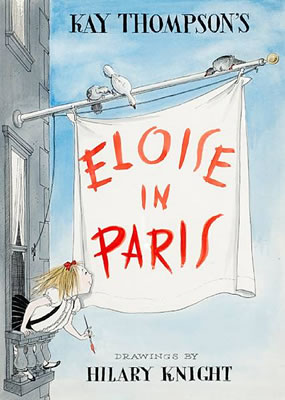
Three book sequels followed: Eloise in Paris (1957), Eloise at Christmastime (1958) and Eloise in Moscow (1959). Thompson and Knight teamed to create another sequel, Eloise Takes a Bawth, working with children's book editor Ursula Nordstrom. That title was announced in the Harper Books for Boys and Girls fall 1964 catalog, but in the mid-1960s, Thompson removed the three Eloise sequels from print and did not allow [Eloise Takes a Bawth] to be published. It was an action that deprived her collaborator of income for decades (a situation that changed with Thompson's death in 1998). In Salon, Amy Benfer speculated on Thompson's motives in "Will the real Eloise please stand up?" (June 1, 1999):
"Kay Thompson got sick of us. Our initial admiration—a mass consumption of all things Eloise—was viewed as imitation and she did not consider it a form of flattery. Adults and children flooded the Plaza, all insisting that they were Eloise... I think she became jealous. So does Hilary Knight, Thompson's illustrator and collaborator. His pink-splashed black and white drawings of the child Maurice Sendak called, "that brazen loose-limbed delicious little girl monster" provide the punch line to Thompson's allusive, scatting prose.
Knight's contribution to a 1996 profile of Thompson in Vanity Fair is an illustration that shows Thompson kicking the chair out from under Eloise to scrawl "I am Eloise" in lipstick on the vanity mirror in the Plaza's powder room. Knight's illustration may seem a little tawdry. But then again, Knight himself got into something of a tangle with Ms. Thompson over the ownership of Eloise. Their professional relationship effectively ended when Thompson pulled from publication a nearly completed manuscript of yet another sequel; this one was entitled Eloise Takes a Bawth.
In later years, Thompson refused to return Knight's phone calls. Kay Thompson's sense of possession was so strong that she became unwilling to share Eloise, even with the person who literally animated the child in her head.""
Eloise Takes a Bawth was finally published in 2002 Knight recalled:
"Kay and I were like parents to Eloise. We decided that we'd never make her older than six, and that we'd always keep the parents in the background. When you really study the book, you see that Eloise is somewhat wistful. And I guess my job now is to continue what Kay might have thought she was doing when she pulled the books in the first place—to protect Eloise."
Other publications with Knight illustrations include Good Housekeeping and the children's magazine, Cricket. In addition to creating children's picture books—among them, in collaboration with poet Margaret Fishback, A Child's Book of Natural History (USA: Platt & Monk, 1969), a revision and extension of A Child's Primer of Natural History by Oliver Herford—Knight has illustrated for other genres, such as Peg Bracken's The I Hate to Cook Book.
The roll call of artists Knight admires includes Ludwig Bemelmans, Joseph Hirsch, Leo Lionni, Robert Vickrey and Garth Williams.
Over decades, Knight maintained an apartment in midtown Manhattan which also serves as his studio and library, where he adds to his collection of books, sheet music, programs and soundtrack and cast recordings.
Source:
Hilary Knight, Wikipedia, 2012