Page loaded successfully. Showing biography for Homer Ransford Watson.
Homer Ransford Watson BIOGRAPHY
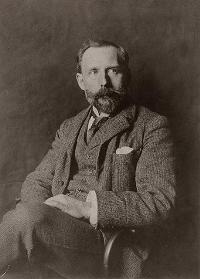
1855 Doon, Ontario, Canada - 1936 Doon, Ontario, Canada. Known for: Landscape, figure, animals, allegory and portrait painting.
Homer Ransford Watson OSA, RCA, CAC (1855 - 1936). Homer Ransford Watson (AKA: Homer Watson) was an important Canadian painter and President of the Royal Canadian Academy of Arts*. Most exhibitions... Read full biography
Homer Ransford Watson OSA, RCA, CAC (1855 - 1936). Homer Ransford Watson (AKA: Homer Watson) was an important Canadian painter and President of the Royal Canadian Academy of Arts*. Most exhibitions that examine the history of Canadian art include his paintings, all comprehensive Canadian art... Read full biography
Homer Ransford Watson OSA, RCA, CAC (1855 - 1936). Homer Ransford Watson (AKA: Homer Watson) was an important Canadian painter and President of the Royal Canadian Academy of Arts*. Most exhibitions that examine the history of Canadian art include his paintings, all comprehensive Canadian art history books discuss him, and most major Canadian museums have his works in their permanent collections. Watson was born in Doon, Ontario (now part of Kitchener) lived there most of his life and died... Read full biography
Homer Ransford Watson OSA, RCA, CAC (1855 - 1936). Homer Ransford Watson (AKA: Homer Watson) was an important Canadian painter and President of the Royal Canadian Academy of Arts*. Most exhibitions that examine the history of Canadian art include his paintings, all comprehensive Canadian art history books discuss him, and most major Canadian museums have his works in their permanent collections. Watson was born in Doon, Ontario (now part of Kitchener) lived there most of his life and died there. (1). His best known medium was oil paint, although, there are many works in watercolor, graphite, pen and ink, chalk, drybrush, wood engraving*, etching* and lithograph*. His most frequent subjects are landscapes of the countryside near Doon. Oscar... Read full biography
Homer Ransford Watson OSA, RCA, CAC (1855 - 1936). Homer Ransford Watson (AKA: Homer Watson) was an important Canadian painter and President of the Royal Canadian Academy of Arts*. Most exhibitions that examine the history of Canadian art include his paintings, all comprehensive Canadian art history books discuss him, and most major Canadian museums have his works in their permanent collections. Watson was born in Doon, Ontario (now part of Kitchener) lived there most of his life and died there. (1). His best known medium was oil paint, although, there are many works in watercolor, graphite, pen and ink, chalk, drybrush, wood engraving*, etching* and lithograph*. His most frequent subjects are landscapes of the countryside near Doon. Oscar Wilde (1854 - 1900), a friend and patron, famously referred to Watson as the "Canadian Constable" because o... Read full biography
Artist Biography
Biography page for Homer Ransford Watson ((1855 - 1936)), known for Landscape, figure, animals, allegory and portrait painting. Showing 1 biographical entries and 0 sample artworks.
Homer Ransford Watson - Artist Info
About Homer Ransford Watson
Biography from the Archives of askART
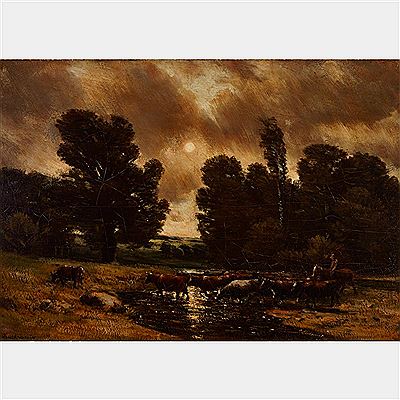 Homer Ransford Watson OSA, RCA, CAC (1855 - 1936)
Homer Ransford Watson (AKA: Homer Watson) was an important Canadian painter and President of the Royal Canadian Academy of Arts*. Most exhibitions that examine the history of Canadian art include his paintings, all comprehensive Canadian art history books discuss him, and most major Canadian museums have his works in their permanent collections.
Watson was born in Doon, Ontario (now part of Kitchener) lived there most of his life and died there. (1)
His best known medium was oil paint, although, there are many works in watercolor, graphite, pen and ink, chalk, drybrush, wood engraving*, etching* and lithograph*. His most frequent subjects are landscapes of the countryside near Doon. Oscar Wilde (1854 - 1900), a friend and patron, famously referred to Watson as the "Canadian Constable" because of his skill and penchant for painting landscapes. Watson's other subjects included portraits, figures, animals, genre*, allegory*, pioneer life, mountains, rivers and lakes. The locations, in addition to those near his home, include the Adirondack Mountains and Susquehanna and Hudson rivers of New York; the Rocky Mountains in B.C. and Alberta; southern Quebec; Great Britain; and the Canadian Maritime provinces. His styles were Realism*, Impressionism* and Fauvism*. His painting and his philosophy about it were much influenced by the Barbizon School* and the Hudson River School*. AskART have some good illustrations of his work. (2)
Quote: "To me nature speaks of a mighty region outside man, a great spirituality…" - Homer Watson (3)
He was mostly a self-taught artist who studied by copying paintings from books at the Toronto Normal School (1874 - 1875). However, throughout his life he sought out the advice, influence and association of many prominent artists such as: Thomas Mower Martin (4), John Arthur Fraser, Henry Sandham, Lucius O'Brien, Henri Perré, Georges Inness (5) [see AskART Hudson River School essay], James McNeill Whistler, James Kerr-Lawson, Edward John Gregory, Charles William Norton, Sir George Clausen, and Horatio Walker. (6)
Watson's travels included New York (1876 - 1877); Nova Scotia [Halifax] (1881); England, Scotland, France (1887 - 1891); Quebec (1896); Scotland [Glasgow] (1901); Nova Scotia [Cape Breton] and Cobalt [Ontario] (1909); England (1910 and 1912); and British Columbia, Alberta and the Rocky Mountains (1921 and 1929). (7)
He was a member of the Ontario Society of Artists* (1878); a member and President of the Royal Canadian Academy of Arts* (Associate, 1880; Academician, 1882; Vice-President, 1914; President, 1918 - 1922); and a founding member of The Canadian Art Club* (1907) and its first President (1907 to 1911). (8)
Since the 1880s and posthumously his works have been included in numerous important exhibitions such as: the Colonial and Indian Exhibition, London, England (1886); "World's Columbian Exposition"*, Chicago (1893); "Pan-American Exposition"*, Buffalo, New York (1901); "Louisiana Purchase Exposition"*, St. Louis, Missouri (1904); "Exposition d'art Canadien", Musée du Jeu de Paume, Paris (1927); 'Outstanding Artists of the last 50 Years', National Gallery of Canada, Ottawa (1935); "A Century of Canadian Art", Tate Gallery, London, England (1938); "Ontario Society of Artists Retrospective", (1947); "Canadian Painting", National Gallery, Washington, D.C. (1950); "Three Hundred Years of Canadian Art", National Gallery of Canada, Ottawa (1967); "Heroes and Heroines", Art Gallery of Ontario, Toronto (1978); "Canadians in Paris, 1867 - 1914", Art Gallery of Ontario (1979); "Speaking about Landscape, Speaking to the Land", Art Gallery of Ontario (2003); "The Transformative Power Of Art", Art Gallery of Ontario (2005); and "Expanding Horizons: Painting and Landscape Photography of American and Canadian Landscape 1860 - 1918", Montreal Museum of Fine Arts and touring (2009 - 2010). (9)
He also exhibited at the Art Association of Montreal [now Montreal Museum of Fine Arts] between 1880 and 1894; the Toronto Industrial Exhibition [now Canadian National Exhibition], Ontario (1881 - 1922); the Royal Academy*, London, England (1888); and the New Gallery, London, England (1888).
The public venues for Watson's solo and retrospective exhibitions were the New Gallery, London, England (1889); Royal Institute, Glasgow, Scotland (1889 and 1902); and the Art Gallery of Toronto [now Art Gallery of Ontario] (1930).
Posthumously there have been solo and retrospective exhibitions at the Chateau Laurier, Ottawa "Memorial" (1937); National Gallery of Canada, Ottawa, "Homer Watson R.C.A.: Paintings and Drawings" (1963); Kitchener-Waterloo Art Gallery, Ontario, "Homer Watson (1855 - 1936): Nature Seen through a Temperament" (1975); and Homer Watson House & Gallery, Kitchener, "The Landscapes of Homer Watson" (2000).
The venues for his commercial gallery group and solo exhibitions include Dowdeswell Gallery, London, England; Cottier & Co., New York; and Jenkins Art Galleries, Toronto.
Watson's works have been avidly collected since 1880, when Queen Victoria added "The Pioneer Mill" to the Royal Collection (10); they are frequently traded on the Canadian auction markets, and they are in many important Canadian public collections.
According to the Canadian Heritage Information Network* there are a total of 1694 (11) Homer Watson works in the permanent collections of Canadian museums. They include: the Agnes Etherington Art Centre (Kingston, Ontario), Art Gallery of Alberta (Edmonton), Art Gallery of Greater Victoria (B.C.), Art Gallery of Hamilton (Ontario), Art Gallery of Nova Scotia (Halifax), Art Gallery of Ontario (Toronto), Beaverbrook Art Gallery (Fredericton, New Brunswick), Canadian Museum of Civilization (Gatineau, Quebec), Canadian War Museum (Ottawa), Mackenzie Art Gallery (Regina, Saskatchewan), McCord Museum of Canadian History (Montreal), McMichael Canadian Art Collection (Kleinburg, Ontario), Mendel Art Gallery (Saskatoon, Saskatchewan), Montreal Museum of Fine Arts (Quebec), Museum London (Ontario), Robert McLaughlin Gallery (Oshawa, Ontario), Tom Thomson Memorial Art Gallery (Owen Sound, Ontario), Vancouver Art Gallery (B.C.), Whyte Museum of the Canadian Rockies (Banff, Alberta) and the Winnipeg Art Gallery (Manitoba).
The National Gallery of Canada has an incredible 1603 Homer Watson works in its collection comprised of oil paintings, watercolors, drawings, studies, sketches and prints, many of which are illustrated online. (12)
His awards and honors include the Bronze Medal, Indian and Colonial Exhibition, London, England (1886); First Prize, Art Association of Montreal spring show (1895); Bronze Medal, World's Columbian Exposition, Chicago, Illinois (1893); Gold Medal, "Pan-American Exposition" *, Buffalo, New York (1901); Bronze Medal, Louisiana Purchase Exposition, St. Louis, Missouri (1904); and a posthumous Honorary Doctorate from the University of Western Ontario, London (1936). (13)
Footnotes:
(1) Sources: National Gallery of Canada (NGC) information form (probably prepared by Watson himself) dated April 26, 1920 - http://cybermuse.gallery.ca/cybermuse/servlet/imageserver?src=DO9355&ext=x.pdf; and "A Dictionary of Canadian Artists, Volume 9 (online only)" (2009), by Anne Newlands and Judith Parker.
(2) Sources: AskART Images; The Development of Canadian Art (1964), by R.H. Hubbard (see AskART book references); and museum illustrations and descriptions of mediums in the Canadian Heritage Information Network* data base.
Note: Late in life Watson began painting in a style similar to that of the members of the Group of Seven*; AskART images have several examples of this shift to Fauvism*, The Road near Guelph dated 1927 is a good illustration.
(3) Source: Page 154 Landmarks of Canadian Art (1978), by Peter Mellen (see AskART book references).
(4) All artist associates mentioned in this biography have their own pages in AskART.
(5) According to Paul Duval, the works of Thomas Cole exhibiting "precise observation and romantic mood' viewed by Watson on his 1876 New York trip had a "pervading impact" on Watson's early work. Whereas the influence of Inness can be seen in Watson's works about 10 years later. Source: Page 32 High Realism in Canada (1974), by Paul Duval (see AskART book references).
(6) Education sources: A Dictionary of Canadian Artists, Volume 9 (online only)" (2009), by Anne Newlands and Judith Parker; Art Gallery of Ontario - the Canadian Collection (1970), by Helen Pepall Bradfield; NGC library & archives - http://www.gallery.ca/english/library/biblio/ngc081.html; and NGC Information form dated April 26, 1920 - http://cybermuse.gallery.ca/cybermuse/servlet/imageserver?src=DO9355&ext=x.pdf.
Notes: Watson traveled to Toronto in 1872 to meet Martin and to show him his work and ask his opinion of it; Fraser, Sandham, O'Brien and Perre worked with Watson at Notman & Fraser photography studio, Toronto from 1874 to 1875; he met Inness while in New York in 1876; sought out Whistler, Kerr-Lawson, Gregory, Norton and Clausen while in England; and Walker was a painting and travel companion in Canada and Scotland (1896 - 1901).
(7) Travel sources: NGC information form dated April 26, 1920 - http://cybermuse.gallery.ca/cybermuse/servlet/imageserver?src=DO9355&ext=x.pdf; A Dictionary of Canadian Artists, Volume 9 (online only)" (2009), by Anne Newlands and Judith Parker; and Homer Watson House & Gallery, Kitchener, Ontario - http://www.homerwatson.on.ca/teacher_resources.htm.
Note: Not all sources agree on all travel dates, for example, some indicate two trips to England in the 1887 to 1891 period and some do not mention the 1912 trip. Without prejudice, our principle source is Homer Watson House & Gallery, Kitchener, Ontario.
(8) Association sources: A Dictionary of Canadian Artists, Volume 9 (online only)" (2009), by Anne Newlands and Judith Parker; Passionate Spirits: A History of the Royal Canadian Academy of Arts, 1880 - 1980 (1980), by Rebecca Sisler; Canadian Art - Its Origin and Development (1943) by William Colgate (see AskART book references); and the Ontario Society of Artists - http://ontariosocietyofartists.org/the_osa_archives/history.
(9) Exhibition sources: Ibid; The Fine Arts in Canada (1925), by Newton MacTavish; Art Gallery of Ontario - the Canadian Collection (1970), by Helen Pepall Bradfield; Three Hundred Years of Canadian Art (1967), by R.H. Hubbard and J.R. Ostiguy; The Collector's Dictionary of Canadian Artists at Auction (2001), by Anthony R. Westbridge and Diana L. Bodnar; The National Gallery of Canada Catalogue of Paintings and Sculpture: Canadian School - Vol III (1960), by R.H. Hubbard; Art and Architecture in Canada (1991), by Loren R. Lerner and Mary F. Williamson (see all previous in AskART book references); Art Gallery of Ontario archived catalogue summaries online; and Homer Watson House & Gallery, Kitchener, Ontario - http://www.homerwatson.on.ca/teacher_resources.htm.
Note: Newton MacTavish says, Watson exhibited at the New English Art Club* as well, which is likely since Whistler was a member and Clausen showed there; however no date is provided.
(10) "In 1880, at the first exhibition of the Canadian Academy of Arts [later Royal Canadian Academy of Arts], Watson exhibited The Pioneer Mill, which was purchased by the Marquis of Lorne, Governor General of Canada, for Queen Victoria. Widely celebrated in the press, it launched Watson's career…" Source: A Dictionary of Canadian Artists, Volume 9 (online only)" (2009), by Anne Newlands and Judith Parker.
"Upon seeing The Pioneer Mill, the Queen of England immediately wanted another work of art by the young Canadian. Royal recognition propelled Homer Watson to national prestige and international acclaim, attracting droves of admirers." Source: Homer Watson House & Gallery, Kitchener, Ontario - http://www.virtualmuseum.ca/pm_v2.php?id=exhibit_home&fl=0&lg=English&ex=00000563.
Note: Both paintings are still in the Royal Collection; the second work, The Last of the Drought painted in 1881 is illustrated on the Royal Collection website - http://www.royalcollection.org.uk/eGallery/object.aspsearchText=watson&x=8&y=6&object=400547&row=6&detail=about and The Pioneer Mill is catalogued in Victorian Pictures in the Collection of Her Majesty The Queen (1992), by Sir Oliver Millar (see AskART book references). Additional source: Alex Buck, Senior Database Cataloguer (Paintings) The Royal Collection.
(11) The breakdown - 69 oils, 54 watercolors, 20 wood engravings, 27 etchings, 20 lithographs and 1504 drawings.
(12) Source: National Gallery of Canada - http://cybermuse.gallery.ca/cybermuse/search/artist_work_e.jsp?iartistid=5802.
(13) Sources: A Dictionary of Canadian Artists, Volume 9 (online only)" (2009), by Anne Newlands and Judith Parker; Homer Watson House & Gallery, Kitchener, Ontario - http://www.homerwatson.on.ca/teacher_resources.htm; and NGC Information form dated April 26, 1920 - http://cybermuse.gallery.ca/cybermuse/servlet/imageserver?src=DO9355&ext=x.pdf.
* For more in-depth information about these terms and others, see AskART.com Glossary http://www.askart.com/AskART/lists/Art_Definition.aspx.
Prepared and contributed by M.D. Siverbrooke.