Page loaded successfully. Showing biography for Howard Brown.
Howard Brown BIOGRAPHY
1878 Lexington, Kentucky - 1945. Known for: Illustration-pulp action-science fiction.
Published in the March 1919 issue of Everyday Engineering Magazine was an extensive article by Raymond Francis Yates (a science writer and the magazine's editor), titled "The Science of Camouflage... Read full biography
Published in the March 1919 issue of Everyday Engineering Magazine was an extensive article by Raymond Francis Yates (a science writer and the magazine's editor), titled "The Science of Camouflage Explained." Much of the article is devoted to the wartime contributions of dozens of civilian artists... Read full biography
Published in the March 1919 issue of Everyday Engineering Magazine was an extensive article by Raymond Francis Yates (a science writer and the magazine's editor), titled "The Science of Camouflage Explained." Much of the article is devoted to the wartime contributions of dozens of civilian artists who applied ship camouflage to American merchant ships during World War I. Sanctioned by the U.S. Shipping Board (or Emergency Fleet Corporation), there were about a dozen teams stationed at various... Read full biography
Published in the March 1919 issue of Everyday Engineering Magazine was an extensive article by Raymond Francis Yates (a science writer and the magazine's editor), titled "The Science of Camouflage Explained." Much of the article is devoted to the wartime contributions of dozens of civilian artists who applied ship camouflage to American merchant ships during World War I. Sanctioned by the U.S. Shipping Board (or Emergency Fleet Corporation), there were about a dozen teams stationed at various ports around the country. The team in the New York District (headquartered in Manhattan at 345 East 33rd Street) was headed by American muralist William Andrew Mackay. On the cover of this issue is a signed full-color illustration by Howard V. Brown... Read full biography
Published in the March 1919 issue of Everyday Engineering Magazine was an extensive article by Raymond Francis Yates (a science writer and the magazine's editor), titled "The Science of Camouflage Explained." Much of the article is devoted to the wartime contributions of dozens of civilian artists who applied ship camouflage to American merchant ships during World War I. Sanctioned by the U.S. Shipping Board (or Emergency Fleet Corporation), there were about a dozen teams stationed at various ports around the country. The team in the New York District (headquartered in Manhattan at 345 East 33rd Street) was headed by American muralist William Andrew Mackay. On the cover of this issue is a signed full-color illustration by Howard V. Brown of one of the artists in Mackay's unit, testing the effectiveness of a scale model of a camouflage-painted ship model through a periscope... Read full biography
Artist Biography
Biography page for Howard Brown ((1878 - 1945)), known for Illustration-pulp action-science fiction. Showing 2 biographical entries and 0 sample artworks.
Howard Brown - Artist Info
About Howard Brown
Biography from the Archives of askART
 Published in the March 1919 issue of Everyday Engineering Magazine was an extensive article by Raymond Francis Yates (a science writer and the magazine's editor), titled "The Science of Camouflage Explained." Much of the article is devoted to the wartime contributions of dozens of civilian artists who applied ship camouflage to American merchant ships during World War I.
Sanctioned by the U.S. Shipping Board (or Emergency Fleet Corporation), there were about a dozen teams stationed at various ports around the country. The team in the New York District (headquartered in Manhattan at 345 East 33rd Street) was headed by American muralist William Andrew Mackay. On the cover of this issue is a signed full-color illustration by Howard V. Brown of one of the artists in Mackay's unit, testing the effectiveness of a scale model of a camouflage-painted ship model through a periscope-like instrument that simulates viewing conditions at sea. The purpose of the camouflage (called "dazzle camouflage") was not to conceal the ship, but to prevent the German submarine (U-boat) commander from accurately aiming a torpedo at it. It is of additional interest to note that, at the time, Brown himself was working for Mackay as a ship camouflage artist.
Sources
Behrens, Roy R., ed., Ship Shape: A Dazzle Camouflage Sourcebook. Dysart, Iowa: Bobolink Books, 2012, p. 74.
Yates, Raymond Francis, "The Science of Camouflage Explained" in Everyday Engineering Magazine Vol 6 No 6 (March 1919), pp. 253-256.
Submitted by Roy R. BehrensBiography from the Archives of askART
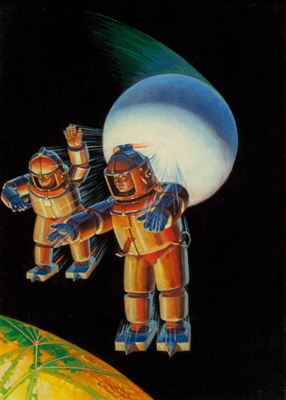 Howard Vachel Brown was born in Lexington, Kentucky, and received his art education at the School of the Chicago Art Institute. His work was exhibited at the National Academy and featured by the the International Exhibition of American Illustrators. From 1913-1931 Brown was the cover illustrator for Scientific American. He also illustrated for Gernsback's Electrical Experimenter, 1916-1917, and Argosy and Science and Invention in 1919.
Brown created every cover from January 1934 through May 1937 of Tremain's Astounding Stories and did about half of the covers through November 1938. After Gernsback lost Wonder Stories and his main artist Frank R. Paul stopped doing covers for that magazine, Brown did every cover from August 1936 through August 1940, with the exception of the August 1937 issue, which was done by H. W. Wesso.
Source:
http://isfdb.tamu.edu/cgi-bin/ea.cgi?Howard_V._Brown