Page loaded successfully. Showing biography for Howard Finster.
Howard Finster BIOGRAPHY
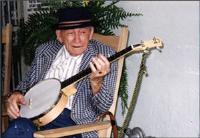
1916 Valley Head, Alabama - 2001 Rome, Georgia. Known for: Naive religious-words, folk art constructions.
For forty years, Howard Finster was a minister. After retirement, he lived in Summerville, Georgia, and constructed a garden dedicated to his religious beliefs. Called "Paradise Gardens Park and... Read full biography
For forty years, Howard Finster was a minister. After retirement, he lived in Summerville, Georgia, and constructed a garden dedicated to his religious beliefs. Called "Paradise Gardens Park and Museum," it has become a fantastic world created from found objects-- fragments of mirrors, salvaged... Read full biography
For forty years, Howard Finster was a minister. After retirement, he lived in Summerville, Georgia, and constructed a garden dedicated to his religious beliefs. Called "Paradise Gardens Park and Museum," it has become a fantastic world created from found objects-- fragments of mirrors, salvaged refrigerator doors, concrete walls, hubcaps, mosaic cement paths, and a pump house of Coca-Cola bottles---all to the glory of the Lord. Finster appeared regularly on Sundays to great visitors and to... Read full biography
For forty years, Howard Finster was a minister. After retirement, he lived in Summerville, Georgia, and constructed a garden dedicated to his religious beliefs. Called "Paradise Gardens Park and Museum," it has become a fantastic world created from found objects-- fragments of mirrors, salvaged refrigerator doors, concrete walls, hubcaps, mosaic cement paths, and a pump house of Coca-Cola bottles---all to the glory of the Lord. Finster appeared regularly on Sundays to great visitors and to guide them through the maze of symbolic sculptures, structures including a John Deer tractor and the Tomb of the Unknown Body. Indeed he has become a much-loved man for the vigor of his beliefs and his compassion towards others. Except for a book of... Read full biography
For forty years, Howard Finster was a minister. After retirement, he lived in Summerville, Georgia, and constructed a garden dedicated to his religious beliefs. Called "Paradise Gardens Park and Museum," it has become a fantastic world created from found objects-- fragments of mirrors, salvaged refrigerator doors, concrete walls, hubcaps, mosaic cement paths, and a pump house of Coca-Cola bottles---all to the glory of the Lord. Finster appeared regularly on Sundays to great visitors and to guide them through the maze of symbolic sculptures, structures including a John Deer tractor and the Tomb of the Unknown Body. Indeed he has become a much-loved man for the vigor of his beliefs and his compassion towards others. Except for a book of drawings he did in the 1930s, he did not do paintings until 1976 when he had a vision to do sacred art. He began to... Read full biography
Artist Biography
Biography page for Howard Finster ((1916 - 2001)), known for Naive religious-words, folk art constructions. Showing 3 biographical entries and 0 sample artworks.
Howard Finster - Artist Info
About Howard Finster
Name variants
William Howard Finster
Biography from the Archives of askART
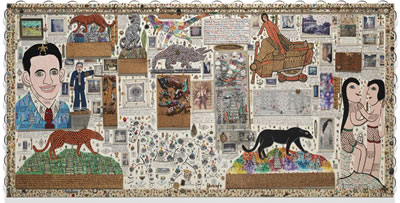 For forty years, Howard Finster was a minister. After retirement, he lived in Summerville, Georgia, and constructed a garden dedicated to his religious beliefs. Called "Paradise Gardens Park and Museum," it has become a fantastic world created from found objects-- fragments of mirrors, salvaged refrigerator doors, concrete walls, hubcaps, mosaic cement paths, and a pump house of Coca-Cola bottles---all to the glory of the Lord.
Finster appeared regularly on Sundays to great visitors and to guide them through the maze of symbolic sculptures, structures including a John Deer tractor and the Tomb of the Unknown Body. Indeed he has become a much-loved man for the vigor of his beliefs and his compassion towards others.
Except for a book of drawings he did in the 1930s, he did not do paintings until 1976 when he had a vision to do sacred art. He began to mount them on glass salvaged from television screens. His mediums became oil, house paint, watercolor and car lacquer--all wild Baroque creations. In 1999, he completed a 4 X 8 foot painting of The Last Supper.
He has painted album covers for the rock groups R.E.M. and Talking Heads, the latter voted album cover of the year in 1985 by Rolling Stone Magazine. In 1996, Finster was commissioned by the Coca Cola Company to paint an eight foot Olympic Coke Bottle to represent the United States Art exhibits at the Olympics.
In December 1995, the High Museum of Atlanta, Georgia held a Birthday Party exhibit for Finster that proved to be one of the most highly attended events at the museum.
He and his wife Pauline raised five children.
Source:
Chuck and Jan Rosenak, Contemporary American Folk Art, and Museum of Folk Art Encyclopedia
Alice Rae Yelen, "Passionate Visions", American Art Review, February 1995Biography from Outsider Folk Art Gallery
Howard Finster is a well-known self-taught artist. Born in Alabama, he attended school for six years. He married Pauline Freeman in 1935 and had five children.
He was a 'jack-of-all-trades': house painter, bicycle and lawnmower repairman-anything to support his family. Finster was also a Baptist Minister for about 40 years until, in 1965, he realized no one in his congregation was listening to him. At this time he was directed by the Lord to transform his swampland in Pennville, Georgia into Paradise Garden. In 1976 an angel appeared upon the paint on his finger and said "paint sacred art".
Finster never stopped. He was inspired to get out the Lord's message. Finster was a master promoter. After his first dealer, Jeff Camp, failed to sell his painting, he found Phyllis Kind, who brought his work to prominence.
Finster and his family produced some 50,000 works many of which were signed, dated and numbered. A show of his cosmology and masterworks was presented at Lehigh University in the Fall of 2004.Biography from The Johnson Collection
WILLIAM HOWARD FINSTER (1916–2001)
Over the course of his extraordinary career, William Howard Finster was referred to by a number of nicknames—monikers ascribed by Finster himself, by admirers and customers, and eventually by the nation’s top art curators and critics. These appellations included “the Grandfather of Southern Folk Art,” “the second Noah,” and “man of visions.” The title he liked best, however, was “preacher,” for in all his varied pursuits Finster’s primary goal was to spread his Christian faith, by whatever means possible. In the end, his most effective evangelizing tool was the nearly forty-eight thousand paintings and sculptures he created in the second half of his life.
Largely using scrap materials, Finster filled salvaged picture planes with images and writings that simultaneously evoke the illuminated manuscripts of William Blake as well as the eye-catching, homespun billboards that peppered American backroads in the early twentieth century. In addition to fabricating sought-after art objects, Finster transformed his north Georgia property into “Paradise Garden,” a roadside attraction cast in cement, repurposed materials, and paint, and welcomed visitors into his immersive world.
The divine revelations that informed Finster’s personal mythos and stoked his imagination began in early childhood. The youngest of thirteen children, he spent time between chores carving decorative jugs and bottles in a makeshift woodshop and assembling sticks, stones, and other supplies sourced from his family’s farm into small-scale structures. Although his parents were not regular churchgoers, Finster committed to a life of ministry as a teenager.
Having quit school after the sixth grade, he married Pauline Freeman in 1935. He then took up his calling, traveling throughout the rural South to preach at tent revivals, local churches, and even the roof of his own car. His earliest drawings were devised as teaching tools: “chalk work” blackboard diagrams, sketched for his Sunday school classes, combined words and pictures in a style that would characterize his later paintings.
In addition to his ministry, Finster worked in textile factories and sawmills, as a handyman, and doing small repairs, work that occasionally took him to the county garbage dump. Even there, he found inspiration and spiritual resonance, likening the detritus to a preview of a world to come and the concept of redemption: “I myself never had anything worth much, but when I went to the dump, I saw beautiful things that people threw away. . . . I said these things need to be displayed.”
After creating his first “museum-park” in Trion, Georgia, he subsequently purchased four acres of land in nearby Pennville in 1961 and began constructing the dynamic art installation that would become his largest work. Concrete was his primary medium, applied over armatures of bike frames and adorned in reclaimed supplies, including jewelry, bottle caps, glass, and even a jar containing his son’s preserved tonsils. Finster retired from the pulpit in 1965 to focus exclusively on the project. A 1975 Esquire article titled “Backyards, The Garden of Paradise” featured Finster’s grounds, and the national publicity brought sightseers—and art dealers—to what became known as “Paradise Garden.”
In 1976, Finster experienced what was perhaps the most influential vision of his life. While fixing a bicycle, a small human face appeared in a paint smudge on his forefinger and commanded him to paint sacred art. Finster intended to create five thousand objects in total—a goal he reached in 1985 and significantly surpassed before his death—numbering and dating each piece, sometimes to the minute of completion. Finster was rigorously devoted to his process, foregoing a traditional daily schedule in favor of working around the clock, sleeping in his clothes, and taking periodic naps. Using tractor enamel and plywood, he filled surfaces––wood cutouts, shoes, even his Cadillac––with fantastical land and cityscapes, crowding them with sermon-like text and scripture passages.
Animals and angels, along with historical and pop culture figures like George Washington, Elvis Presley, and the Coca-Cola bottle, were regular subjects. Commissioned works for secular rock bands like R.E.M. and Talking Heads, reached millions. In 1983, Finster appeared on Johnny Carson’s Tonight show, where he won over the audience playing his banjo and singing. The following year, Folkways Records (now known as Smithsonian Folkways Recordings) recorded him performing music and telling stories in Paradise Garden; the album, Howard Finster: Man of Many Voices, was released in 1984 and featured liner notes authored by artist-musician Art Rosenbaum. Finster appreciated the exposure: “They read my message on album covers and in magazines,” he said in a 1989 interview. “Forty years I pastored and my messages were forgot, probably every one. But my art’s reaching presidents, reaching kings and queens, reaching all over the world.”
Finster’s style dovetailed with the national art market of the late 1970s and early 1980s, when Neo-Expressionism’s raw application of materials and Pop Surrealism’s wry sense of humor were the vogue. He began participating in exhibitions in 1976; in 1977, the Library of Congress commissioned four paintings for the American Folklife Center in Washington, DC. His inclusion in an American exhibition of self-taught artists at the 1984 Venice Biennale drew considerable attention.
Paradise Garden was an ongoing project for Finster over the years. New features and galleries were constantly added, crafted from bottles, bicycles, and detritus. Using funds from a National Endowment for the Arts grant, he converted an adjacent abandoned chapel into the World’s Folk Art Church in 1981. The site became a place of pilgrimage for believers and fans, including artists Keith Haring and Purvis Young, who considered Finster an inspiration and influence. Aided by his children and grandchildren, Finster continued to make and sell works as he aged, favoring Sharpie markers and paint pens as his primary media. He and Pauline moved away from Paradise Garden in the final years of his life, and Finster died in Rome, Georgia at age eighty-four.
Finster’s work is widely exhibited and represented in the permanent collections of the Smithsonian American Art Museum, the National Portrait Gallery, and the Philadelphia Museum of Art, among others. The High Museum of Art in Atlanta, which presented the landmark 1996 exhibition, Howard Finster: Visions from Paradise Garden, holds the largest institutional body of his work. After falling into disrepair following Finster’s death, Paradise Garden was purchased by Chattooga County, Georgia, in 2011 and restored by the Paradise Garden Foundation. It admits ten thousand guests annually and is listed on the National Register of Historic Places.
The Johnson Collection, Spartanburg, South Carolina
thejohnsoncollection.org