Page loaded successfully. Showing biography for Hubert Robert.
Hubert Robert BIOGRAPHY
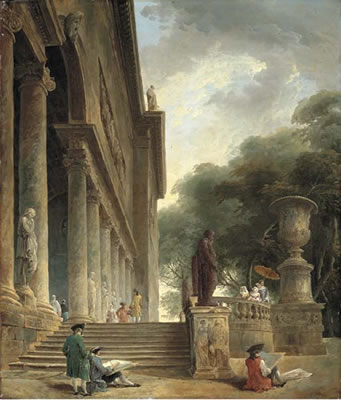
1733 Paris, France - 1808 Paris, France. Known for: Historical scene, architecture and portrait painting.
An artist whose subjects ranged from portraits to classical ruins, Hubert Robert is also remembered for the liveliness of his personality, his prolific drawings and paintings, and his adventurous... Read full biography
An artist whose subjects ranged from portraits to classical ruins, Hubert Robert is also remembered for the liveliness of his personality, his prolific drawings and paintings, and his adventurous spirit. Among his works are romantic, allegorical landscape scenes, often of the French countryside,... Read full biography
An artist whose subjects ranged from portraits to classical ruins, Hubert Robert is also remembered for the liveliness of his personality, his prolific drawings and paintings, and his adventurous spirit. Among his works are romantic, allegorical landscape scenes, often of the French countryside, and also views of Rome and Paris. One of them, Grand Galerie of the Louvre in Ruins was a fantasy, but another, Hotel Dieu in Flames, was from an on-site sketch of the event. He exhibited numerous times... Read full biography
An artist whose subjects ranged from portraits to classical ruins, Hubert Robert is also remembered for the liveliness of his personality, his prolific drawings and paintings, and his adventurous spirit. Among his works are romantic, allegorical landscape scenes, often of the French countryside, and also views of Rome and Paris. One of them, Grand Galerie of the Louvre in Ruins was a fantasy, but another, Hotel Dieu in Flames, was from an on-site sketch of the event. He exhibited numerous times at the Salons, and his work was very popular with aristocratic, prominent persons, likely helped by the fact that his father, Nicolas Robert, was an upper-servant to the Marquis of Choiseul-Stainville, who was very well connected in upper class... Read full biography
An artist whose subjects ranged from portraits to classical ruins, Hubert Robert is also remembered for the liveliness of his personality, his prolific drawings and paintings, and his adventurous spirit. Among his works are romantic, allegorical landscape scenes, often of the French countryside, and also views of Rome and Paris. One of them, Grand Galerie of the Louvre in Ruins was a fantasy, but another, Hotel Dieu in Flames, was from an on-site sketch of the event. He exhibited numerous times at the Salons, and his work was very popular with aristocratic, prominent persons, likely helped by the fact that his father, Nicolas Robert, was an upper-servant to the Marquis of Choiseul-Stainville, who was very well connected in upper class circles. Ironically Robert's parents much objected to his plans to become an artist.... Read full biography
Artist Biography
Biography page for Hubert Robert ((1733 - 1808)), known for Historical scene, architecture and portrait painting. Showing 1 biographical entries and 0 sample artworks.
Hubert Robert - Artist Info
About Hubert Robert
Name variants
Robert Hubert
Biography from the Archives of askART
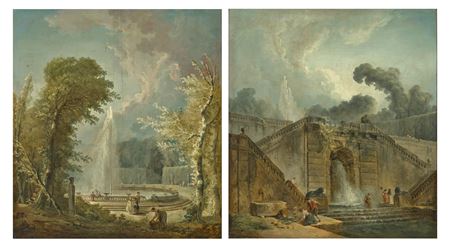 An artist whose subjects ranged from portraits to classical ruins, Hubert Robert is also remembered for the liveliness of his personality, his prolific drawings and paintings, and his adventurous spirit. Among his works are romantic, allegorical landscape scenes, often of the French countryside, and also views of Rome and Paris. One of them, Grand Galerie of the Louvre in Ruins was a fantasy, but another, Hotel Dieu in Flames, was from an on-site sketch of the event.
He exhibited numerous times at the Salons, and his work was very popular with aristocratic, prominent persons, likely helped by the fact that his father, Nicolas Robert, was an upper-servant to the Marquis of Choiseul-Stainville, who was very well connected in upper class circles. Ironically Robert's parents much objected to his plans to become an artist.
In the 1770s, Hubert Robert received the appointment of draftsman and designer of the King's gardens. For the Marquis de Laborde and the Marquis de Girardin, he also designed gardens. For Madame Geoffrin, he did a series of garden views that were "among the best of his work done for prominent private patrons." (european) The philosopher, Voltaire, selected him to paint decorations for his theatre at Ferney.
He received a classical education from 1745-1751 at the College de Navarre, which was operated by Jesuit priests and, next to the Sorbonne, was considered the best school in Paris. He studied with Michel-Ange Slotz, a sculptor, and from him learned much about perspective and drawing as well as sculpture. However, he decided his preference was painting rather than sculpture. The classical training he received at the College was apparent in much of his work on which he frequently had Latin inscriptions and scenes of classical ruins.
In 1754, he went to Rome with the entourage of the Count of Stainville, who had just been appointed ambassador to Italy from France, and who was the son of the Marquis who employed his father, Nicolas Robert. He stayed in Rome for eleven years and made many excellent connections including with artists Francesco Piranesi and Giovanni Panini, leading painters who were very influential on his work. He took advantage of educational opportunities such as the special permission he was granted to join the students at the Academy of Rome. He became friends with the Rococo painter, Jean-Honore Fragonard, and formed an association with the Abbé de Saint-Non, from whom he got commissions for drawings to be engraved by the Abbé for a book the Abbé was doing on Italian cities and antiquities. Robert accompanied him to Naples in 1760, and staying there for five years, he learned much about classical Rome and also saw the ruins of Pompeii.
In 1765, he returned to Paris and had immediate positive response to his painting and was voted into the Académie Royale. His work combined influence from his years in Rome, especially the "romanticized version of the style of Panini and visionary architect Giovanni Battista." (Getty). His first exhibit at the Salon was in 1767, and with his growing reputation, he became the designer of the King's gardens at Versailles as well as the keeper of the paintings of Louis XVI. Many of his paintings recorded Parisien life "from fires to festivals to urban renewal projects." (Getty)
During the French Revolution, he was briefly imprisoned, and escaped the guillotine because another man who had the same name went in his place. Afterwards he became one of the first curators of the Louve Musée.
Hubert Robert died April 15, 1808 of apoplexy.
Sources:
http://www.europeanpaintings.com/exhibits/xviiicent/roberbio.htm
http://en.wikipedia.org/wiki/Hubert_Robert
http://www.getty.edu/art/gettyguide/artMakerDetails?maker=284&page=1