Page loaded successfully. Showing biography for Hughie Lee-Smith.
Hughie Lee-Smith BIOGRAPHY
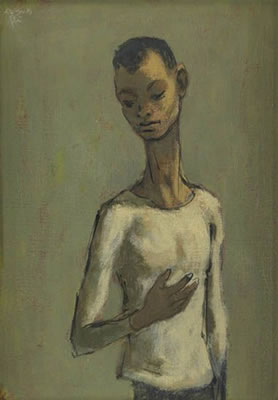
1915 Eustis, Florida - 1999 Albuquerque, New Mexico. Known for: Figure in desolate landscape painting, surrealism, teaching.
Hughie Lee-Smith was born in 1911 in Eustis, Florida. He moved with his mother to Cleveland, Ohio when he was ten years old. His work of the 1930s was characterized by a gently expressionistic social... Read full biography
Hughie Lee-Smith was born in 1911 in Eustis, Florida. He moved with his mother to Cleveland, Ohio when he was ten years old. His work of the 1930s was characterized by a gently expressionistic social realism reminiscent of Ben Shahn. In 1937 he won a scholarship to the Detroit Society of Arts and... Read full biography
Hughie Lee-Smith was born in 1911 in Eustis, Florida. He moved with his mother to Cleveland, Ohio when he was ten years old. His work of the 1930s was characterized by a gently expressionistic social realism reminiscent of Ben Shahn. In 1937 he won a scholarship to the Detroit Society of Arts and Crafts. In 1947 after studying at the Cleveland Institute of the Arts, working under the Works Progress Administration, teaching college art courses and serving as an artist for the United States Navy,... Read full biography
Hughie Lee-Smith was born in 1911 in Eustis, Florida. He moved with his mother to Cleveland, Ohio when he was ten years old. His work of the 1930s was characterized by a gently expressionistic social realism reminiscent of Ben Shahn. In 1937 he won a scholarship to the Detroit Society of Arts and Crafts. In 1947 after studying at the Cleveland Institute of the Arts, working under the Works Progress Administration, teaching college art courses and serving as an artist for the United States Navy, he found himself working in a Ford foundry. It was not long before he began to paint in a more energetically primitivist style. By 1950 this approach had evolved into a sophisticated kind of magic realism bordering on the surreal. He was an elder... Read full biography
Hughie Lee-Smith was born in 1911 in Eustis, Florida. He moved with his mother to Cleveland, Ohio when he was ten years old. His work of the 1930s was characterized by a gently expressionistic social realism reminiscent of Ben Shahn. In 1937 he won a scholarship to the Detroit Society of Arts and Crafts. In 1947 after studying at the Cleveland Institute of the Arts, working under the Works Progress Administration, teaching college art courses and serving as an artist for the United States Navy, he found himself working in a Ford foundry. It was not long before he began to paint in a more energetically primitivist style. By 1950 this approach had evolved into a sophisticated kind of magic realism bordering on the surreal. He was an elder statesman of the American imagination, and his very fine technical accomplishments are gratifyingly matched by his obvious and abundant l... Read full biography
Artist Biography
Biography page for Hughie Lee-Smith ((1915 - 1999)), known for Figure in desolate landscape painting, surrealism, teaching. Showing 5 biographical entries and 0 sample artworks.
Hughie Lee-Smith - Artist Info
About Hughie Lee-Smith
Name variants
Hughie Lee Smith
Biography from the Archives of askART
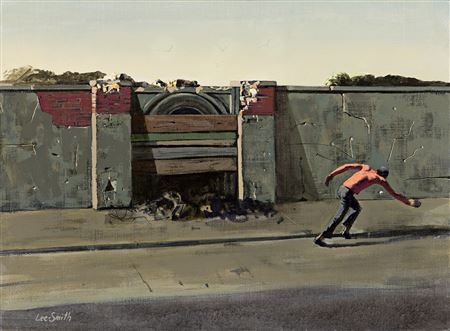 Hughie Lee-Smith was born in 1911 in Eustis, Florida. He moved with his mother to Cleveland, Ohio when he was ten years old. His work of the 1930s was characterized by a gently expressionistic social realism reminiscent of Ben Shahn. In 1937 he won a scholarship to the Detroit Society of Arts and Crafts.
In 1947 after studying at the Cleveland Institute of the Arts, working under the Works Progress Administration, teaching college art courses and serving as an artist for the United States Navy, he found himself working in a Ford foundry.
It was not long before he began to paint in a more energetically primitivist style. By 1950 this approach had evolved into a sophisticated kind of magic realism bordering on the surreal. He was an elder statesman of the American imagination, and his very fine technical accomplishments are gratifyingly matched by his obvious and abundant love for the human quandary.
In 1958 he moved to New York City and taught at the Art Students League for fifteen years. He became an associate member of the National Academy in 1963 and a full member in 1967. He was the second black member to be named, after Henry Tanner. In 1994 he was commissioned to paint the official City Hall portrait of then mayor David Dinkins. Lee-Smith died on February 23, 1999 at the age of eighty-three.
Written and submitted by Jean Ershler Schatz, artist and researcher from Laguna Woods, California.
Sources include:
Gerrit Henry in Art in America, February, 1990
ARTnews, October 1994
Obituary in Art in America, April 1999Biography from the Archives of askART
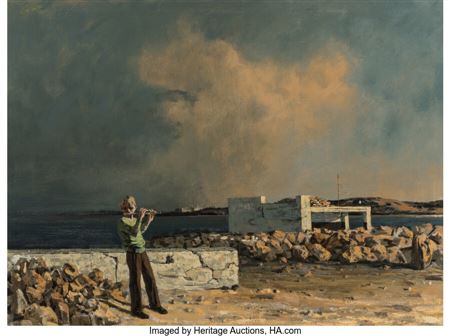 An African-American artist known for oil painting and etchings, Hughie Lee-Smith was born in Eustis, Florida and in 1938 began study at the Cleveland Institute of Art. He attended Wayne State University in Detroit and then began teaching art.
In 1994, he received an honorary doctorate from the Maryland Institute College of Fine Art. Hughie Lee-Smith was also elected an associate member of the National Academy of Design, the second African-American given that distinction.
In 1994, he was commissioned to paint the official portrait of David Dinkins, then Mayor of New York City.
Work by Lee-Smith is in the collections of the Metropolitan Museum of Art, Detroit Institute of Arts, National Gallery in Washington DC, Howard University and the Schomburg Center for Research in Black Culture in New York City.
Hughie Lee-Smith died of cancer at age 83 in Albuquerque, New Mexico
Sources:
http://www.grnnamdigallery.com/dynamic/artist_bio.asp?ArtistID=25
http://www.findarticles.com/p/articles/mi_m1355/is_16_95/ai_54731430Biography from Michael Rosenfeld Gallery
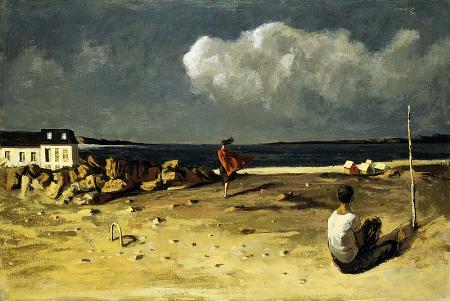 Hughie Lee-Smith was born in Eustis, Florida and raised in Cleveland, Ohio. Lee-Smith received early artistic training at the Karamu House, the Cleveland School of Art (later renamed the Cleveland Institute of Art), and the Detroit Society of Arts and Crafts School.
From 1938 to 1939 he was employed by the Ohio Federal Arts Project. After serving in the United States Navy during World War II, he used funds from the G.I. Bill to earn his B.S. from Wayne State University in Detroit (1953).
Lee-Smith is known for his highly realistic and somewhat surreal paintings of figures in desolate urban landscapes that are fraught with psychological tension; he stated: "In the 1960s, I began to lose my youthful dream of a better world - free of racism, free of the threat of instantaneous cremation of the bomb - and feed on a slow burning disillusionment. As a consequence, my work turned inward, and I began to seek some sort of essence to it all."
Lee-Smith taught at several distinguished institutions and is the recipient of numerous awards. In 1967 he was elected to the National Academy of Design, and in 1984, Hughie Lee-Smith Day (October 19th) was proclaimed in Cleveland, Ohio. In 1988, the New Jersey State Museum organized a traveling retrospective of his work, and in 1997, Lee-Smith was the subject of an exhibition at the Ogunquit Museum of American Art in Maine.Biography from The Johnson Collection
HUGHIE LEE-SMITH (1915-1999)
Art historians have used various words to describe Hughie Lee-Smith’s art: mystical, metaphysical, romantic realism, surrealist. Placing him in a specific category is challenging, but it is clear that his painting is consistently distinctive.
A native of Eustis, Florida, Lee-Smith lived alternately with both his mother and grandmother as a young child, first in Atlanta and then in Cleveland, Ohio. These years were somewhat solitary, and he turned to drawing and copying reproductions of old masters as entertainment. When his mother recognized this interest, she enrolled her ten-year-old son in Saturday classes at the Cleveland Museum of Art. Two years later, he transferred to the Cleveland School of Art (after 1949 known as the Cleveland Institute of Art) for further instruction. As a student at East Technical High, he was involved in the glee club, theatrical performances, and track. It is at this point that he hyphenated his name to make it more distinguished.
In 1934, Lee-Smith won a Scholastic magazine scholarship to study at the Detroit Society of Arts and Crafts. Returning home, he continued his education at the Cleveland School of Art, graduating in 1938 with honors as well as funding for a fifth year of postgraduate study. He also worked on a series of lithographs under the auspices of the Ohio branch of the Works Progress Administration. A year later, he moved to Orangeburg, South Carolina, to chair the art department at historically black Claflin College. Alarmed by the intense prejudice and limited opportunities for African Americans beyond the campus, Lee-Smith's tenure there lasted only two years
The year 1941 saw Lee-Smith back in Detroit and working for the Ford Motor Company on Pratt-Whitney engines for the war effort. He did not neglect his art, however, and won the purchase prize at Atlanta University’s prestigious exhibition of African American art—an event he later called a professional turning point. In 1943, he was drafted into the United States Navy; he served at the Naval Station Great Lakes near Chicago where he was tasked with painting patriotic subjects to lift morale. Following the war, he took up residence again in Detroit; under the GI Bill, he resumed his studies—first at the Detroit Society and then in 1953 at Wayne State University, where he earned a bachelor’s degree in art education.
Inspired by the urban blight he encountered in Detroit, Lee-Smith created compelling scenes of desolation and isolation, such as Rooftop. Racially ambiguous figures frequently populate his spare cityscapes, which resemble stage sets. Although his enigmatic work garnered critical recognition at group exhibitions and won numerous prizes, he largely supported himself by teaching in a variety of settings. He left the Midwest in 1958 for New York, living in the East Village while teaching in the Princeton, New Jersey school system. From 1969 to 1971, he was artist-in-residence and then acting art department chair at Howard University, during a period when the Black Arts Movement was in ascendancy. Lee-Smith also spent fifteen years as an instructor at the Art Students League.
In the 1960s, Lee-Smith began to exhibit regularly at the National Academy of Design, earned several awards, and was made a full academician in 1967, becoming only the second African American after Henry O. Tanner to earn this honor. Despite a lengthy list of exhibitions at commercial galleries and museums, it was not until 1988 that Lee-Smith was given a full-fledged retrospective. Lee-Smith’s work is represented in the collections of the Metropolitan Museum of Art, the Smithsonian American Art Museum, the Detroit Institute of Art, and Howard University, among others.
The Johnson Collection, Spartanburg, South Carolina
thejohnsoncollection.orgBiography from ARTneo
He studied at the Cleveland School of Arts, Center for the Creative arts( Detroit) National Youth Administartion program. In 1930, he taught disadvantaged black children.
Figurative painting style led him to NYC where he taught as well as in Vermont, New Jersey and Art Students League until 1987.
Painted murals. First African American elected to the National Academy of Design( 1987) since Henry Ossawa Tanner in 1927.