Ippolito Caffi BIOGRAPHY
Artist Biography
Biography page for Ippolito Caffi ((1809 - 1866)), known for Architecture, landscape and marine painting-atmospherics. Showing 2 biographical entries and 0 sample artworks.
Ippolito Caffi - Artist Info
About Ippolito Caffi
Biography from the Archives of askART
 Ippolito Caffi was an Italian painter of architectural subjects and seascapes or urban "vedute". He was born at Belluno, Italy to James and Mary Castellani. He studied in Belluno and then in Padua with his cousin the painter Pietro Paoletti, who worked in conjunction with another artist from Belluno in neoclassical style. He studied and produced his first work at the Accademia in Venice where he was able to know the Venetian painters of the eighteenth century. His Rialto Bridge is an example of this period.
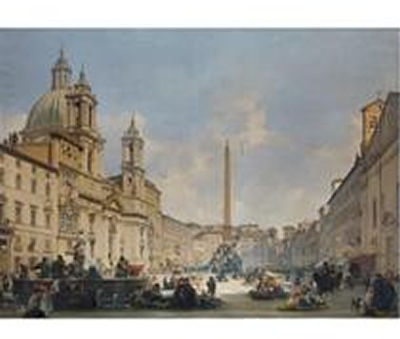
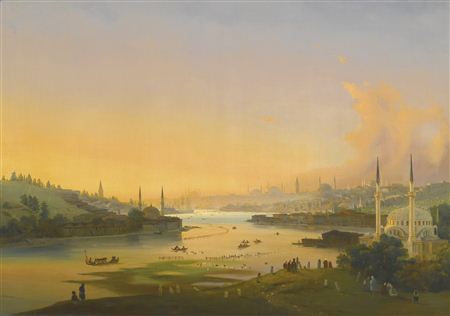
In 1832, Caffi moved to Rome, and in early 1833, opened his own studio, devoting himself to painting and drawing from life. He made some reputation by his treatise on perspective, as well as by his investigations on Roman archaeology. Domiciled in Rome, he often moved to other cities to exhibit his works. In Rome he made a trip in a hot air balloon, which influenced him to paint two pictures almost romantic and also from a unique perspective. In 1843, he visited Athens, Turkey, Palestine and Egypt, returning in 1844 with many sketches and paintings.
The first work of his that created a sensation was Carnival at Venice, which was exhibited at Paris in 1846, and was admired for its brilliant effects of light. Other works of this period are his Panorama of Rome from Monte Mario, Isthmus of Suez, and Close of the Carnival at Rome.
Caffi was highly political and in Venice in 1848 joined revolutionary movements for independence. This activity led to his being captured in 1848 and detained during that year. In 1849, he lived in Genoa and Switzerland; in 1850 in Turin; and then in London during a series of trips. In 1858, he was back in Venice and in more trouble for political activities as he was convicted in 1860 of "the crime of public violence" and imprisoned for three months at San Severo. After his release, he went to Naples, joined the successful army of independence of Garibaldi, and then returned to Venice to resume painting.
However, his political interests led to his death in 1866. Wanting to capture a naval battle on canvas, Caffi died at age 57 on a ship, the King of Italy during the Battle of Lissa, which was part of the Third Italian War for Independence. With Caffi, his comrades and the rest of the crew, the ship went down on its way from Venice to Florence.
Of Ippolito Caffi, it was written that throughout his life he managed to keep a high enough standard of living by selling his paintings, some replicated many times, to European nobility, including the Prince of Austria. Although inspired by models of eighteenth-century Venice, he was able to modernize the vocabulary of pictorial views, by exploring new points of view as in night scenes and with unusual topics such as the flight of the balloon.
Although he was much appreciated in life, Caffi had to wait for the mid-1960s to be seriously considered by art historians. With the major exhibition in Venice to celebrate the centenary of his death, appreciation of his painting began to grow. His paintings were very numerous and some of it was lost.
At the Museo Civico of Belluno there are a few works: Night Festival in San Pietro di Castello (oil on canvas) Caravan in the Desert (oil on canvas) Health and the Grand Canal with the Snow (oil on canvas ) Belluno and Mount Serva (oil on canvas) Piazza San Marco with the Fog (oil on canvas). Other paintings are in private collections and numerous other works are preserved in museums, palaces and villas of many Italian and European cities: Vatican City, Copenhagen, Rome, Turin, Treviso, Trieste, Venice.
Literature:
Jane Turner (ed.), The Dictionary of Art. 5, p. 378. New York, Grove, 1996.
Michael Bryan (1886). Robert Edmund Graves. ed. Dictionary of Painters and Engravers, Biographical and Critical (Volume I: A-K). York St. #4, Covent Garden, London
Sources:
Wikipedia,
http://it.wikipedia.org/wiki/Ippolito_Caffi
http://en.wikipedia.org/wiki/Ippolito_CaffiBiography from Dorotheum, Vienna
Ippolito Caffi was born in Belluno, but spent most of his life travelling throughout Italy and further afield to Egypt, Turkey and Greece. In 1832, when he was still a young man, he moved to Rome, where he quickly became successful as a vedutista. There, he painted the celebrated piazze and monuments of the Eternal City. In 1835, he published his treatise on perspective, "Lezione di prospettiva pratica", showcasing his mastery of both the theory and practice of spatial construction. Building upon the tradition established by Canaletto, Caffi modernised the genre of vedute. Throughout his career, he frequently travelled between Rome and Venice, where the present work was created.
The composition captures the charm and atmospheric character of Venice. The scene opens onto the Molo and the entrance to the Piazzetta San Marco. To the left is the Doge’s Palace, which guides the viewer’s gaze along the broad promenade of the Riva degli Schiavoni, one of the city’s most recognisable areas. In the centre stand the two famous columns: the Column of San Marco, topped by the winged lion, and the Column of San Todaro.
More than just a visual record of this important site, Caffi captures the vitality of Venetian life. The elongated shadows in the foreground suggest a late afternoon setting, and figures of Venetians strolling along the Riva bring the scene to life.
Caffi’s paintings introduced a new approach to the tradition of vedute painting. His interest in the effects of light and atmosphere is immediately visible in the present painting.