Page loaded successfully. Showing biography for Ismael De La Serna.
Ismael De La Serna BIOGRAPHY
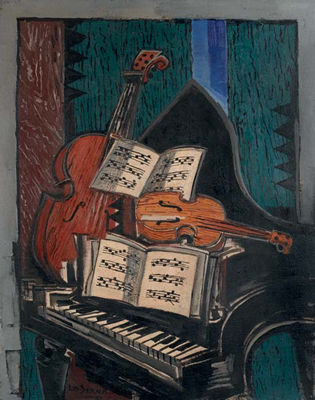
1898 Granada, Spain - 1968 Paris, France. Known for: Cubist and abstract painting-still life, figure, illustration.
Ismael Gonzålez de la Serna was born in 1898 in Granada, Spain. He began painting and drawing when he was nine years old. While in school, he became friends with Federico Garcia Lorca, later to... Read full biography
Ismael Gonzålez de la Serna was born in 1898 in Granada, Spain. He began painting and drawing when he was nine years old. While in school, he became friends with Federico Garcia Lorca, later to become a famous poet. Indeed, it was De La Serna who in 1918 illustrated Garcia Lorca's first book,... Read full biography
Ismael Gonzålez de la Serna was born in 1898 in Granada, Spain. He began painting and drawing when he was nine years old. While in school, he became friends with Federico Garcia Lorca, later to become a famous poet. Indeed, it was De La Serna who in 1918 illustrated Garcia Lorca's first book, Impresiones y Paisajes. De la Serna pursued his studies at the Academy of Fine Arts in Granada, where he learned the traditional rules of composition, form, and color. A turning point came in his life in... Read full biography
Ismael Gonzålez de la Serna was born in 1898 in Granada, Spain. He began painting and drawing when he was nine years old. While in school, he became friends with Federico Garcia Lorca, later to become a famous poet. Indeed, it was De La Serna who in 1918 illustrated Garcia Lorca's first book, Impresiones y Paisajes. De la Serna pursued his studies at the Academy of Fine Arts in Granada, where he learned the traditional rules of composition, form, and color. A turning point came in his life in 1917, when he viewed an exhibition of French Impressionists in Madrid. By his own testimony, thereafter he was determined to be a "free" painter, devoted to new forms. In 1915, at age seventeen, he exhibited for the first time in Granada. A few years... Read full biography
Ismael Gonzålez de la Serna was born in 1898 in Granada, Spain. He began painting and drawing when he was nine years old. While in school, he became friends with Federico Garcia Lorca, later to become a famous poet. Indeed, it was De La Serna who in 1918 illustrated Garcia Lorca's first book, Impresiones y Paisajes. De la Serna pursued his studies at the Academy of Fine Arts in Granada, where he learned the traditional rules of composition, form, and color. A turning point came in his life in 1917, when he viewed an exhibition of French Impressionists in Madrid. By his own testimony, thereafter he was determined to be a "free" painter, devoted to new forms. In 1915, at age seventeen, he exhibited for the first time in Granada. A few years later, upon his second exhibition, the art critic Manuel Robles wrote: "There is no dou... Read full biography
Artist Biography
Biography page for Ismael De La Serna ((1898 - 1968)), known for Cubist and abstract painting-still life, figure, illustration. Showing 2 biographical entries and 0 sample artworks.
Ismael De La Serna - Artist Info
About Ismael De La Serna
Name variants
Isamel De La Serna, Ismael del la Serna, Ismaël Gonzalez de la Serna
Biography from Papillon Gallery
Ismael Gonzålez de la Serna was born in 1898 in Granada, Spain. He began painting and drawing when he was nine years old. While in school, he became friends with Federico Garcia Lorca, later to become a famous poet. Indeed, it was De La Serna who in 1918 illustrated Garcia Lorca's first book, Impresiones y Paisajes.
De la Serna pursued his studies at the Academy of Fine Arts in Granada, where he learned the traditional rules of composition, form, and color. A turning point came in his life in 1917, when he viewed an exhibition of French Impressionists in Madrid. By his own testimony, thereafter he was determined to be a "free" painter, devoted to new forms.
In 1915, at age seventeen, he exhibited for the first time in Granada. A few years later, upon his second exhibition, the art critic Manuel Robles wrote: "There is no doubt that de la Serna knows color and his spirit penetrates the essence and line of his work." Nonetheless, Robles hoped that de la Serna would abandon the spirit of Modernism."
The Spanish artistic community, unlike that in neighboring France, was resistant to the innovations of Post-impressionism. Granada in particular imposed intolerable limits on such an "extraordinary soul" as De La Serna's, as it was described by Lorca.
De La Serna, impassioned in his pursuit of his vocation and life's work, and yearning for a stimulating cultural environment, moved to Paris in 1921, where his compatriot, Picasso, had been an international figure in the cubist movement for more than a decade. He was introduced to Picasso by the writer, critic, and art collector known as Tériade. According to Tériade, Picasso, upon seeing de la Serna's work, exclaimed: "At last, a true painter! As grand as Juan Gris!"
The year 1927 was one of remarkable success for De La Serna. Tériade devoted an article on him in issues of the art review, "Cahiers d'Art", which simultaneously covered the works of luminaries such as Renoir and Picasso. Tériade wrote that De La Serna was the painter "we had all been waiting for." That is, his poetic sensibility lent in certain unity to his work and deftly combined a vigor of expression with a delicacy of form.
Paul Guillaume then organized an exhibition of fifty of De La Serna's works to wide acclaim. An individual exhibition at the Gallery Flechtheim in Berlin was equally successful, all of the works found buyers. The gallery even signed De La Serna to a contract, which remained in effect until 1933, when Hitler's rise to power forced its revocation.
The Nazi rise to power definitely had unfortunate consequences. It is thought that those works of De La Serna's still residing in Germany, including many of his most vulnerable paintings, were destroyed by the Nazi regime.
Luckily, De La Serna had been warmly received throughout Europe. In 1928, he signed contracts to exhibit his works at the Galerie Zak in Paris and at the Galerie Le Centaure in Brussels. Christian Zervos wrote enthusiastically in Cahiers d'Art that De La Serna's incredible skill at drawing allowed him to make abstractions of reality.
While a number of his works certainly echo the influence of Picasso and Braque, such influence was mirrored within a Cubism of his own making. In the instinctive equilibrium of his work, the blend of exuberance and sober expression, the use of color, and the strength of the lines, De La Serna reminded Zervos of Zurburan, El Greco, and Cézanne.
Indeed, to Zervos, Cubism brought out either a deep expressiveness due to the distortion of the central object or figure represented, or resulted in an abstract painting composed of forms independent of the exterior reality. In any case, representation of both possibilities was typical of de la Serna's work. The artist easily balanced and reconciled the extremes of both representation and abstraction. Although a traditional Cubist subject, Nature Mort de la Guitare is a strong example of de la Serna's Cubist technique of the late 1920's.
In 1930, the Galerie Zak devoted an entire exhibition to de la Serna;s works. The National Gallery of Berlin,and the museum of Mannheim both acquired paintings of his. In 1932, he returned triumphantly to Spain, where he toured with successful exhibitions throughout his homeland. In 1936, he took part in an exhibition at the Musée du Jeu de Paume in Paris. During this time, he rarely participated in public showings of his work. After the Second World War, he released works he had painted secretly which honored the Resistance and decried the atrocities of war.
De la Serna continued to work throughout the 1940's and 1950's. His style evolved into pure combinations of color and form. His paintings continued to be shown in France, Germany, Spain, and Mexico. In 1963, he was invited to participate in an exhibition of French paintings at the Tate Gallery in London and in an exhibition at the Hammer Gallery in New York.
In 1974, the Musée d'Art Moderne de la Ville de Paris organized a retrospective of nearly one hundred of de la Serna's paintings from throughout his career. The retrospective tracked the artist's diversity of subjects and the technical scope of his talent.
De la Serna died in Paris in 1968. His personal contributions to the language of art endure.Biography from Templum Fine Art Auction
Born in Guadix but raised in Granada, the city where he spent his childhood and adolescence, and where during his school years he would make friends with Federico García Lorca and Manuel Ángeles Ortiz, and as an adult, with Juan Cristóbal, Falla and Andrés Segovia.
At the Prado he practised as a copyist of El Greco, Titian, El Bosco and Francisco de Zurbarán. It was the latter's still lifes and his visit in 1917 to the exhibition "Great French Impressionist Painters" at the Museum of Modern Art in the capital of Spain that would later define part of his work.
He returned to Granada and made the cover of Impressions and Landscapes by his friend the poet Federico García Lorca. In 1921 he went to Paris, where he settled irregularly, with occasional returns to his country. In Paris his work was recognised by Picasso, the editor Tériade, and the poet, art dealer and host of the magazine Cahiers d'Art, Christian Zervos.
In 1932 he appeared in Spain, invited by the Society of Iberian Artists; that year he was recruited by Manuel Bartolomé Cossío to participate in the “Museo circulante” or “Museo del pueblo” of the Misiones Pedagógicas, together with Blesa, Fernández Mazas and Eduardo Vicente, coordinated by Ramón Gaya in the task of copying singular works. On 28 September 1933 he married Susana in Cannes, Zervos' first wife, with whom he travelled to Spain from Bilbao to Madrid and from there to Granada in 1933. In 1934 he was a witness at the wedding of Georgette and César Vallejo.
In 1937 he participated in the Spanish Pavilion at the International Exhibition in Paris. He held his last major exhibition in 1952. He died in Paris at the age of seventy. There is evidence of two retrospective exhibitions after his death, one in 1968 at the Museum of Modern Art in the City of Paris, and another in Spain in 1976, organised by the bank of Granada, the city in which a street is named after him.