Page loaded successfully. Showing biography for Ivan Konstantinovich Aivazovsky.
Ivan Konstantinovich Aivazovsky BIOGRAPHY
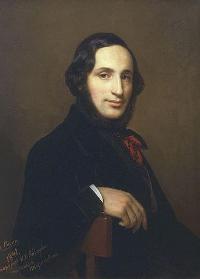
1817 Feodosiya, Crimea, Ukraine - 1900 Feodosiya, Crimea, Ukraine. Known for: Atmospheric marine scene painting.
Ivan Aivazovksy July 29, 1817 - May 5, 1900) was a Russian painter of Armenian descent living and working in Crimea, most famous for his seascapes, which constitute more than half of his paintings.... Read full biography
Ivan Aivazovksy July 29, 1817 - May 5, 1900) was a Russian painter of Armenian descent living and working in Crimea, most famous for his seascapes, which constitute more than half of his paintings. Aivazovsky was born in the town of Feodosiya (Theodosia), Crimea (Russian Empire) (modern-day... Read full biography
Ivan Aivazovksy July 29, 1817 - May 5, 1900) was a Russian painter of Armenian descent living and working in Crimea, most famous for his seascapes, which constitute more than half of his paintings. Aivazovsky was born in the town of Feodosiya (Theodosia), Crimea (Russian Empire) (modern-day Ukraine) to a poor Armenian family. His parents' family name was Aivazian. Some of the artist's paintings bear a signature, in Armenian letters, "Hovhannes Aivazian". His talent as an artist earned him... Read full biography
Ivan Aivazovksy July 29, 1817 - May 5, 1900) was a Russian painter of Armenian descent living and working in Crimea, most famous for his seascapes, which constitute more than half of his paintings. Aivazovsky was born in the town of Feodosiya (Theodosia), Crimea (Russian Empire) (modern-day Ukraine) to a poor Armenian family. His parents' family name was Aivazian. Some of the artist's paintings bear a signature, in Armenian letters, "Hovhannes Aivazian". His talent as an artist earned him sponsorship and entry to the Simferopol gymnasium and later the St.Petersburg Academy of Arts, which he graduated with a gold medal. Earning awards for his early landscapes and seascapes, he went on to paint a series of portraits of Crimean coastal towns... Read full biography
Ivan Aivazovksy July 29, 1817 - May 5, 1900) was a Russian painter of Armenian descent living and working in Crimea, most famous for his seascapes, which constitute more than half of his paintings. Aivazovsky was born in the town of Feodosiya (Theodosia), Crimea (Russian Empire) (modern-day Ukraine) to a poor Armenian family. His parents' family name was Aivazian. Some of the artist's paintings bear a signature, in Armenian letters, "Hovhannes Aivazian". His talent as an artist earned him sponsorship and entry to the Simferopol gymnasium and later the St.Petersburg Academy of Arts, which he graduated with a gold medal. Earning awards for his early landscapes and seascapes, he went on to paint a series of portraits of Crimean coastal towns before travelling throughout Europe. In later life, his paintings of naval scenes earned him a long-standing commission... Read full biography
Artist Biography
Biography page for Ivan Konstantinovich Aivazovsky ((1817 - 1900)), known for Atmospheric marine scene painting. Showing 4 biographical entries and 0 sample artworks.
Ivan Konstantinovich Aivazovsky - Artist Info
About Ivan Konstantinovich Aivazovsky
Name variants
Ivan Aivasosky, Ivan Constantinovitch Aivasovsky, Ivan Constantinovich Aivazofsky, Ivan Konstantinovitch Aivazovski, Iwan Konstantinowitsch Aiwasowski, Ivan Konstantinovisch Ajvasovskij, Iwan Konstantinowicz Ajwazowski
Biography from the Archives of askART
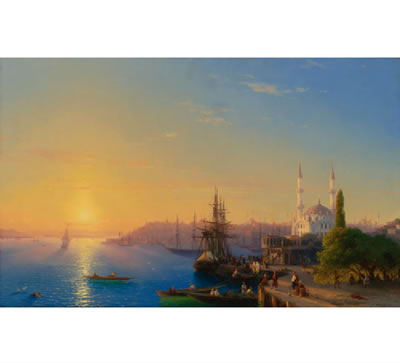 Ivan Aivazovksy July 29, 1817 - May 5, 1900) was a Russian painter of Armenian descent living and working in Crimea, most famous for his seascapes, which constitute more than half of his paintings.
Aivazovsky was born in the town of Feodosiya (Theodosia), Crimea (Russian Empire) (modern-day Ukraine) to a poor Armenian family. His parents' family name was Aivazian. Some of the artist's paintings bear a signature, in Armenian letters, "Hovhannes Aivazian".
His talent as an artist earned him sponsorship and entry to the Simferopol gymnasium and later the St.Petersburg Academy of Arts, which he graduated with a gold medal. Earning awards for his early landscapes and seascapes, he went on to paint a series of portraits of Crimean coastal towns before travelling throughout Europe. In later life, his paintings of naval scenes earned him a long-standing commission from the Russian Navy stationed in the Black Sea.
In 1845, Aivazovsky went to Constantinople upon the invitation of Sultan Abdülmecid I, a city he was to travel to eight times between 1845-1890. During his long sojourn in Constantinople, Aivazovsky was commissioned for a number of paintings as a court painter by the Ottoman Sultans Abdülmecid, Abdulaziz and Abdulhamid, 30 of which are currently on display in the Ottoman Imperial Palace, the Dolmabahce Museum and many other museums in Turkey. His works are also found in dozens of museums throughout Russia and the former Soviet republics, including the Hermitage Museum in Saint Petersburg, and the Aivazovsky Art Gallery in Feodosiya, Ukraine. The office of Turkey's Foreign Minister, Abdullah Gül, has Aivasovsky's paintings on the wall.
At 31, Aivazovsky married Julia Graves, an English governess in St. Petersburg. They had four daughters. The marriage was dissolved, and at the age of 65, Aivazovsky, married Anna Boornazian, a young Armenian widow from Theodosia.
Aivazovsky was deeply affected by the Hamidian massacres of Armenians in Asia Minor in 1895, painting a number of works on the subject such as The Expulsion of the Turkish Ship, and The Armenian Massacres at Trevizond, renouncing a medal which had been awarded to him in Constantinople. He spent his last years in Feodosia where he supplied the town with water from his own estate, opened an art school, began the first archaeological excavations in the region and built a historical museum. Due to his efforts a commercial port was established at Feodosiya and linked to the railway network. Aivasovsky died in Feodosiya in 1900.
Aivazovsky is best known for his seascapes and coastal scenes. His technique and imagination in depicting the shimmering play of light on the waves and seafoam is especially admired, and gives his seascapes a romantic yet realistic quality that echoes the work of English watercolorist J. M. W. Turner and Russian painter Sylvester Shchedrin. Especially effective is his ability to depict diffuse sunlight and moonlight, sometimes coming from behind clouds, sometimes coming through a fog, with almost transparent layers of paint. A series of paintings of naval battles painted in the 1840s brought his dramatic skills to the fore, with the flames of burning ships reflected in water and clouds. He also painted landscapes, including scenes of peasant life in Ukraine and city life in Constantinople. Some critics have called his paintings from Constantinople Orientalist, and others feel the hundreds of seascapes can be repetitive and melodramatic.
Aivazovsky became the most prolific Russian Armenian painter of his time. He left over 6,000 works at his death in 1900. The funds earned during his successful career as an artist enabled him to open an art school and gallery in his hometown of Feodosiya.
As of 2006, Aivazovsky's works have been auctioned for as much as $3,200,000, and his international reputation continues to grow. He is also said to be the most forged of all Russian Armenian painters.
A minor planet 3787 Aivazovskij, discovered by Soviet astronomer Nikolai Stepanovich Chernykh in 1977 is named after him.
Aivazovsky is referenced in Anton Chekhov's play Uncle Vanya.
Russia, Ukraine, and Armenia have issued postage stamps of Aivazovsky's works.
Source:
Wikipedia: http://en.wikipedia.org/wiki/Ivan_AivazovskyBiography from Heritage Auctions
A Russian-Armenian painter whose seascapes comprise nearly half of his body of work, Aivasovsky is a marine artists. His early work consisted of paintings of Crimean coastal towns, and his best-known pieces depict ships at sea, as well as peaceful landscapes of life in the Ukraine and Istanbul.
It is Aivasovky's command of light and water that make his paintings stand out. He often used layers of paint to create a transparent effect, where the light of sun or flame was softened but in stark contrast to the energy and intensity of the water. His works exhibit the realism and naturalism that convey both texture and mood.Biography from Thomaston Place Auction Gallery
Ivan Konstantinovich Aivazovsky was Russian "last Romantic," and a figurehead as such. Ivan was born in 1817, in Theodosia. Christened Hovhannes, the Armenian form of Ivan, was the youngest of three and grew up where he had a panoramic view of the sea.
His talent caught the attention of his father's architect friend. He received lessons and showed drawings to the town's governor, who brought opportunities for Ivan.
Ivan befriended the governor's son and was given supplies, whose promotion to provincial responsibilities moved his family to the capital, Simferopol. While attending school, Ivan befriended the son of Natalia Feodorovna Naryshkin, who had links to nobility, and helped him secure a scholarship to the Imperial Academy of Arts in St. Petersburg.
When Emperor Nicholas I invited French painter Philippe Tanneur to St. Petersburg in 1835, Aivazovsky was made as his assistant. He angered the painter by submitting his own painting, which won silver at the Academy's exhibition. Tanneur demanded it's removal from the exhibition, but the Emperor was impressed and bought the painting, then sent Ivan with the Baltic Fleet to paint more maritime art.
When he returned, Aivazovsky became an academician of the Imperial Academy of Arts. He was appointed as the Navy's chief painter, allowing him to produce more coastal scenes and naval battles. In 1845, after travelling to Constantinople, he settled back in Theodosia, where he built a home and studio, holding an exhibition in 1846. In 1847, he became a professor at the Academy and married Julia Graves, with whom he had four daughters.
Aivazovsky started a school in Theodosia, contributing to the development of the town. In 1892, he travelled to North America, where he had 20 paintings in the World Exhibition in Chicago. Afterwards, he gave his last class at the Academy - a two-hour demonstration of seascape techniques that ended with rapturous applause.Biography from Sovcom
Ivan Konstantinovich Aivazovsky was born in 1817 in Feodosiya, Crimea, Ukraine, and passed away in 1900 in Feodosiya, Crimea, which later became part of the Russian Federation. He was a renowned Russian painter celebrated for his mastery of marine art.
Aivazovsky was an honorary member of the academies in Amsterdam, Rome, and Paris (1845), Florence (1876), and Stuttgart (1878). From 1833 to 1839, he studied at the Imperial Academy of Arts in St. Petersburg. As a “pensioner” of the Academy, he worked in Crimea (1838–1840) and Italy (1840–1844), while also traveling to France, England, and several other countries. His style was notably influenced by the French marine painters Claude Lorrain and Carle Vernet.
In 1844, Aivazovsky was appointed artist of the Main Naval Staff. He accompanied military campaigns, including the Crimean War (1853–1856), during which he created many dramatic battle paintings. His contributions to the arts earned him the title of Knight of the Legion of Honor and numerous other international distinctions.
Aivazovsky’s works are housed in major collections, including the State Tretyakov Gallery, the State Russian Museum, the Feodosia Art Gallery, and various regional museums.