Page loaded successfully. Showing biography for James Bard.
James Bard BIOGRAPHY
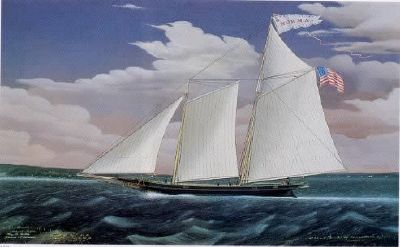
1815 New York City - 1897 White Plains, New York. Known for: Steamboat portrait and marine painting.
Born in New York City, eight years after Robert Fulton sent the first steamboat up the Hudson River, James Bard saw and reflected in his marine paintings the industrial development of shipping in... Read full biography
Born in New York City, eight years after Robert Fulton sent the first steamboat up the Hudson River, James Bard saw and reflected in his marine paintings the industrial development of shipping in America. He and his twin brother John Bard together painted more than 350 marine portraits, steamships... Read full biography
Born in New York City, eight years after Robert Fulton sent the first steamboat up the Hudson River, James Bard saw and reflected in his marine paintings the industrial development of shipping in America. He and his twin brother John Bard together painted more than 350 marine portraits, steamships and sailboats in the New York Harbor and on the Hudson River. Likely James did the outline sketches, and John filled in the color and backgrounds. However, James quit working with John after 1849, and... Read full biography
Born in New York City, eight years after Robert Fulton sent the first steamboat up the Hudson River, James Bard saw and reflected in his marine paintings the industrial development of shipping in America. He and his twin brother John Bard together painted more than 350 marine portraits, steamships and sailboats in the New York Harbor and on the Hudson River. Likely James did the outline sketches, and John filled in the color and backgrounds. However, James quit working with John after 1849, and John died seven years later, but James kept painting, doing nearly 4000 works during his lifetime and leaving a record of nearly every steamship on the Hudson River during the second half of the 19th century. He worked until the year of his death... Read full biography
Born in New York City, eight years after Robert Fulton sent the first steamboat up the Hudson River, James Bard saw and reflected in his marine paintings the industrial development of shipping in America. He and his twin brother John Bard together painted more than 350 marine portraits, steamships and sailboats in the New York Harbor and on the Hudson River. Likely James did the outline sketches, and John filled in the color and backgrounds. However, James quit working with John after 1849, and John died seven years later, but James kept painting, doing nearly 4000 works during his lifetime and leaving a record of nearly every steamship on the Hudson River during the second half of the 19th century. He worked until the year of his death and died in White Plains, New York. Although the paintings are rather primitive in their flat colors and perspect... Read full biography
Artist Biography
Biography page for James Bard ((1815 - 1897)), known for Steamboat portrait and marine painting. Showing 3 biographical entries and 0 sample artworks.
James Bard - Artist Info
About James Bard
Biography from the Archives of askART
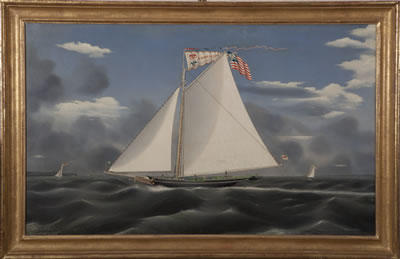 Born in New York City, eight years after Robert Fulton sent the first steamboat up the Hudson River, James Bard saw and reflected in his marine paintings the industrial development of shipping in America.
He and his twin brother John Bard together painted more than 350 marine portraits, steamships and sailboats in the New York Harbor and on the Hudson River. Likely James did the outline sketches, and John filled in the color and backgrounds.
However, James quit working with John after 1849, and John died seven years later, but James kept painting, doing nearly 4000 works during his lifetime and leaving a record of nearly every steamship on the Hudson River during the second half of the 19th century. He worked until the year of his death and died in White Plains, New York.
Although the paintings are rather primitive in their flat colors and perspective, the work is important to marine historians because of the accuracy and detail of the depictions. Usually the ships are placed against a generic background, and if figures are present, they are stiff and primarily serve the purpose of showing the size of the ship. James usually put his name and studio address on his work, so he had ongoing promotion for his paintings.
Source:
David M Zellman, 300 Years of American ArtBiography from Caldwell Gallery Hudson
James Bard was born in 1815 in Chelsea, NYC with a twin brother John. He was a self-taught marine artist with a keen interest in steamboats and small sailing vessels. James and John worked closely together, producing their first painting at the age of twelve and consequently forming a partnership in 1831. Together they recorded many of the important ships passing through the Long Island Sound and Hudson River, NYC. The accurate observances in these paintings are still quite important to historians of navigation.
Their collaborative paintings, over 350 in all, were most often signed J. & J. Bard. In 1850 James' brother John abandon the partnership for unknown reasons. However, James continued painting quite successfully due to the increase in shipbuilding throughout the 1850s. Various forms of signature and address appear in the lower right corner of Bard's paintings as an invitation to prospective buyers to visit his studio. James Bard completed over 4,000 paintings, the last dated 1890 just seven years before his death. The National Museum of American Art in Washington D.C. exhibited Bard's retrospective in 1987.Biography from Vallejo Gallery LLC
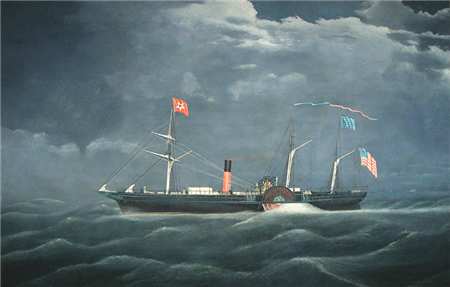 The twin brothers, John and James Bard were self-taught ship portraitists who created accurate paintings of the steamships and sailing craft which operated around New York, Long Island sound and the Hudson River areas. Because the vessels depicted were drawn to exact scale after intensive personal observation and measurements, paintings by James Bard and his brother are considered extremely important to the history of navigation.
By 1839, the brothers had gone their separate ways. James Bard continued to paint at a tremendous rate, completing more than 430 known paintings during his lifetime, and quite reasonably, hundreds more. His most enduring legacy is the important record he created of almost every steamship that operated on the Hudson River during the last half of the nineteenth century.
Bard's stylistic seas and skies are skillfully combined with draftsman-like quality in the careful rendering of his vessels. Movement is shown with a spray of water made up of a profusion of small white dots. His works are all exuberant and filled with a sense of Americana that capture with simplistic beauty the flavor of an age that will not be seen again.