Page loaded successfully. Showing biography for James Havard.
James Havard BIOGRAPHY
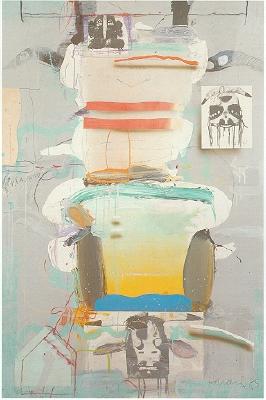
1937 Galveston, Texas - 2020. Known for: Modernist genre-figure, abstraction.
Following are excerpts written by Julie Sasse for descriptions of works by James Havard for the Tucson Museum of Art where Sasse is Curator of Contemporary Art:. JAMES HAVARD. Falling Eagle. Mixed... Read full biography
Following are excerpts written by Julie Sasse for descriptions of works by James Havard for the Tucson Museum of Art where Sasse is Curator of Contemporary Art:. JAMES HAVARD. Falling Eagle. Mixed media on board. Recent Acquisition at the Tucson Museum of Art. Considered a "pioneer of abstract... Read full biography
Following are excerpts written by Julie Sasse for descriptions of works by James Havard for the Tucson Museum of Art where Sasse is Curator of Contemporary Art:. JAMES HAVARD. Falling Eagle. Mixed media on board. Recent Acquisition at the Tucson Museum of Art. Considered a "pioneer of abstract illusionism," Havards signature paintings include collage elements, images and text that refer to prehistoric Native American culture, squeezings of paint directly from the tube, and spray painted... Read full biography
Following are excerpts written by Julie Sasse for descriptions of works by James Havard for the Tucson Museum of Art where Sasse is Curator of Contemporary Art:. JAMES HAVARD. Falling Eagle. Mixed media on board. Recent Acquisition at the Tucson Museum of Art. Considered a "pioneer of abstract illusionism," Havards signature paintings include collage elements, images and text that refer to prehistoric Native American culture, squeezings of paint directly from the tube, and spray painted "shadows" giving the illusion that the paint is actually suspended in front of the paint surface. Closely related to the Abstract Expressionists because of his expressive sweeping and gestural brushes of paint, Havard is a sensuous colorist who powerfully... Read full biography
Following are excerpts written by Julie Sasse for descriptions of works by James Havard for the Tucson Museum of Art where Sasse is Curator of Contemporary Art:. JAMES HAVARD. Falling Eagle. Mixed media on board. Recent Acquisition at the Tucson Museum of Art. Considered a "pioneer of abstract illusionism," Havards signature paintings include collage elements, images and text that refer to prehistoric Native American culture, squeezings of paint directly from the tube, and spray painted "shadows" giving the illusion that the paint is actually suspended in front of the paint surface. Closely related to the Abstract Expressionists because of his expressive sweeping and gestural brushes of paint, Havard is a sensuous colorist who powerfully conjures up emotional responses and impressions from the viewer. Havard was born in Galveston, Texas, in 1937. Upon graduation... Read full biography
Artist Biography
Biography page for James Havard ((1937 - 2020)), known for Modernist genre-figure, abstraction. Showing 3 biographical entries and 0 sample artworks.
James Havard - Artist Info
About James Havard
Name variants
James Pinkney Harvard
Biography from the Archives of askART
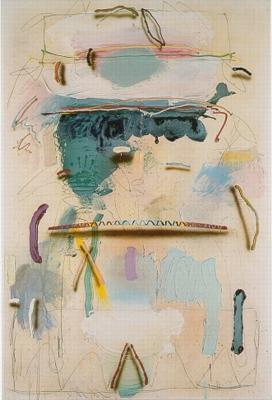 Following are excerpts written by Julie Sasse for descriptions of works by James Havard for the Tucson Museum of Art where Sasse is Curator of Contemporary Art:
JAMES HAVARD
Falling Eagle
Mixed media on board
Recent Acquisition at the Tucson Museum of Art
Considered a "pioneer of abstract illusionism," Havards signature paintings include collage elements, images and text that refer to prehistoric Native American culture, squeezings of paint directly from the tube, and spray painted "shadows" giving the illusion that the paint is actually suspended in front of the paint surface. Closely related to the Abstract Expressionists because of his expressive sweeping and gestural brushes of paint, Havard is a sensuous colorist who powerfully conjures up emotional responses and impressions from the viewer.
Havard was born in Galveston, Texas, in 1937. Upon graduation from Houston State College in 1959 he moved east to attend the Pennsylvania Academy of the Fine Arts. After moving to New York City in the 1980s, Havard focused on large-scale, expressive paintings referencing Native American culture in a most unique way. Over the next ten years, he made frequent visits to Santa Fe, New Mexico, for inspiration and to pursue his interest in collecting. Havards style of blending expressionistic abstraction with indigenous symbols caught the attention of museums throughout the country and soon his works were added to several important collections, including the Metropolitan Museum of Art, the Los Angeles County Museum of Art and the Solomon R. Guggenheim Museum of Art.
In 1989 Havard moved to Santa Fe, New Mexico. This painting is the first purchase by the founding members of the Contemporary Arts Society for the Tucson Museum of Arts permanent collection.
_______________________________________________________________________________
JAMES HAVARD
Two mixed media works on paper from the late 1970s by James Havard are included in the Amos Collection at Aerospace and Mechanical Engineering Building at The University of Arizona.
Havard was born in Galveston, Texas, in 1937. Although he entered Houston State College on an agricultural scholarship, shortly thereafter, he turned his interests to the visual arts. Intrigued by the East, he moved upon graduation in 1959 to Philadelphia where he attended the Pennsylvania Academy of the Fine Arts. Havards early work focused on still lifes and more traditional forms of art making, but by the early 1960s experimentation and rule-breaking was replacing the accepted norms of the school.
Avoiding pop art, Havard instead delved into minimalism and began a twenty-year professional relationship with noted Marion Locks Gallery in Philadelphia with his first solo show there in 1970. During this time he began to experiment with industrial materials, vacuformed plastic shapes and metallic paints from the auto body show beneath his studio. Finding the luminescence of his new pearlescent surfaces more lyrical in quality, Havard scratched and abraded the surface of these works and soon realized the illusionistic techniques that could be controlled by the use of airbrushing. These original experimentations were later refined into the painterly, abstract trompe loeil gestures for which he is known today.
Rich squeezings of paint squirted directly onto the canvas surface contrasted against subtle pastel backgrounds became his trademark by the late 1970s. "Abstract illusionism," actually more of a commercial term used to define his work, overshadowed his interest in the Native American subject matter which would become as important, in time, as his bravura painting style. Making reference in text or figurative reference to the Arapaho, Iroquois, and episodes in Native American history, Havard infused his expressive work with poetic metaphors about Native American artifacts and culture (while several exhibitions of Native American art have included works by James Havard, he denies any specific, official affiliation with any particular tribe).
After moving to New York City in the 1980s, Havard focused on large-scale, expressive paintings referencing Native American culture in a most unique way. Over the next ten years, he made frequent visits to Santa Fe, New Mexico, for inspiration and to pursue his interest in collecting. Havards style of blending expressionistic abstraction with indigenous symbols caught the attention of museums through the country and soon his works were added to several important collections, including the Metropolitan Museum of Art, the Los Angeles County Museum of Art and the Solomon R. Guggenheim Museum of Art. Havard was now exhibiting his work in Sweden, Australia, New York and Paris and newspapers from the Houston Post to the New York Times were reviewing his exhibitions. His works became even more colorful and expressive and iconistic than ever before.
In 1989 Havard moved to Santa Fe, New Mexico. In contrast to previous decade, his work became smaller, partly due to the limitations of his new studio space, but his repertoire of images expanded to include early American images and icons and even personal whimsy such as abstracted references to his love of the sport of golf. Once again employing the use of industrial technology, Havard added photo silk screened images of Hopi masks and tabletas and motifs from Zuni pottery; often taking images directly from textbooks and titling the works AH101 (Art History 101, referring to an introductory-level class). Printed collaged and bundled fabrics further enhanced the expressive quality of his sensuous works. Admitting a connection with Tapies and Motherwell, Havard remains involved with the act of painting and the spontaneity of the expressive manner in which he has worked for thirty years.
**Note from Louis K. Meisel (December 2024)
In the Bio of this artist it might be interesting to note that in mid 70’s Louis k. Meisel whose gallery was and still is in SoHo assembled a group of up to ten artists who’re making abstract paintings containing an illusion of a third dimension. The five leaders were and are Harvard, Jack Lembeck, George green, Tony King and Michael Gallagher.
Louis Meisel coined the Term Abstract Illusionism and brought all these artists to the art world attention with over 30 gallery museum shows. The so called art critics of the day called this art esoteric realism because abstract paints hat be FLAT!.Biography from Wright
James Havard first gained recognition in the 1970s for pioneering the Abstract Illusionist movement, a style of painting where forms on the picture plane were shaded to appear three-dimensional. The movement included artists such as Al Held and Allan D'Arcangelo. By the 1980s and 1990s, Havard returned to figuration, creating works inspired by Art Brut masters such as Jean Dubuffet. Richly colored, collaged and carved in encaustics, these works are raw, rudimentary and elemental, drawing inspiration from Native American, African and Caribbean tribal cultures, cave paintings and children's drawings. Havard also made mixed media box constructions offering another area of experimentation in his incredibly prolific forty-year career.
James Havard was born in 1937 in Galveston, Texas. He earned a BA from Sam Houston State College in Huntville, Texas in 1959 and attended the Pennsylvania Academy of Fine Arts, Philadelphia from 1961 - 1965. During the 1960s and 1970s Havard traveled extensively throughout Europe and lived in France, Spain, Denmark, Sweden, and the Caribbean island of Tortola where he had a second home. He lived in New York in the 1970s and 1980s before moving to Santa Fe, New Mexico permanently in 1989. He has exhibited extensively for over forty years in the United States and Europe.
His work is included in the permanent public collections of the Metropolitan Museum of Art, NY, the Solomon R. Guggenheim Museum NY, the Los Angeles County Museum of Art, the Smithsonian Museum, the Museum of Modern Art in Stockholm, Sweden, among others. He now lives in Pennsylvania.Biography from Auctionata, Inc. (CLOSED)
Colliding illusionistic and abstract imagery, the early works of James Havard (American, b.1937) are sites of synthesis and simultaneous discordance. They serve as visual precursors to certain forms of contemporary art with their pastel colors and apparently arbitrary compositions that nevertheless elicit a semiotic language. In the late 1970s Havard began looking to Native American culture for inspiration, and moved away from trompe l’oeil techniques of shadow painting.
His works are included in the collections of the Guggenheim, New York; the Museum of Modern Art, Stockholm, and LACMA, Los Angeles, among others.