Page loaded successfully. Showing biography for Jean-Michel Basquiat.
Jean-Michel Basquiat BIOGRAPHY
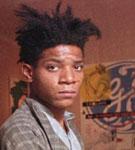
1960 New York City - 1988 New York City. Known for: Street-graffiti, naive figure painting, drawing.
Lots Sold: 83%, High Price: $110.5M (2017), Per sq in: $23201 (2020).
Noted for his graffiti street paintings under the name pseudonym 'SAMO', Jean-Michel Basquiat was born in Brooklyn. His father was Haitian-born Gerard Basquiat. His mother, Matilde Andradas, had been... Read full biography
Noted for his graffiti street paintings under the name pseudonym 'SAMO', Jean-Michel Basquiat was born in Brooklyn. His father was Haitian-born Gerard Basquiat. His mother, Matilde Andradas, had been born in Brooklyn of Puerto Rican parents. He had two sisters (born in 1963 and 1966) also born in... Read full biography
Noted for his graffiti street paintings under the name pseudonym 'SAMO', Jean-Michel Basquiat was born in Brooklyn. His father was Haitian-born Gerard Basquiat. His mother, Matilde Andradas, had been born in Brooklyn of Puerto Rican parents. He had two sisters (born in 1963 and 1966) also born in Brooklyn. When only a small boy, Basquiat began drawing, inspired by the cartoons and Hitchcock films he watched on television. He also loved to read comic books and Mad Magazine, with its Alfred E.... Read full biography
Noted for his graffiti street paintings under the name pseudonym 'SAMO', Jean-Michel Basquiat was born in Brooklyn. His father was Haitian-born Gerard Basquiat. His mother, Matilde Andradas, had been born in Brooklyn of Puerto Rican parents. He had two sisters (born in 1963 and 1966) also born in Brooklyn. When only a small boy, Basquiat began drawing, inspired by the cartoons and Hitchcock films he watched on television. He also loved to read comic books and Mad Magazine, with its Alfred E. Neuman character. His mother encouraged this interest in art, and when he was only seven he produced a children's book with a friend, Mark Prozzo. When only eight, Basquiat was hit by a car while he played in the street, requiring him to spend a month... Read full biography
Noted for his graffiti street paintings under the name pseudonym 'SAMO', Jean-Michel Basquiat was born in Brooklyn. His father was Haitian-born Gerard Basquiat. His mother, Matilde Andradas, had been born in Brooklyn of Puerto Rican parents. He had two sisters (born in 1963 and 1966) also born in Brooklyn. When only a small boy, Basquiat began drawing, inspired by the cartoons and Hitchcock films he watched on television. He also loved to read comic books and Mad Magazine, with its Alfred E. Neuman character. His mother encouraged this interest in art, and when he was only seven he produced a children's book with a friend, Mark Prozzo. When only eight, Basquiat was hit by a car while he played in the street, requiring him to spend a month in the hospital. During this time his mother gave him a copy of the book, Gray's Anatomy... Read full biography
Artist Biography
Biography page for Jean-Michel Basquiat ((1960 - 1988)), known for Street-graffiti, naive figure painting, drawing. Showing 4 biographical entries and 0 sample artworks.
Jean-Michel Basquiat - Artist Info
About Jean-Michel Basquiat
Biography from the Archives of askART
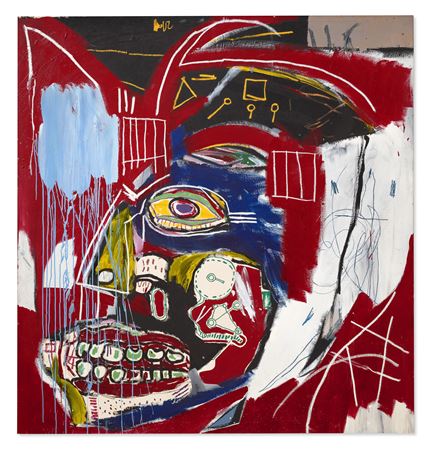 Noted for his graffiti street paintings under the name pseudonym 'SAMO', Jean-Michel Basquiat was born in Brooklyn. His father was Haitian-born Gerard Basquiat. His mother, Matilde Andradas, had been born in Brooklyn of Puerto Rican parents. He had two sisters (born in 1963 and 1966) also born in Brooklyn.
When only a small boy, Basquiat began drawing, inspired by the cartoons and Hitchcock films he watched on television. He also loved to read comic books and Mad Magazine, with its Alfred E. Neuman character. His mother encouraged this interest in art, and when he was only seven he produced a children's book with a friend, Mark Prozzo. When only eight, Basquiat was hit by a car while he played in the street, requiring him to spend a month in the hospital. During this time his mother gave him a copy of the book, Gray's Anatomy, the influence of which was to later show up in his artwork as well as the name of a band he co-founded in 1979, called Gray.
When his parents separated, Jean Michel Basquiat lived with his father and sisters first in Brooklyn until his father moved, with his three children, to Mira Mar, Puerto Rico. There Basquiat attended an Episcopalian school. He later moved back to New York, where he attended City as School, a progressive school in Manhattan. There he met Al Diaz, a graffitist who lived in the lower east side projects. They became friends and artistic collaborators. The two were among the most popular students at their school, both creative and also with an affinity for getting into trouble. Basquiat invented a fictional character named SAMO (for same old shit), and he and Diaz began spray-painting witticisms 'by SAMO' around lower Manhattan.
At fifteen, he ran away (for the second time), and lived for a period of weeks in Washington Square Park, until his father found him and brought him home. Through City as School, Basquiat became involved with a drama group. He also has admiration for famous people such as Joplin, Hendrix, Charlie Parker, Billie Holliday, Sugar Ray Robinson, and Joe Louis. Some of these were later to appear in his paintings. Leaving home for good around 1978, Basquiat stayed at homes of friends, including the loft of British artist Stan Peskett. He tried to support himself by selling postcards and t-shirts that he painted. In an attempt to make a sale, he approached Andy Warhol in a restaurant, and did make the sale, but it was not until some years later that the two became friends.
Basquiat began dating Alexis Adler in the late 1970s, and the two moved into an apartment, his first address of his own. Their crowd included filmmakers, musicians, and artists. Basquiat and Diaz had a falling out about that time, which ended their SAMO collaboration, and Basquiat turned his focus to his own art and music. Part of his scene were Keith Haring and Kenny Scharf, and Basquiat and Haring begin an on-and-off relationship that lasted until Basquiat's death.
In 1980, Basquiat's art was exhibited for the first time, and encouraged by the reception of his art, he quit his band, Gray. With a new girlfriend, Suzanne Mallouk, a singer and artist, Basquiat moved into an apartment. In 1981 he traveled to Europe for the first time, for a one-man show in Italy, where the work was shown under the name SAMO. Back in Soho, Basquiat became friends with Shenge Kapharoah, an artist from Barbados, with whom he shared many African ideologies. Traveling to Los Angeles for an exhibition in 1982, Basquiat ended up staying for about six months, enjoying the climate and club scene there. From then on he returned to LA several times a year.
In 1983 Basquiat moved into a space in a building he leased from Andy Warhol, and from that time on their relationship grew. They worked together, painted each other's portraits, attended art events together in New York and abroad, and discussed their philosophies. Racial issues and identities were often a concern of Basquiat's.
In 1984, Basquiat traveled to Maui, Hawaii, a place he visited regularly from that time on. He rented a ranch in Hana, a remote part of the island, where he set up a studio to make drawings and painting with materials he had sent over from Los Angeles. Returning to New York, collaborative paintings he created with Warhol and Clemente were exhibited internationally, and Basquiat become a celebrity in his own right. Also in 1984 he met Jennifer Goode, who was to be one of his most serious romantic affairs. Drug use, which had been part of his life since his teens, became more and more of a problem however. At only twenty-four, his deteriorating health had become noticeable.
In 1986, Basquiat, Jennifer Goode, and her brother traveled to Africa for his first time, but by late that year the two had broken up, with her complaining of his abuse of heroin. Basquiat continued to travel both domestically and internationally for his exhibits. After Warhol's death in 1987, he became withdrawn and less productive. He had always been resistant to the idea of drug abuse programs, but in an apparent attempt to kick drugs on his own he left New York in April, 1988 for his ranch in Hawaii. There he stayed until June, when he left to return to New York. As he passed through Los Angeles, friends there found him happy and proclaiming he was free from drugs. However, on August 12, 1988, he was found in his New York loft, dead at twenty-seven from an overdose of heroin.
Sources:
togeocities.com
Phoebe Hoban, Basquiat: A Quick Killing in Art, Penquin Books, 1999Biography from RoGallery
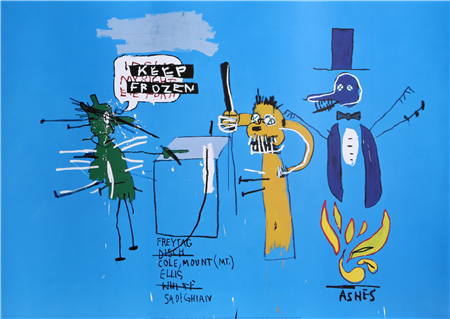 Jean-Michel Basquiat was an American artist born in Brooklyn, New York. He gained fame, first as a graffiti artist in New York City, and then as a highly successful avant-garde artist in the international art scene of the 1980s.
His mother, Matilde, was Puerto Rican and his father, Gerard, was of Haitian origin. At an early age, Basquiat displayed an aptitude for art and was encouraged by his mother to draw, paint, and to participate in other art-related activities.
In 1977, when he was 17, Basquiat and his friend Al Diaz started spray-painting graffiti art on subway cars and slum buildings in lower Manhattan, adding the infamous signature of SAMO, meaning Same Old Shit.
In 1978, Basquiat left home and quit school a year before graduating. He lived with friends and survived by selling T-shirts and postcards. In 1980, he participated in a multi-artist exhibition, sponsored by Collaborative Projects Incorporated. During the next few years, he continued exhibiting his works around New York alongside artists such as Keith Haring and Barbara Kruger.
Basquiat's art career is known for his three broad, though overlapping styles. In the earliest period, from 1980 to late 1982, Basquiat used painterly gestures on canvas, most often depicting skeletal figures and mask-like faces that expressed his obsession with mortality, and imagery derived from his street existence, such as automobiles, buildings, police, children's sidewalk games, and graffiti.
A middle period from late 1982 to 1985 features multipanel paintings and individual canvases with exposed stretcher bars, the surface dense with writing, collage and seemingly unrelated imagery. These works reveal a strong interest in Basquiat's black and Hispanic identity and his identification with historical and contemporary black figures and events.
The last style, from about 1986 to Basquiat's death in 1988, displays a new type of figurative depiction, in a new painterly style, with different symbols, sources, and content.
In 1983, Basquiat befriended Andy Warhol and the two made a number of collaborative works. Often, they discussed and disputed about the lacking African American art and literature. They also painted together, influencing each others' work. Some claimed that Andy Warhol was merely using Basquiat for some of his techniques and insight, but this was never based on much fact, just mere speculation. Their relationship continued until Warhol's death.
By 1984, many of Basquiat's friends were concerned about his excessive drug use and increasingly erratic behaviour, including signs of paranoia. Basquiat appeared on the cover of The New York Times Magazine in a feature entitled "New Art, New Money: The Marketing of an American Artist" in 1985.
As Basquiat's international success heightened, his works were shown in solo exhibitions across major European capitals. Basquiat travelled to Africa in 1986 and his work was shown on the Ivory Coast.
Warhol's death in 1987 came as very distressing to Basquiat. He continued to struggle with his addictions. In 1988, Basquiat escaped New York City to his island retreat in Maui. He died of a heroin overdose.
Exhibitions:
2005 Basquiat, Brooklyn Museum, New York, March 11 to June 5
1998 Gagosian Gallery, Los Angeles
1998 Museu de Arte Moderna, Recife
1998 Tony Shafrazi Gallery, New York
1998 Pinacoteca, Sao Paulo
1998 Galerie Jerome de Noirmont, Paris
1997 Art Beatus, Vancouver
1997 Big Step, Inc. Isaka
1997 Mitsukochi Museum, Tokyo; MIMOCA, Marugame
1997 Museo Nacional de Bellas Artes, Buenos Aires
1997 Kaohsiung Museum of Fine Arts, Kaohsiung; Taiwan Museum of Art, Taiwan
1997 Fondation Dina-Vierny-Musee Maillol, Paris
1997 Gallery Hyundai, Seoul
1997 Parco Gallery, Tokyo
1996 Galerie Enrico Navarra, Paris
1996 Galeries Lucien Durand-Enrico Navarra, Paris
1996 Junta de Andalucia, Malaga
1996 The Bruce Museum, Greenwich
1996 Tony Shafrazi Gallery, New York
1996 Quintana Gallery, Coral Gables
1996 Robert Miller Gallery, New York; Serpentine Gallery, Lodon
1995 1995 Center Gallery, Miami-Dade Community College, Wolfson Campus; Castellani Art Museum, Niagara Univerity, New York; The University of Memphis, Memphis; University of South Florida Art Museum, Tampa; Otis Gallery of Art and Design, Los Angeles; Austin Museum of Art, Austin
1994 Henry Art Gallery, University of Washington, Seattle
1994 Johnson County Community College Gallery of Art, Overland Park
1994 Robert Miller Gallery, New York
1994 Mount Holyoke College of Art Museum, South Hadley, MA; Wadsworth Atheneum, Hartford; The Andy Warhol Museum, Pittsburg; The studio Museum in Harlem, New York; Krannert Art Museum and Kinkead Pavilion, University of Illinois, Champaign; COCA/Museum of Contemporary Art, Miami
1993 Newport Harbour Art Museum, Newport Beach
1993 FAE, Musee d'Art Contemporain, Pully-Lausanne
1993 Tony Shafrazi Gallery, New York
1993 Musee Galerie de la Seita, Paris
1993 Delta Gallery, Rotterdam
1993 Salon de Mars, Paris, booth of Galerie Enrico Navarra
1993 Alpha Cubic Gallery, Tokyo
1993 Galerie Sho Contemporary Art, Tokyo
1993 Galerie Bruno Bischhofberger, Zurich
1992 Metropolitan Museum of Art, New York
1992 Whitney Museum of American Art, New York
1992 Menil Collection, Houston
1992 Des Moines Art Center, Iowa
1992 Montgomery Museum of Fine Art, Alabama
1992 Vrej Baghoomian Gallery, New York
1992 Galerie Eric van de Wegh, Brussels
1992 Musee Cantini, Marseille
1991 P.S.Gallery, Tokyo
1991 Galerie de Poche, Paris
1990 Gallery le Gall Peyroulet, Paris
1990 Galerie Fabien Boulakia, Paris
1990 Robert Miller Gallery, New York
1989 Kestner-Gesellschaft, Hanover
1989 Vrej Baghoomian Gallery, New York
1989 Galerie Enrico Navarra, Paris
1989 Dau al Set, Galeria d'Art, Barcelona
1989 Galerie Thaddaeus Ropac, Salzburg
1988 Galerie Hans Mayer
1988 Galerie Michael Haas, Berlin
1988 Vrej Baghoomian Gallery, New York
1988 Galerie Thaddaeus Ropac, Salzburg
1988 Fay Gold Gallery, Atlanta
1988 Gallery Schlesinger Limited, New York
1988 Annina Nosei Gallery, New York
1988 Galerie Yvon Lambert, Paris
1988 Galerie Beaubourg, Paris
1987 Galerie Daniel Templon, Paris
1987 Akira Ikeda Gallery, Tokyo
1987 Tony Shafrazi Gallery, New York
1987 Galerie Thaddaeus Ropac, Salzburg
1987 P.S.Gallery, Tokyo
1986 Larry Gagosian, Los Angeles
1986 Fay Gold Gallery, Atlanta
1986 Fay Gold Gallery, Atlanta
1986 Galerie Bruno Bischofberger, Zurich
1986 Galerie Thaddaeus Ropac, Salzburg
1986 Akira Ikeda Gallery, Nagoya
1986 Centre Culturel Francais d'Abidjan, Ivory
1986 Galerie Delta, Rotterdam
1986 Kestner-Gesellschaft, Hanover
1986 Galerie Michael Werner, Cologne
1985 Mary Boone Gallery, New York
1985 Akira Ikeda Gallery, Tokyo
1985 Annina Nosei Gallery, New York
1985 Galerie Bruno Bischofberger, Zurich
1985 University Art Museum, University of California, Berkley; La Jolla Museum of Contemporary Art, La Jolla
1984 Mary Boone Gallery, New York
1984 The Fruitmaker Gallery, Edinburgh
1984 ICA, London
1984 Museum Boymans-van Beuningen, Rotterdam
1984 Carpenter + Hochman gallery, Dallas
1984 'New Expressionists', Sidney Janis Gallery, New York
1984 'Paintings and Sculpture Today', Indianapolis Musuem of Art, Indianapolis, Indiana
1984 'American Neo-Expressionists', Aldrich Museum, Ridgefield, Connecticut
1984 'New Art', Musee D'Art Contemporain, Montreal
1983 'New York Now', Kestner-Gesellschaft, hannover; Kunstverein Munich; Musee Cantonal des Beaux-Arts, Lausanne; and Kunstverein fur die Rheinlande und Westfalen, Dusseldorf
1983 'Whitney Biennale', Whitney Museum, New York
1983 'New Work', Sidney Janis Gallery, New York
1983 'Intoxication', Monique Knowlton Gallery, New York; and Mary Boone Gallery, New York
1983 'Back to the Usa', Kunstmuseum Luzern, Luzern; Rheinisches Landmuseum, Bonn; Wurttembergischer Kunstverein, Stuttgart; and Annina Nosei Gallery, New York
1983 'Selected Works', Ulrike Kantor Gallery, Lost Angeles
1983 'Mary Boone and her Artists', Seibu Museum, Tokyo
1983 'Written Imagery Unleashed in the Twentieth Century', Fine Arts Museum of Long Island, Hempstead, Long Island
1983 'Food for the Soup Kitchens', Fashion Moda, Bronx, New York
1983 'Contemporary Drawing', Delahunty Gallery, Dallas, Texas
1983 'From the Streets', Greenville County Museum of Art, Greenville, South Carolina
1983 'Post Graffiti', Sidney Janis Gallery, New York
1983 'Paintings', Mary Boone Gallery, New York
1983 West Beach Café, Venice, California
1983 Galerie Bruno Bischofberger, Zurich
1983 Akira Ikeda Gallery, Tokyo
1982 Emilio Mazzoli Gallery, Modena
1982 Mario Diacono Gallery, Rome
1982 Annina Nosei Gallery, New York
1982 Blum/Helman Gallery, New York
1982 Marlborough Gallery, New York
1982 Galerie Bruno Bischofberger, Zurich
1982 Fun Gallery, New York
1982 Galerie Delta, Rotterdam
1982 1982 'New New York', Florida State University Art Gallery, Tallahassee, Florida; Metropolitan Museum and Art Centre, Coral Gables, Flordia
1982 'Body Language - Current Issues in Figuration', University Art Gallery San Diego State University, San Diego, California.
1982 'Avantgarde and Transavantgarde '68 to '77' Aurelian Walls, Rome
1982 'Five Americans', Museu Civico, Modena
1982 'Drawings/Vision: New York', Janus Gallery, Los Angeles
1982 'Works on Paper', Larry Gagosian Gallery, Los Angeles
1982 'Fast', Alexander F Milliken Gallery, New York
1982 'Documneta 7', Kassel, West Germany
1982 'The Expressionist Image: From Pollock to Today', Sidney Janis Gallery, New York
1982 'The Pressure to Paint', Marlborough Gallery, New York
1981 Annina Nosei Gallery, New York
1981 Emilio Mazzoli Gallery, Modena
1981 'New York, New Wave', Institute for Art and Urban Resources, P.S.1, Long Island City, New YorkBiography from Heritage Auctions
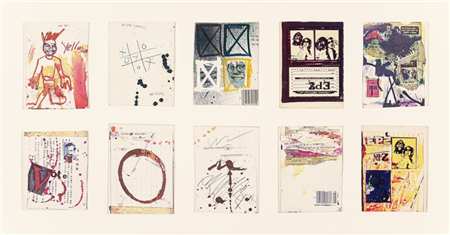 Jean-Michel Basquiat was a notorious street artist, who rapidly rose to fame in the 1980s with his graffiti and ghetto-style art. He invented an alter ego 'Samo,' a fictional character who earned a living selling 'fake' religion.
Basquiat's primitive imagery was influenced by commercial art, comic books, baseball cards, and events such as the Kennedy assassination. He also made biting social commentary on stereotypical black images and events. In 1983, he met Andy Warhol, with whom he often collaborated.
Basquiat died of a drug overdose in 1988.Biography from Phillips New York
One of the most famous American artists of all time, Jean-Michel Basquiat first gained notoriety as a subversive graffiti-artist and street poet in the late 1970s. Operating under the pseudonym SAMO, he emblazoned the abandoned walls of the city with his unique blend of enigmatic symbols, icons and aphorisms. A voracious autodidact, by 1980, at 22-years of age, Basquiat began to direct his extraordinary talent towards painting and drawing. His powerful works brilliantly captured the zeitgeist of the 1980s New York underground scene and catapulted Basquiat on a dizzying meteoric ascent to international stardom that would only be put to a halt by his untimely death in 1988.
Basquiat's iconoclastic oeuvre revolves around the human figure. Exploiting the creative potential of free association and past experience, he created deeply personal, often autobiographical, images by drawing liberally from such disparate fields as urban street culture, music, poetry, Christian iconography, African-American and Aztec cultural histories and a broad range of art historical sources.Insights
Basquiat's Untitled, 1982, achieved $110.5 million at auction, making it the most expensive work to be sold by an American artist.
Basquiat's oeuvre is currently being celebrated at the Barbican Art Gallery's Basquiat: Boom for Real Barbican retrospective.