Page loaded successfully. Showing biography for John Louis (Cutapuis) Clarke.
John Louis (Cutapuis) Clarke BIOGRAPHY
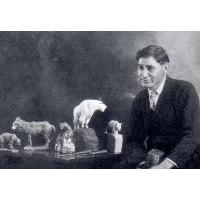
1881 Highwood, Montana - 1970 East Glacier Park, Montana. Known for: Wildlife wood carving-panels, Indian genre painting.
How could a Native American boy lacking the ability to hear or speak and raised at the edge of what would become Glacier National Park grow to become one of the most celebrated and collected wood... Read full biography
How could a Native American boy lacking the ability to hear or speak and raised at the edge of what would become Glacier National Park grow to become one of the most celebrated and collected wood sculptors in American history? It’s quite a story. John L. Clarke (1881-1970) experienced a meteoric... Read full biography
How could a Native American boy lacking the ability to hear or speak and raised at the edge of what would become Glacier National Park grow to become one of the most celebrated and collected wood sculptors in American history? It’s quite a story. John L. Clarke (1881-1970) experienced a meteoric rise to national notoriety. Many individuals and the Native American experience molded this man—who was made with the bark on. John L. Clarke was born the grandson of Blackfeet Chief Stands Alone and... Read full biography
How could a Native American boy lacking the ability to hear or speak and raised at the edge of what would become Glacier National Park grow to become one of the most celebrated and collected wood sculptors in American history? It’s quite a story. John L. Clarke (1881-1970) experienced a meteoric rise to national notoriety. Many individuals and the Native American experience molded this man—who was made with the bark on. John L. Clarke was born the grandson of Blackfeet Chief Stands Alone and infamous frontiersman Malcom Clarke (1817-1869). Malcom’s murder led in part to the 1870 Baker Massacre of 217 Blackfeet on the Marias River in northern Montana—an event burned into the memory of every Blackfeet. Andrew R. Graybill, author of The Red... Read full biography
How could a Native American boy lacking the ability to hear or speak and raised at the edge of what would become Glacier National Park grow to become one of the most celebrated and collected wood sculptors in American history? It’s quite a story. John L. Clarke (1881-1970) experienced a meteoric rise to national notoriety. Many individuals and the Native American experience molded this man—who was made with the bark on. John L. Clarke was born the grandson of Blackfeet Chief Stands Alone and infamous frontiersman Malcom Clarke (1817-1869). Malcom’s murder led in part to the 1870 Baker Massacre of 217 Blackfeet on the Marias River in northern Montana—an event burned into the memory of every Blackfeet. Andrew R. Graybill, author of The Red and the White: A Family Saga of the American West wrote, “The Clarkes thus offer a rich historical lens through which to view... Read full biography
Artist Biography
Biography page for John Louis (Cutapuis) Clarke ((1881 - 1970)), known for Wildlife wood carving-panels, Indian genre painting. Showing 3 biographical entries and 0 sample artworks.
John Louis (Cutapuis) Clarke - Artist Info
About John Louis (Cutapuis) Clarke
Name variants
J L Clarke, Man Who Speaks Not Cutapuis
Biography from the Archives of askART
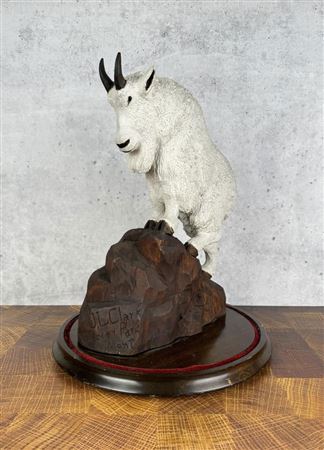 How could a Native American boy lacking the ability to hear or speak and raised at the edge of what would become Glacier National Park grow to become one of the most celebrated and collected wood sculptors in American history? It’s quite a story. John L. Clarke (1881-1970) experienced a meteoric rise to national notoriety. Many individuals and the Native American experience molded this man—who was made with the bark on.
John L. Clarke was born the grandson of Blackfeet Chief Stands Alone and infamous frontiersman Malcom Clarke (1817-1869). Malcom’s murder led in part to the 1870 Baker Massacre of 217 Blackfeet on the Marias River in northern Montana—an event burned into the memory of every Blackfeet. Andrew R. Graybill, author of The Red and the White: A Family Saga of the American West wrote, “The Clarkes thus offer a rich historical lens through which to view the shifting grounds of race in the West and the wider nation during the mid-nineteenth century. They are also ideal in another sense: their individual stories are enormously compelling, for both the historian and the general reader.”
Robbed of his hearing by scarlet fever at just two years old, John and his family moved from the hardscrabble ranch life of central Montana near Highwood to Midvale, now East Glacier Park, on the western end of the Blackfeet Indian Reservation. As cultural historian and John L. Clarke biographer Larry Len Peterson wrote in Blackfeet John L. “Cutapuis” Clarke and the Silent Call of Glacier National Park: America’s Wood Sculptor, “He felt a visceral fascination with the natural world and found his home in the grandeur of Glacier country in northwestern Montana. Wilderness, especially big wilderness, is where wildness most often happens, and it was where Clarke discovered himself and subjects for his art.”
After attending several deaf schools in North Dakota, Montana, and Wisconsin, Clarke worked in Milwaukee, Wisconsin as a master wood carver for several years and then returned to Midvale around 1910, started sculpting, and never wavered. He rose to fame by applying his passions for the Glacier country, its wildlife, and Native Americans to the arts of wood carving, sculpture, sketching, and painting. Louis W. Hill, Great Northern Railway president and unflagging promoter of Glacier National Park, played a significant part in that rise by including Clarke in a clever and well-planned promotional campaign that was initiated soon after the park was created in 1910.
John L. Clarke and his wife Mamie were very moved by the visits of their dear friend Charles M. Russell (1864-1926) who in 1918 urged Clarke to embrace his Native American heritage. Russell understood that it would play well to tourists visiting the park. Soon, Clarke’s carvings often were signed not only with “J. L. Clarke,” but also at times “Cutapuis,” Piegan for “Doesn’t Talk.” Taking a cue from Russell, Clarke eventually illustrated his letters to friends and patrons and also began using an Indian head cipher with his signature. Clarke and Joe De Yong would be close friends for fifty years.
In 1918 there was national recognition for Clarke when a prestigious gold medal was presented by the Pennsylvania Academy of Fine Arts in Philadelphia for a carving of a bear. Clarke exhibited there in 1917, 1918, 1922, 1923-1932, and 1935. Many more national honors would follow.
Clarke created art that was collected not only by adoring tourists, but also by the famous such as his friends Charles M. Russell and Joe De Yong—who was also deaf; John D. Rockefeller, Jr.; and President William Harding, among many others.
His 1956 masterwork, The Blackfeet Encampment, four feet by thirteen feet, graces the Montana Historical Society in Helena. Well-received retrospective exhibitions followed at the MHS in 1993/1994 and 2014. On March 1, 2003, John L. Clarke was inducted into the Gallery of Outstanding Montanans at the MHS. The citation for John L. Clarke in part read, “Facing odds that would have deterred lesser men, he crafted a career as a renowned Blackfeet artist. His legacy survives as a worthy inspiration for all Montanans.” Spokesman for the nominating committee, Kirby Lambert, gave special praise and lauded Clarke as “…one of my personal favorites” of the almost three dozen individuals in the Gallery.
The Montana Historical Society in Helena; Charles M. Russell Museum, Great Falls, Montana; Museum of the Plains Indian, Browning, Montana; Miracle of America Museum, Polson, Montana; and Glacier County Museum, Cut Bank, Montana have impressive collections of his art, among others. His archival collection is located at the John L. Clarke Gallery, East Glacier Park, Montana.
Source:
Biography written and submitted by Larry Len Peterson, author of Blackfeet John L. “Cutapuis” Clarke and the Silent Call of Glacier National Park: America’s Wood Sculptor)Biography from the Archives of askART
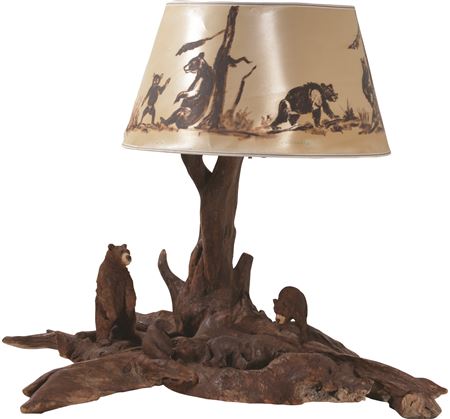 There is not now and never will be another artist like John Clarke. The grandson of Malcolm Clarke, the tempetuous West Point troublemaker whose murder triggered the Baker Massacre of an innocent Blackfeet band, Clarke lived quietly but deeply in East Glacier most of his life. The Big Hotel was built on his father's land allotment, and John's studio-home was not far away. He was born in Highwood, Montana.
As a small child, apparently after surviving Scarlet Fever, John lost his hearing and ability to speak. He was intelligent and well-educated in specialized schools for the deaf and mute, such as the North Dakota School for the Deaf at Devil's Elbow from 1894 to 1897, the Montana School for the Deaf and Blind, now in Great Falls, from 1898 to 1899, and St. John's School for the Deaf in Milwaukee, Wisconsin, where he learned to carve. As a young man he was remarkably handsome, a trait he preserved with dignity until his death.
His fame began when his work came to the attention of W. Frank Purdy of the American School of Sculpture. He exhibited at the Palace of Fine Arts in 1925, received a gold medal from the American Art Gallery of Philadelphia, and had a showing at the New York Academy of Design. Louis W. Hill, of the Great Northern Railway, took a special interest and John's goat carvings have been connected to the GN logo, a mountain goat silhouette on a crag. He also loved to carve bears.
His Blackfeet name is "Cu-ta-pu-ie," the Man Who Talks Not. Maybe he didn't speak aloud, but his fingers flew in sign talk as well as carving and painting.
Submitted by Mary Scriver
Source: New Interpretations by Dale Burk, Copyright 1969. Stoneydale Press.Biography from Flathead Gallery (CLOSED)
John Louis Clarke, 1881 to 1970, was the son of Blackfeet tribesman Horace Clarke. Scarlet fever at the age of two left him permanently deaf and mute, earning him his Blackfeet name, Cutapuis—"the man who talks not." Throughout his life, he patiently communicated by writing notes, using sign language, or creating art.
Clarke's artistic abilities emerged at a very early age. In 1913 he returned to East Glacier where he opened a studio from which he operated until his death in 1970.
Clarke is usually considered self-taught, although he attended the Chicago Art Institute for a short time. He became a most prolific artist who worked in oils, watercolors, clays, charcoals, and even crayons. But his real fame developed from his international reputation for his sensitively executed, vibrant wood carvings of bears, mountain goats, and other wild animals of the Glacier National Park, particularly using cottonwood.
At his artistic height, John was generally considered one of the best portrayers of Western wildlife. He crafted a career as a renowned Blackfeet artist; his legacy survives as a worthy inspiration to all Montanans.