Page loaded successfully. Showing biography for John Northcote Nash.
John Northcote Nash BIOGRAPHY
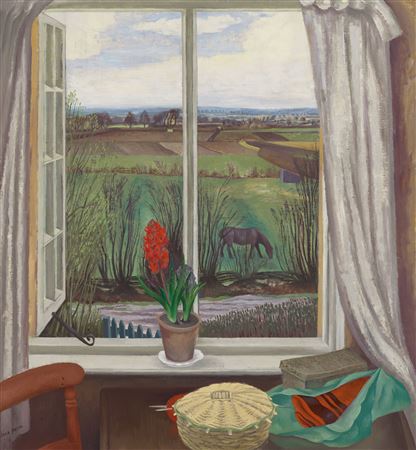
1893 London, England - 1977 Colchester, England. Known for: Modernist landscape painting, illustration, engraving.
John Nash was born in London in 1893, the younger brother of the artist Paul Nash. Educated at Wellington College, he exhibited with his brother from 1913, and fought in World War I from 1916 to 1918... Read full biography
John Nash was born in London in 1893, the younger brother of the artist Paul Nash. Educated at Wellington College, he exhibited with his brother from 1913, and fought in World War I from 1916 to 1918 with the Artists Rifles. On the recommendation of his brother, he worked as an official war artist... Read full biography
John Nash was born in London in 1893, the younger brother of the artist Paul Nash. Educated at Wellington College, he exhibited with his brother from 1913, and fought in World War I from 1916 to 1918 with the Artists Rifles. On the recommendation of his brother, he worked as an official war artist from 1918. From 1924 to 1929 he taught at The Ruskin School of Drawing and Fine Art (Oxford), and from 1934 to 1940 taught at the Royal College of Art (London), working on wood engravings,... Read full biography
John Nash was born in London in 1893, the younger brother of the artist Paul Nash. Educated at Wellington College, he exhibited with his brother from 1913, and fought in World War I from 1916 to 1918 with the Artists Rifles. On the recommendation of his brother, he worked as an official war artist from 1918. From 1924 to 1929 he taught at The Ruskin School of Drawing and Fine Art (Oxford), and from 1934 to 1940 taught at the Royal College of Art (London), working on wood engravings, lithographs, etc. He started World War II in the Observer Corps, moving to the Admiralty as an official war artist with the rank of Captain in the Royal Marines in 1940. He was promoted Acting Major in 1943 and relinquished his commission in November 1944. He... Read full biography
John Nash was born in London in 1893, the younger brother of the artist Paul Nash. Educated at Wellington College, he exhibited with his brother from 1913, and fought in World War I from 1916 to 1918 with the Artists Rifles. On the recommendation of his brother, he worked as an official war artist from 1918. From 1924 to 1929 he taught at The Ruskin School of Drawing and Fine Art (Oxford), and from 1934 to 1940 taught at the Royal College of Art (London), working on wood engravings, lithographs, etc. He started World War II in the Observer Corps, moving to the Admiralty as an official war artist with the rank of Captain in the Royal Marines in 1940. He was promoted Acting Major in 1943 and relinquished his commission in November 1944. He died in 1977 in Colchester. John Nash had no formal art training but was encouraged by his brother to develop his abiliti... Read full biography
Artist Biography
Biography page for John Northcote Nash ((1893 - 1977)), known for Modernist landscape painting, illustration, engraving. Showing 2 biographical entries and 0 sample artworks.
John Northcote Nash - Artist Info
About John Northcote Nash
Biography from the Archives of askART
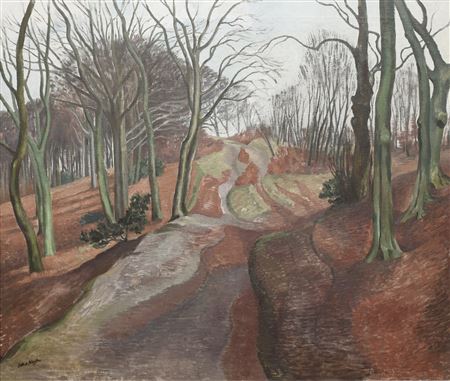 John Nash was born in London in 1893, the younger brother of the artist Paul Nash. Educated at Wellington College, he exhibited with his brother from 1913, and fought in World War I from 1916 to 1918 with the Artists Rifles. On the recommendation of his brother, he worked as an official war artist from 1918. From 1924 to 1929 he taught at The Ruskin School of Drawing and Fine Art (Oxford), and from 1934 to 1940 taught at the Royal College of Art (London), working on wood engravings, lithographs, etc. He started World War II in the Observer Corps, moving to the Admiralty as an official war artist with the rank of Captain in the Royal Marines in 1940. He was promoted Acting Major in 1943 and relinquished his commission in November 1944. He died in 1977 in Colchester.
John Nash had no formal art training but was encouraged by his brother to develop his abilities as a draughtsman. His early work was in watercolour and included biblical scenes, comic drawings and landscapes. A joint exhibition with Paul at the Dorien Leigh Gallery, London, in 1913 was successful, and John was invited to become a founder-member of the London Group in 1914 and to join Robert Bevan's Cumberland Market Group in 1915. He was an important influence on the work of the artist Dora Carrington (with whom he was in love), and some of her works have been mistaken for his in the past. In 1916 he married Carrington's friend Christine Kuhlenthal, who had studied at the Slade.
Nash began painting in oils with the encouragement of Harold Gilman, whose meticulous craftsmanship influenced his finest landscapes such as The Cornfield (1918; London, Tate).The Cornfield was the first painting Nash completed that did not depict the theme of war. The picture with its ordered view of the landscape and geometric treatment of the corn stocks prefigures his brother Paul's Equivalents for the Megaliths.
John said that he and Paul used to paint for their own pleasure only after six o'clock, when their work as war artists was over for the day. Hence the long shadows cast by the evening sun across the middle of the painting.
His most famous painting is Over the Top (oil on canvas, 79.4 x 107.3 cm), now hanging in the Imperial War Museum, London. It is a celebrated image of the attack during which the 1st Battalion Artists Rifles left their trenches and pushed towards Marcoing near Cambrai. Of the eighty men, sixty-eight were killed or wounded during the first few minutes. Nash was one of the twelve spared by the shellfire and painted this picture three months later.
After World War I his efforts went into painting mainly landscapes. Emotions, however, concerning the war continued to linger for many years and this was depicted in his landscape painting. This is particularly evident in The Moat, Grange Farm, Kimble, oil on canvas, exhibited in 1922. In this brooding landscape the trees and their tendril-like branches envelope the entire picture plane. The dark subtle colours and evening light give the painting a claustrophobic atmosphere. This painting, completed a few years after the war, is characterized by a sense of bleak desolation that suggests the profound introspection that for many followed the devastation of the war. Although he had a great love of nature he often used natural subjects to convey powerful and sensitive thoughts concerning the human condition. He was close friends with the writer Ronald Blythe, who dedicated his best-selling book Akenfield to the artist.
In addition to his painting abilities, John Nash was also an accomplished print maker. He was a founding member of the Society of Wood Engravers (1920), and he produced woodcuts and wood engravings first as decorations to literary periodicals, and then increasingly as illustrations for books produced by the private presses; these include Jonathan Swift's Directions to Servants (Golden Cockerel Press, 1925) and Edmund Spenser's The Shepheard's Calendar (Cresset Press, 1930). A particular interest in botanical subjects can be instanced in this period by his illustrations to Gathorne-Hardy's Wild Flowers in Britain (Batsford 1938).
MUSEUM COLLECTIONS
• Fine Arts Museums of San Francisco
• Art Gallery of New South Wales, Sydney, Australia
• Courtauld Institute of Art, London, UK
• Royal Academy of Arts Online Catalogue
• Tate Gallery, London, UK
• Tate Gallery Archive, London, UK
• The Faringdon Collection at Buscot Park, Oxfordshire, UK
• Victoria Art Gallery, Bath, England
• BIBLIOGRAPHY
• Blythe, Ronald. John Nash's Cats. Liverpool: Wood Lea, 2003.
• Colvin, Clare. John Nash Book Designs. Colchester: The Minories, 1986.
• Freer, Allen. John Nash: The Delighted Eye. London: Ashgate, 1993.
• Greenwood, Jeremy, ed. The Wood Engravings of John Nash. Liverpool: Wood Lea, 1987.
• Haycock, David Boyd (2009). A Crisis of Brilliance: Five Young British Artists and the Great War. London, Old Street Publishing.
• John Nash. (British Artists of Today, 11.) London: Fleuron, 1925.
• Lewis, John. John Nash: The Painter as Illustrator. Godalming: Pendomer, 1978.
• Nash, John. English Garden Flowers. London: Duckworth, 1948.
• Packer, William. "John Nash and Over the Top." The Jackdaw, December/January 2006.
• Lascelles,Venetia John Nash in Meadle 1922-1939 Privately Published, 2006
Source:
Wikipedia,
http://en.wikipedia.org/wiki/John_Nash_%28artist%29Biography from Duke's
Following his first trip in 1939, John Nash was a frequent visitor to the Gower Peninsula in South Wales, the first area in the United Kingdom to be designated an "Area of Outstanding Natural Beauty".
Nash and his wife Christine worked together, with Christine exploring the landscape, finding suitable vistas for John to work on before returning to lead him to the appointed place. Nash would often make a sketch on the spot as the basis of a work he would later complete in his studio. On one of these early visits to Llangennith (Llangenydd), Nash executed the work 'Llangennith Burrows' (now in the Government Art Collection), a watercolour view looking toward the small tidal island of Burry Holms with the famous rolling sand dunes of Llangennith Burrows Beach to the foreground.
Long-time friend of Nash, Ronald Blythe, opined on the work in 2010: "Your John Nash Landscape is of the Gower Peninsula near Swansea, one of his favourite places. You can just glimpse the sea beyond the farm. It was probably painted 1950-1960. His great friend the artist Sir Cedric Morris came from Sketty on the Gower. John Nash painted all over Britain but was fond of Wales. He was faithful to agricultural buildings and to a 'working' countryside"