Page loaded successfully. Showing biography for Joseph E Yoakum.
Joseph E Yoakum BIOGRAPHY
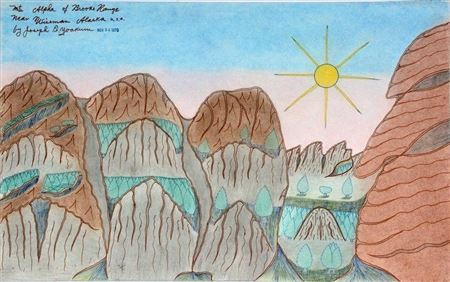
1886 Window Rock, Arizona - 1972. Known for: Naive dream-landscape, outsider art.
The story of how the art of Joseph Yoakum first came to the public eye begins with a window, just as his life begins at Window Rock, Arizona, 'where I were born' as one of his titles says. As if his... Read full biography
The story of how the art of Joseph Yoakum first came to the public eye begins with a window, just as his life begins at Window Rock, Arizona, 'where I were born' as one of his titles says. As if his whole life was set to be a metaphor where every stone wall had a window to escape through. From his... Read full biography
The story of how the art of Joseph Yoakum first came to the public eye begins with a window, just as his life begins at Window Rock, Arizona, 'where I were born' as one of his titles says. As if his whole life was set to be a metaphor where every stone wall had a window to escape through. From his own words, his story begins when he ran away, and in time his feet walked every continent except Antarctica, from circus to circus, from town to town, from job to job. He loved to name the names of... Read full biography
The story of how the art of Joseph Yoakum first came to the public eye begins with a window, just as his life begins at Window Rock, Arizona, 'where I were born' as one of his titles says. As if his whole life was set to be a metaphor where every stone wall had a window to escape through. From his own words, his story begins when he ran away, and in time his feet walked every continent except Antarctica, from circus to circus, from town to town, from job to job. He loved to name the names of those places, when he told of those travels. But in 1967 Joseph Yoakum, age 79 (or 81, depending on your source) found himself living alone in a tiny store front on 82nd Street near Stony Island Avenue in Chicago. He had hit the stone wall of age. 'A... Read full biography
The story of how the art of Joseph Yoakum first came to the public eye begins with a window, just as his life begins at Window Rock, Arizona, 'where I were born' as one of his titles says. As if his whole life was set to be a metaphor where every stone wall had a window to escape through. From his own words, his story begins when he ran away, and in time his feet walked every continent except Antarctica, from circus to circus, from town to town, from job to job. He loved to name the names of those places, when he told of those travels. But in 1967 Joseph Yoakum, age 79 (or 81, depending on your source) found himself living alone in a tiny store front on 82nd Street near Stony Island Avenue in Chicago. He had hit the stone wall of age. 'A middle class black community. A decent neighborhood,' says a neighbor. But Yoakum didn't feel safe on the streets at night. He had to stay in the small... Read full biography
Artist Biography
Biography page for Joseph E Yoakum ((1886 - 1972)), known for Naive dream-landscape, outsider art. Showing 1 biographical entries and 0 sample artworks.
Joseph E Yoakum - Artist Info
About Joseph E Yoakum
Biography from the Archives of askART
 The story of how the art of Joseph Yoakum first came to the public eye begins with a window, just as his life begins at Window Rock, Arizona, 'where I were born' as one of his titles says. As if his whole life was set to be a metaphor where every stone wall had a window to escape through. From his own words, his story begins when he ran away, and in time his feet walked every continent except Antarctica, from circus to circus, from town to town, from job to job. He loved to name the names of those places, when he told of those travels. But in 1967 Joseph Yoakum, age 79 (or 81, depending on your source) found himself living alone in a tiny store front on 82nd Street near Stony Island Avenue in Chicago. He had hit the stone wall of age. 'A middle class black community. A decent neighborhood,' says a neighbor. But Yoakum didn't feel safe on the streets at night. He had to stay in the small room, and the nights were long. There was no getting past this wall. 'I thought I would go crazy.' He told a reporter.
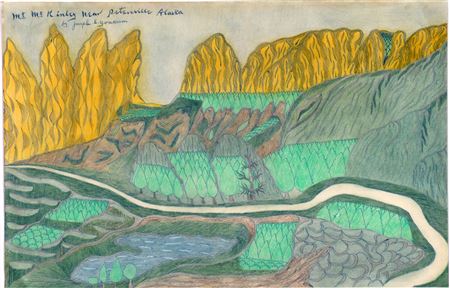
According to Phil Hanson, Yoakum woke up one night, ill. He was impelled to draw, as if in a vision. He realized when it was done, that he had drawn a picture of Golgotha. He had never drawn before. 'He always said it was a spiritual unfoldment. He had his Science and Health there.' said Hanson. A passage reads, 'There is no life, truth, intelligence in matter. All is infinite Mind, and its infinite manifestations, for God is All-in-all.' No matter. Only meaning, unfolding spiritually. He found the window in his visions, unfolding as he drew them. And once he started, he couldn't stop. That was in 1962. By 1967, his shelves were piled high with his visions, drawn with ball-point pen on paper purchased at the local Woolworths, then colored in 'like a coloring book' with colored pencils, and polished down with a little wad of toilet paper. He decided to string a line across the window and clothes-pin some drawings there. Maybe sell some.
There was a knock at the door. It was a man who introduced himself as John Hobgood, a neighbor, an anthropologist and a professor at Chicago State College. He liked those drawings in the window. They had stopped him cold. Yoakum was pleased to sell him some. They became friends. 'He was grandfatherly, kind, easy going.' says Hobgood, 'and very mystical. He would see a place clearly in a vision and then paint it. It was clear to Hobgood that these pictures needed to be shown. Four months later, Hobgood was having lunch in a coffee house called 'The Whole' in the basement of St. Bartholomew's Lutheran Church. It was set up as an ecumenical Christian ministry for the Chicago State and Wilson Junior College students. Hobgood noticed student art exhibited in the lounge area. He went into the office and asked if they might be interested in meeting Yoakum, and displaying some of his work. The director, Harvey Pranian, said he'd be pleased to take a look. Have him stop by.
Pranian remembers seeing Yoakum for the first time. 'He was a large man, with huge hands. He was shy, quiet, proud of his drawings. He felt flattered that anyone would want to show them. He carried a portfolio with maybe a hundred pictures. I chose twenty or thirty which we later matted. We thought we'd charge $25 a piece. He gave me a drawing in thanks, but he liked my secretary, gave her maybe six.' (artist Jim Nutt laughed at this. 'That's true. He liked women. In a nice way. He went out of his way to be kind to them.' 'If you were a woman,' said Roger Brown, 'you were lucky.')
Pranian's friend, Reverend Clyde Allison of the Emerald Avenue Presbyterian Church came by to see the exhibit. Yoakum happened to be there at the time. 'He was dressed in work clothes, the kind everybody wore,' says Allison, 'He took me around, and told me stories about each picture, and when he told the story, he was the picture. In his eyes he saw in every spot a spirituality that nobody else could see. He didn't see a mountain, he saw the meaning behind it, he didn't see a river, he saw divine channels. I've never met a more spiritual man in my life.'
The pastor of St. Bartholomew's sent a letter to the Chicago Daily News. The News had just done a piece on the local Chicago coffee houses and left out The Whole. Wouldn't they be interested in carrying the story of a former circus traveler who started painting in his seventies? Norman Mark was handed the story. When he discovered that Yoakum's work had sold for a quarter the month before -- or given as a gift to anyone who ran an errand for him, and were now selling for $25, it looked like a prime ground-floor opportunity. Mark phoned Yoakum, and agreed to meet him at the Whole. The interview lasted over three hours, and the cynic was won over by the spirituality of the man. 'God and the Bible figure strongly in Yoakum's life,' he wrote. 'His philosophy, his syntax, his lifestyle are all cast in a Biblical mold.' The article, which appeared soon afterwards in the November 11th issue of the Panorama section, still holds up as a beautiful piece of writing and a vivid portrait of the artist.
Yet as fine as the article was, it was one of the visitors mentioned in the article that furthered Yoakum's influence more. ''Thomas Brand.' writes Mark, 'traveled to the Whole to check on some printing he was to do for the coffeehouse, and immediately caught the fever.' According to Jim Nutt, Thomas Brand was a printer, a former student at the School of the Art Institute of Chicago. A few months before, he had printed a comic book for some of the 'Who Chicago' or 'Hairy Who' artists just coming into recognition through their shows at the Hyde Park Art Center. These were all A.I.C. students or former students, working on vivid, highly crafted inner-image paintings. They included the A.I.C. teacher Ray Yoshida, his students Christina Ramburg, Phil Hanson and Roger Brown. Karl Wirsum, Jim Nutt and Gladys Nilsson were also included, as colleagues and friends. Thomas Brand told gallery owner Ed Sherbeyn about the exhibit, who contacted (and contracted) Yoakum, and arranged an exhibition for the next spring.
'First Gallery showing of Chicago's Own Primitives' proclaimed the poster, 'March 29th to May 5th, 1968. Edward Sherbeyn Gallery, 2952 North Clark Street, Chicago.' It had a photo of a Yoakum arbitrarily printed in blue and brown. Jim Nutt was shown the poster by some of his Roosevelt University students, and was not impressed. But Karl Wirsum lived in the run-down north-side neighborhood where this gallery was, saw a Yoakum in the window, and he, too, stopped dead in his tracks. He walked in and found the Yoakums pinned across the wall from the floor to the ceiling, and others stacked on the side. They were priced at $12.50 for the small, $25.00 for the medium, and $50 for the large ones. He bought one on the spot and took it home. Jim Nutt walked into Wirsum's house, saw it across the room, and tore off to the gallery himself. He bought several, and took them home to his wife, Gladys Nilsson. They came back, bought more, and told their other friends, the most important one being a colleague, an artist turned art historian, a man named Whitney Halstead.
Nilsson and Nutt soon moved to California, but the Yoakum images stayed vivid. As they drove through the great Western landscapes for the first time, they'd exclaim to each other, 'Look! a Yoakum!' pointing to a mountain scene to the north or south. In Sacramento they met Adaliza McHugh, an eccentric gallery owner of a place called 'The Candy Store', and convinced her to carry Yoakums as well. They became the go-betweens. So it was natural that they would eventually meet Yoakum himself--though it felt odd.
'The feeling was that this type of work wasn't being produced by anybody', says Nutt -- 'that times had made it impossible to be a folk artist or a naive. The term 'outsider' hadn't been coined yet. I was aware of the book that Sydney and Harriet Janis had written in the early forties, and it talked about a number of artists of the twenties and thirties, Morris Hirschfield and John Kane being the best known. But you had the feeling that it was over. So the idea of getting in touch with somebody was like jumping back into the past.'
But, Ray Yoshida, Phil Hanson, Roger Brown, Whitney Halstead, and others did meet Yoakum. There is a photo of them all standing with Yoakum in front of his storefront, each one on the threshold of their own careers. Yoakum's art would be included in their joint exhibitions, catalogues and books. The Chicago art critic, Dennis Adrian saw Yoakum's role in this group and made sure, through his talks and writings, that the art world knew it too.
Hanson describes Whitney Halstead as 'a small man, precise, formal, charming.' Nutt says of him, 'Whitney may not have been among the first to visit. But somewhere along the line he became interested, very interested. As an art historian, he not only was taken with the work, he became really charmed with Mr. Yoakum in the nicest of ways, and then just decided to do something about it. Halstead would befriend Yoakum, care for him, hire him lawyers, buy him art supplies, organize shows, get him to the hospital, and carefully document every detail of his life, every story Yoakum told, interviewing anyone he could, leaving a large file box of unpublished material for future biographers at the Chicago Art Institute archives. Halstead purchased unfinished drawings so that Yoakum's unique method of working would be preserved. A major Yoakum retrospective at the Art Institute of Chicago was made possible by the work bequeathed by Halstead.
From internet
http://www.rawvision.com/back/yoakum/yoakum.html
----------------------------------------------------------------------Born on the Navajo reservation at Window Rock, Arizona, he is believed to be Indian but referred to himself as "as old black man" so is included in references to Black-American artists.
His childhood was spent on a farm near Walnut Grove, Missouri, and he ran away to join the circus. He was also with Buffalo Bill's Wild West Show. He was a sailor and World War I veteran and then, having lived the life of an itinerant, married and had five children. From the 1920s to 1960s, his whereabouts are largely unknown. In 1962, he settled in Chicago until his death 10 years later. He began painting when he lived in Chicago and created a substantial number of pastel and watercolor drawings, most of them dream-like landscapes. He called them spiritual unfoldment, blends of fact and fancy, "portraits of places he had visited".
Source:
"Art & Auction", March 2003, 'Market Place'
Peter Falk, "Who Was Who in American Art"