Page loaded successfully. Showing biography for Joseph O'Sickey.
Joseph O'Sickey BIOGRAPHY
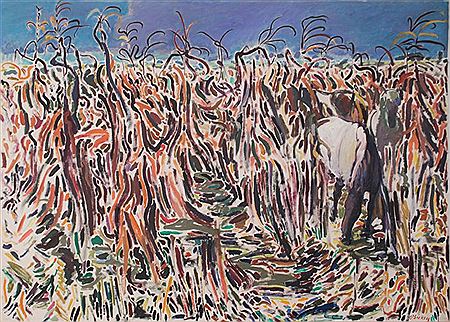
1918 Detroit, Michigan - 2013 Ravenna, Ohio. Known for: Figure and floral painting, garden landscape, teaching.
Following is the obituary of the artist by Steven Litt, the Cleveland Plain Dealer, July 22, 2013. Joseph O'Sickey was a leading Northeast Ohio artist beloved for his approachable vision: . Joseph... Read full biography
Following is the obituary of the artist by Steven Litt, the Cleveland Plain Dealer, July 22, 2013. Joseph O'Sickey was a leading Northeast Ohio artist beloved for his approachable vision: . Joseph O'Sickey, the much beloved Northeast Ohio artist who depicted his backyard garden in Twin Lakes as an... Read full biography
Following is the obituary of the artist by Steven Litt, the Cleveland Plain Dealer, July 22, 2013. Joseph O'Sickey was a leading Northeast Ohio artist beloved for his approachable vision: . Joseph O'Sickey, the much beloved Northeast Ohio artist who depicted his backyard garden in Twin Lakes as an earthly paradise, and whose work radiated the warmth of his long and happy marriage to his late wife, Algesa O'Sickey, died Monday after a two-year battle with lymphoma. He was 94. O'Sickey was... Read full biography
Following is the obituary of the artist by Steven Litt, the Cleveland Plain Dealer, July 22, 2013. Joseph O'Sickey was a leading Northeast Ohio artist beloved for his approachable vision: . Joseph O'Sickey, the much beloved Northeast Ohio artist who depicted his backyard garden in Twin Lakes as an earthly paradise, and whose work radiated the warmth of his long and happy marriage to his late wife, Algesa O'Sickey, died Monday after a two-year battle with lymphoma. He was 94. O'Sickey was admitted to hospice care on Thursday at Robertson Memorial Hospital in Ravenna, said his longtime friend, Cleveland Heights architect Robert Blatchford. "He was like a father to me," Blatchford said Monday. "I grew up without a father, so he substituted as... Read full biography
Following is the obituary of the artist by Steven Litt, the Cleveland Plain Dealer, July 22, 2013. Joseph O'Sickey was a leading Northeast Ohio artist beloved for his approachable vision: . Joseph O'Sickey, the much beloved Northeast Ohio artist who depicted his backyard garden in Twin Lakes as an earthly paradise, and whose work radiated the warmth of his long and happy marriage to his late wife, Algesa O'Sickey, died Monday after a two-year battle with lymphoma. He was 94. O'Sickey was admitted to hospice care on Thursday at Robertson Memorial Hospital in Ravenna, said his longtime friend, Cleveland Heights architect Robert Blatchford. "He was like a father to me," Blatchford said Monday. "I grew up without a father, so he substituted as that for me. He made me do better work architecturally.". O'Sickey's son, Joel, 62, said a private memorial ser... Read full biography
Artist Biography
Biography page for Joseph O'Sickey ((1918 - 2013)), known for Figure and floral painting, garden landscape, teaching. Showing 2 biographical entries and 0 sample artworks.
Joseph O'Sickey - Artist Info
About Joseph O'Sickey
Biography from the Archives of askART
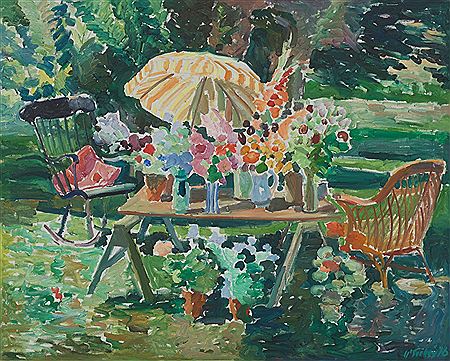 Following is the obituary of the artist by Steven Litt, the Cleveland Plain Dealer, July 22, 2013
Joseph O'Sickey was a leading Northeast Ohio artist beloved for his approachable vision:
Joseph O'Sickey, the much beloved Northeast Ohio artist who depicted his backyard garden in Twin Lakes as an earthly paradise, and whose work radiated the warmth of his long and happy marriage to his late wife, Algesa O'Sickey, died Monday after a two-year battle with lymphoma. He was 94.
O'Sickey was admitted to hospice care on Thursday at Robertson Memorial Hospital in Ravenna, said his longtime friend, Cleveland Heights architect Robert Blatchford.
"He was like a father to me," Blatchford said Monday. "I grew up without a father, so he substituted as that for me. He made me do better work architecturally."
O'Sickey's son, Joel, 62, said a private memorial service would be held Tuesday at the Wood-Kortright-Borkoski Funeral Home in Ravenna.
A public celebration of Joseph and Algesa O'Sickey, who died in 2006 at age 89, will be scheduled at a later time, Joel O'Sickey, the only surviving family member, said.
O'Sickey is widely viewed as a member of the Cleveland School, a group whose work bridged tradition and modernism in the first half of the 20th century.
More accurately, O'Sickey was part of the wave of Northeast Ohio artists who matured after World War II, and who helped shape generations of young artists through teaching at area universities and colleges.
O'Sickey's peers included Joseph McCullough, Julian Stanczak, Ed Mieczkowski and John Paul Miller. He was also a close friend of Roy Lichtenstein, the Pop artist famous for paintings styled like images lifted from comics.
Of the Cleveland group, O'Sickey was the most conservative. He was heavily influenced by 20th century French artists Henri Matisse and Pierre Bonnard, and the 19th-century French Impressionists.
O'Sickey also loved his early art lessons at the Cleveland Museum of Art, where he learned to paint in ink on paper with Chinese brushes.
In an interview at his house in Twin Lakes last December, O'Sickey said that he and Lichtenstein both grew disenchanted with Abstract Expressionism, which came to dominate American art in the late 1950s.
Lichtenstein responded by taking inspiration from commercial art, advertising and Disney cartoons as a way to separate his work sharply from the visible angst and splashy brushwork of the Ab-Ex painters, particularly the second-generation imitators of Jackson Pollock and Willem de Kooning.
O'Sickey, meanwhile, reasoned that he could make an art that was authentically his - and not imitative of anyone else - by drawing and painting his favorite subjects in a quick, spontaneous manner.
"My feeling was that as long as I did sketches in reaction to what I saw, I wasn't reacting against anybody else's work," he said. "I felt that as long as I went through my process of drawing, there was no way my drawings could be like anybody else's."
Born in Detroit in 1918 as the second of five children in a Polish-American family, O'Sickey grew up in Cleveland's Slavic Village, where he delivered newspapers during the Depression to help his parents make ends meet. His parents allowed him to keep his tips to pay for art supplies.
He attended the Cleveland School of Art, now the Cleveland Institute of Art, and graduated in 1940. He was drafted into the Army in 1941 and served in Oran, Algeria, and Assam, India.
Joseph O'Sickey painted thousands of quick ink studies, such as an undated study of an owl
He met Algesa D'Agostino at the 1030 Gallery in Cleveland, where she worked as an assistant and later as director. They married in 1947.
In a career that spanned more than six decades, O'Sickey inspired admirers and collectors in Northeast Ohio and in New York, where he was represented by the Kennedy Galleries.
O'Sickey had numerous one-man shows, including "Joseph O'Sickey: Unifying Art, Life and Love," which closed at the Canton Museum of Art on Sunday. His work has been collected by leading institutions, including the Cleveland Museum of Art.
O'Sickey supported himself as a commercial artist after World War II, by producing fashion illustrations, advertisements, posters and other graphic products, including renderings for Cleveland architect Robert Little, in whose office he met and befriended Blatchford.
O'Sickey's favorite subjects included zoo animals and the circus - motifs inspired by childhood visits to the Brook Park Zoo, now Metroparks Zoo, in Cleveland.
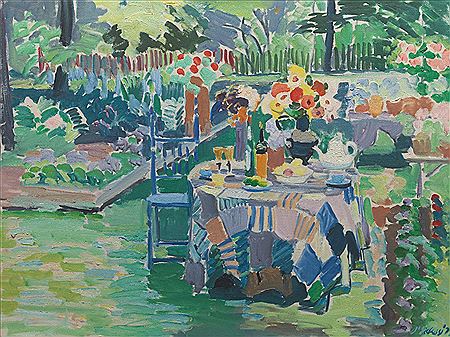
He also reveled in paintings of his backyard in Twin Lakes, where he and Algesa settled after he started teaching at Kent State University in 1964.
O'Sickey frequently posed Algesa, often wearing a broad-brimmed sun hat, amid tables piled high with fruit, or clusters of flowers and potted plants.
Algesa, a gifted artist and interior designer, was a constant inspiration, O'Sickey said.
"I've had a wonderful life," O'Sickey said in December, "and I had Algesa. No matter how successful another artist might be, he didn't have Algesa."
Online Source:
www.cleveland.com/arts/index.ssf/2013/07/joseph_osickey_was_a_leading_n.htmlBiography from the Archives of askART
 Joseph O'Sickey, born in Detroit in 1918, has been a painter and teacher throughout his career. As a child he attended Saturday classes at the Cleveland Museum of Art, which retains one of his paintings in its permanent collection, and the Cleveland Institute of Art, where he received a Bachelor's degree in 1940.
He graduated from the Cleveland School of Art (now the Cleveland Institute of Art) in 1940 and taught at Ohio State University (1946-47), Akron Art Institute (1949-52), Western Reserve University School of Architecture (1956-64), and Kent State University (1964-89).
Among the most honored painters active in the region, O'Sickey won the Cleveland Arts Prize in Visual Arts in 1974, and was called "a dean of painting in Northeast Ohio" by Steven Litt, art and architecture critic of the Plain Dealer.
However, his work continued to develop through his 20s, strongly influenced by post-impressionism.
O'Sickey was represented in New York by Jacques Seligmann Galleries during the 1960s and 1970s (which presented seven one-person shows of his work) and by Kennedy Galleries in the 1980s and 1990s. In Ohio, notable exhibitions include a Distinguished Alumnus one-person show at the Cleveland Institute of Art (1982); a one-person show at the Canton Museum of Art (1995); exhibition in 24 May Shows at the Cleveland Museum of Art between 1938 and 1977.
O'Sickey's work is also in the collections of the Cleveland Museum of Art, Ohio; Canton Museum of Art, Ohio; Westmoreland Museum of American Art, Greensburg, Pennsylvania; Butler Institute of American Art, Youngstown, Ohio; and Columbus Museum, Columbus, Georgia.
Sources:
The Cleveland Public Library
Information submitted by Richard Louis