Page loaded successfully. Showing biography for Jules Joseph Lefebvre.
Jules Joseph Lefebvre BIOGRAPHY
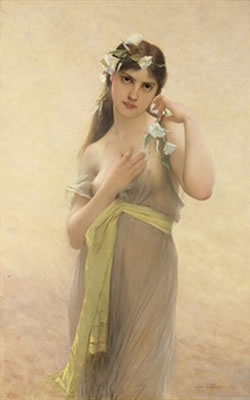
1836 Tournan, France - 1911 Paris, France. Known for: Figure and landscape painting, nudes.
JULES-JOSEPH LEFEBVRE (1836-1911). Lefebvre, born at Tournan, France on March 14, 1836, was a teacher at the Academie Julian, a favorite of many American art students (along with Boulanger, his... Read full biography
JULES-JOSEPH LEFEBVRE (1836-1911). Lefebvre, born at Tournan, France on March 14, 1836, was a teacher at the Academie Julian, a favorite of many American art students (along with Boulanger, his colleague). At the Ecole des Beaux-Arts, Lefebvre studied under Léon Cogniet (1794-1880), the teacher of... Read full biography
JULES-JOSEPH LEFEBVRE (1836-1911). Lefebvre, born at Tournan, France on March 14, 1836, was a teacher at the Academie Julian, a favorite of many American art students (along with Boulanger, his colleague). At the Ecole des Beaux-Arts, Lefebvre studied under Léon Cogniet (1794-1880), the teacher of Laurens and Bonnat. Lefebvre's Death of Priam won the Prix de Rome in 1861, and he began a lifelong specialization in the female nude in 1866 with Nymph and Bacchus. The French government purchased La... Read full biography
JULES-JOSEPH LEFEBVRE (1836-1911). Lefebvre, born at Tournan, France on March 14, 1836, was a teacher at the Academie Julian, a favorite of many American art students (along with Boulanger, his colleague). At the Ecole des Beaux-Arts, Lefebvre studied under Léon Cogniet (1794-1880), the teacher of Laurens and Bonnat. Lefebvre's Death of Priam won the Prix de Rome in 1861, and he began a lifelong specialization in the female nude in 1866 with Nymph and Bacchus. The French government purchased La Vérité (Truth) in 1870 (Musée d'Orsay, Paris), a cold, expressionless standing nude carrying a beacon, in imitation of Ingres' La Source (see Weinberg, 1991, p. 231). Gammell (1986) described how Edmund Tarbell reacted to La Vérité. The Boston... Read full biography
JULES-JOSEPH LEFEBVRE (1836-1911). Lefebvre, born at Tournan, France on March 14, 1836, was a teacher at the Academie Julian, a favorite of many American art students (along with Boulanger, his colleague). At the Ecole des Beaux-Arts, Lefebvre studied under Léon Cogniet (1794-1880), the teacher of Laurens and Bonnat. Lefebvre's Death of Priam won the Prix de Rome in 1861, and he began a lifelong specialization in the female nude in 1866 with Nymph and Bacchus. The French government purchased La Vérité (Truth) in 1870 (Musée d'Orsay, Paris), a cold, expressionless standing nude carrying a beacon, in imitation of Ingres' La Source (see Weinberg, 1991, p. 231). Gammell (1986) described how Edmund Tarbell reacted to La Vérité. The Boston painter wondered how this talented artist could create such a "chalky nude."... Read full biography
Artist Biography
Biography page for Jules Joseph Lefebvre ((1836 - 1911)), known for Figure and landscape painting, nudes. Showing 4 biographical entries and 0 sample artworks.
Jules Joseph Lefebvre - Artist Info
About Jules Joseph Lefebvre
Name variants
Jules Lefebver
Biography from the Archives of askART
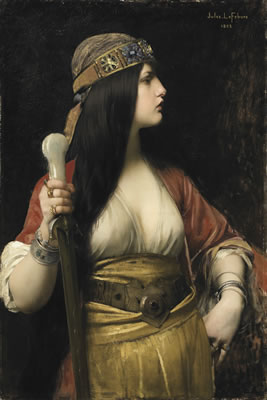 JULES-JOSEPH LEFEBVRE (1836-1911)
Lefebvre, born at Tournan, France on March 14, 1836, was a teacher at the Academie Julian, a favorite of many American art students (along with Boulanger, his colleague). At the Ecole des Beaux-Arts, Lefebvre studied under Léon Cogniet (1794-1880), the teacher of Laurens and Bonnat.
Lefebvre's Death of Priam won the Prix de Rome in 1861, and he began a lifelong specialization in the female nude in 1866 with Nymph and Bacchus. The French government purchased La Vérité (Truth) in 1870 (Musée d'Orsay, Paris), a cold, expressionless standing nude carrying a beacon, in imitation of Ingres' La Source (see Weinberg, 1991, p. 231). Gammell (1986) described how Edmund Tarbell reacted to La Vérité. The Boston painter wondered how this talented artist could create such a "chalky nude." Gammell explained that he wanted a symbolic figure with calculated color and generalized forms.
Wealthy American collectors, such as William H. Vanderbilt and William Astor had Lefebvre's nudes in their collections, and many American art students sought his teaching; the list includes Charles H. Davis, Robert Reid, Arthur Wesley Dow, George Hitchcock, Gari Melchers, Elizabeth Nourse, Willard Metcalf, Adolph Shulz, Albert Sterner, Kenyon Cox, E. Boyd Smith, Otto Stark, John H. Vanderpoel, and Robert Vonnoh. Lefebvre, who taught separate classes for men and women, was stingy with his compliments, but he praised Nourse's work, while she was at the Académie Julian, where most Americans received his critiques. In addition, Elmer Boyd Smith wrote in his diary on February 7, 1883 that Lefebvre praised one of his drawings: "the best 'send-off' I've had." But Strickler, in her recent study on Tarbell (2001, p. 36), characterized Boulanger as "attentive and popular" while Lefebvre was seen as "remote and feared."
Pissarro's claim that Lefebvre was not a great draftsman seems indefensible (Rewald, 1946, pp. 405-406). Lefebvre's Graziella of 1878 (Metropolitan Museum of Art) is an elegantly posed and gracefully conceived figure. Julius Kaplan (2000, p. 269) relates how further "harsh judgements appeared in La Presse by 1875" against Lefebvre's art. William Rothenstein (1931, p. 39), who was also at the Julian Academy, described Lefebvre as "a skillful but thoroughly conventional painter of the nude . . . personally straightforward and unaffected." His Une Japonaise: Language of the Fan, in the Chrysler Museum, Norfolk, Virginia (1882), for instance, is no Japanese woman at all, but a rather homely model disguised in an elegant silk kimono. D'Igny, in Arts and Letters (1888), mentioned Lefebvre's "tall figure and formidable moustache, are somewhat at variance with the gentle benevolence of his features. He looks like a cavalry officer who has forgotten his cavalry swagger." Lefebvre's Lady Godiva (Musée de Picardie, Amiens) is a tour de force in perspective, as the viewer looks up a winding cobblestone street. The striking but rather illustrative painting was exhibited at the Paris Universal Exposition of 1900. Lefebvre died in Paris on February 24, 1911.
Sources:
Strahan, Edward [Earl Shinn], Art Treasures of America: Being the Choicest Works of Art in the Public and Private Collections of North America. Philadelphia: G. Barrie, 1879, pp. 69-71; D'Igny, Pierre, "The Salon Forty," Arts and Letters 2 (June 1888), p. 356; Eaton, D. Cady, A Handbook of Modern French Painting. New York: Dodd, Mead and Co., 1909, pp. 274-275; Rothenstein, William, Men and Memories: Recollections of William Rothenstein. New York: Coward, McCann, 1931, p. 39; Gammell, R. H. Ives, Twilight of Painting. An Analysis of Recent Trends to Serve in a Period of Reconstruction. New York: G. P. Putnam's Sons, 1946, pl. 28; Burke, Mary Alice Heekin and Lois Marie Fink, Elizabeth Nourse, 1859-1938. A Salon Career. Washington, DC: Smithsonian Institution Press, 1983, pp. 91-92; La femme: The Influence of Whistler and Japanese Print Masters on American Art 1880-1917, Exh. cat. New York: Grand Central Art Galleries, 1983, p. 42; Fehrer, Catherine, "New Light on the Académie Julian and Its Founder (Rodolphe Julian)," Gazette des Beaux-Arts 103 (May-June 1984): 207-216; Grunchec, Philippe, The Grand Prix de Rome: Paintings from the Ecole des Beaux-Arts 1797-1863. Traveling exh. cat. Washington, DC: International Exhibitions Foundation, 1984-85, nos. 31, 100; Milner, John, The Studios of Paris: The Capital of Art in the Late Nineteenth Century. New Haven, CT: Yale University Press, 1988, p. 127; Blaugrund, Annette, Paris 1889: American Artists at the Universal Exposition. New York: Harry N. Abrams, Inc., 1989, pp. 248-249, 251; Weinberg, H. Barbara, The Lure of Paris: Nineteenth-Century American Painters and Their French Teachers. New York: Abbeville Press, 1991; Kaplan, Julius, "Lefebvre," in From Monet to Cézanne: Late 19th Century French Artists. The Grove Dictionary of Art Series. New York: St. Martin's Press, 2000, pp. 268-269.
Submitted by Richard H. Love and Michael Preston Worley, Ph.D.Biography from the Archives of askART
 Jules-Joseph Lefebvre, French 1836 - 1911
Jules Lefebvre was known in his time as the champion of the elegant and exquisite nude and a devotee of the traditional cult of beauty. Born in Tournan, France, little evidence was given of the brilliant career to come. His father was a baker and it was to this trade that he was initially apprenticed.
At the age of sixteen, after showing a wonderful aptitude for drawing and over his mother's objections, his father sent him to Paris to be educated as an artist. There Lefebvre became the pupil of Leon Cogniet and in 1855 made his debut at the World's Exposition in Paris with a portrait.
Carrying off the Grand Prize for the Prix de Rome in 1861, the artist went on to receive all the honors that France could possibly bestow upon its artists. Lefebvre received medals at the annual Paris Salons of 1865, 1868 and 1870, and a First Class medal at the 1878 Exposition Universelle. He was made a Chevalier of the Legion of Honor in 1870 and that same year was appointed a Professor at the Ecole des Beaux-Arts in Paris.
As his studies were always of a chaste, austere and classic character, it was perhaps aptly said that he saw "beauty through a veil of perfection." One reviewer wrote in 1881: "…it is sufficient to just mention his name in order to immediately evoke the memory and the image of the thousand adorable creatures of which he is the young father... An unusually skilled draftsman, Jules Lefebvre better than anyone else caresses, with a brush both delicate and sure, the undulating contour of the feminine form."
Biography excerpted from the unpublished catalog by Edward P. Bentley for the Haussner Restaurant in Baltimore, Maryland, titled: Haussner's, The Art Collection.Biography from Roger King Fine Art
Jules-Joseph Lefebvre was a celebrated French artist and one of the primary teachers of American expatriate painters in the second half of the 19th century. Known for his often allegorical portrayals of the female nude, the popularity of his paintings rivaled that of Bourguereau. (Interestingly, Lefebvre was the teacher of Bouguereau's second wife, Elizabeth.)
An "academic classicist," Lefebvre was trained at the Ecole des Beaux-Arts and made his debut at the Paris Salon in 1855. In 1861 he won the coveted Prix de Rome which earned him five years of art study in that city. After his return to France he won prizes at several Universal Expositions, culminating in a grand prize in 1889. He became a teacher at the Academie Julian in Paris, an atelier favored by Americans studying abroad and one of the first schools to train women. Lefebvre, who had honed his skills in Italy by copying works of Italian Mannerist painter Andrea del Sarto, emphasized precise life drawing skills in his teaching. He was one of the most sought-after teachers at the Academie, and the roster of his students reads like a "who's who" of American art, including Frank Benson, Charles Courtney Curran, Childe Hassam, George Hitchcock, Gari Melchers, Philip Leslie Hale, Lous Aston Knight, Frederick MacMonnies, Willard Metcalf, Guy Rose, Edmund Tarbell, John Twachtman, and Irving Ramsey Wiles, among many others.
Lefebvre was made a member of the Academie des Beaux Arts and a Commander of the Legion of Honor, and today his works are in museums in America and Europe, including the Louvre.
c Roger King Fine ArtBiography from Ruellan Auction
Alfred Jean Marie Broquelet is a painter, engraver and lithographer. The artist was a student of Bouguereau, Tony Robert-Fleury and Paul Maurou.