Page loaded successfully. Showing biography for Karen Karnes.
Karen Karnes BIOGRAPHY
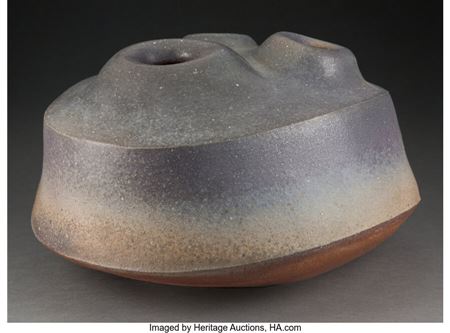
1925 New York City - 2016. Known for: Wheel thrown stoneware pottery, teapots, vases, vessels.
KAREN KARNES (1915-2016) . Beauty and function combine in pottery crafted by Karen Karnes. She was known for her wheel-thrown pieces, lidded casseroles, and salt-glazed pottery. Rather than teach,... Read full biography
KAREN KARNES (1915-2016) . Beauty and function combine in pottery crafted by Karen Karnes. She was known for her wheel-thrown pieces, lidded casseroles, and salt-glazed pottery. Rather than teach, she supported herself and son through sales of her work—unusual for a female craftsperson in the... Read full biography
KAREN KARNES (1915-2016) . Beauty and function combine in pottery crafted by Karen Karnes. She was known for her wheel-thrown pieces, lidded casseroles, and salt-glazed pottery. Rather than teach, she supported herself and son through sales of her work—unusual for a female craftsperson in the 1960s. The daughter of Russian immigrants who worked in the garment district, Karnes was born in New York City. She attended the High School of Music & Art, located in the Hamilton Hills neighborhood on... Read full biography
KAREN KARNES (1915-2016) . Beauty and function combine in pottery crafted by Karen Karnes. She was known for her wheel-thrown pieces, lidded casseroles, and salt-glazed pottery. Rather than teach, she supported herself and son through sales of her work—unusual for a female craftsperson in the 1960s. The daughter of Russian immigrants who worked in the garment district, Karnes was born in New York City. She attended the High School of Music & Art, located in the Hamilton Hills neighborhood on 135th Street in Harlem. The school was known as “The Castle on the Hill,” because of its gothic revival style architecture. From there Karnes went to Brooklyn College where she majored in design, but never touched clay. Many of the instructors had come... Read full biography
KAREN KARNES (1915-2016) . Beauty and function combine in pottery crafted by Karen Karnes. She was known for her wheel-thrown pieces, lidded casseroles, and salt-glazed pottery. Rather than teach, she supported herself and son through sales of her work—unusual for a female craftsperson in the 1960s. The daughter of Russian immigrants who worked in the garment district, Karnes was born in New York City. She attended the High School of Music & Art, located in the Hamilton Hills neighborhood on 135th Street in Harlem. The school was known as “The Castle on the Hill,” because of its gothic revival style architecture. From there Karnes went to Brooklyn College where she majored in design, but never touched clay. Many of the instructors had come from Europe which, according to Karnes, made for “a kind of Bauhaus education in Brooklyn.“ She graduated in 1946.... Read full biography
Artist Biography
Biography page for Karen Karnes ((1925 - 2016)), known for Wheel thrown stoneware pottery, teapots, vases, vessels. Showing 1 biographical entries and 0 sample artworks.
Karen Karnes - Artist Info
About Karen Karnes
Biography from The Johnson Collection
KAREN KARNES (1915-2016)
Beauty and function combine in pottery crafted by Karen Karnes. She was known for her wheel-thrown pieces, lidded casseroles, and salt-glazed pottery. Rather than teach, she supported herself and son through sales of her work—unusual for a female craftsperson in the 1960s.
The daughter of Russian immigrants who worked in the garment district, Karnes was born in New York City. She attended the High School of Music & Art, located in the Hamilton Hills neighborhood on 135th Street in Harlem. The school was known as “The Castle on the Hill,” because of its gothic revival style architecture. From there Karnes went to Brooklyn College where she majored in design, but never touched clay. Many of the instructors had come from Europe which, according to Karnes, made for “a kind of Bauhaus education in Brooklyn.“ She graduated in 1946.
Karnes was introduced to pottery by David Weinrib, her husband. She later recalled how: “In 1950 we went to Italy and lived for a year and a half in a little village outside of Florence, a pottery village with a few large industrial potteries and perhaps fifty to a hundred smaller potteries. It was there that I learned to throw by attending a school run by one of the factories. We set up a little potter's shop in our apartment and ground our own glazes from raw lead and sand in a mortar and pestle.” Upon returning to the United States she obtained a scholarship to study at the New York State College of Ceramics at Alfred University in western New York state. It was there that she began working with stoneware.
Having taken a summer design course in 1947 with Josef Albers, Karnes was pleased to return to Black Mountain College with her husband in October 1952, replacing Robert Turner who had established the ceramic program. They were potters-in-residence, but while he had a title and a salary, she did not. Bernard Leach, a noted British potter and Shõji Hamada from Japan visited during that time. Karnes encountered John Cage, Merce Cunningham, and Franz Kline, along with Willem and Elaine de Kooning. While at Black Mountain she became involved with the Southern Highland Craft Guild and sold her work in nearby Asheville.
In 1954 Karnes moved to the Gate Hill Cooperative community in Stony Point, New York, viewed by some as an extension of Black Mountain College. Cage and Cunningham were often there, and Jasper Johns had a studio nearby. The community consisted of artists, composers, filmmakers, choreographers, and poets, and included founders Paul and Vera Williams, Stan VanDerBeek, M. C. Richards, and David Tudor. About forty miles north of New York City, Gate Hill was a nexus for contemporary art of the day, often attracting practitioners of Fluxus, happenings, and modern dance. Karnes built her own studio and kilns and developed a flameproof clay body which facilitated her casserole specialty. She remained an active member of the community until 1979, when she moved to Morgan, Vermont, located in the so-called northeast kingdom near the Canadian border.
A turning point for Karnes came as a result of a workshop at the Penland School of Craft, picturesquely positioned in the Blue Ridge Mountains in western North Carolina. As she explained, “It was at Penland in 1967 that I first began working with a salt kiln. I had worked for so many years in a kind of quiet palette using more or less one base glaze and a limited color range. Essentially I have always been more intrigued with the process of throwing than I have with glaze decorating. Form had been my primary interest all the time and I was just looking for a way to cover the surface—to bring it back to a wet-pot look with color. For that, salt is marvelous because it gives a beautiful skin to a pot that can be both quiet and exciting.“
Tragedy struck in 1998 when a kiln fire destroyed her Vermont house and studio. Nevertheless, with help from colleagues she rebuilt her facility and went back to work, choosing to produce smaller scale and more intimate pieces. Over her long career Karnes was recognized for her considerable talent; she received two fellowships from the National Endowment for the Arts, in 1976 and 1988. The American Craft Council honored her with its Gold Medal of Highest Achievement in Craftsmanship in 1998, followed a year later by the Vermont Arts Council Governor’s Award for Excellence in the Arts, and in 1990 the Society of Arts and Crafts presented her its Medal of Excellence. Over four decades Karnes served her profession as the curator of the annual pottery show and sale at the Art School at Old Church in Demarest, New Jersey.
Reflecting upon her long and productive career, Karnes stated: “After all these years as a potter, I am still conscious of the privilege of my life. There is still the deep pleasure of making pots on the wheel, the excitement of firing, and kiln opening, the challenge of new forms. It is a life of so much variety and one for which I am fully responsible—a rare quality in work today.”
The Johnson Collection, Spartanburg, South Carolina
thejohnsoncollection.org