Page loaded successfully. Showing biography for Karl August Wirsum.
Karl August Wirsum BIOGRAPHY
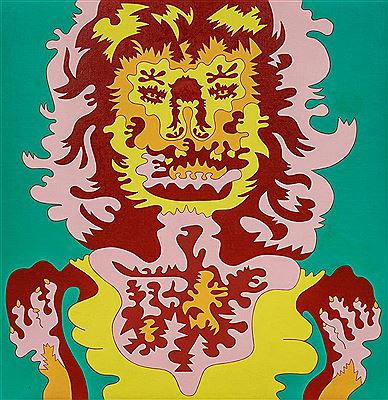
1939 Chicago, Illinois - 2021 Chicago, Illinois. Known for: Drawing, funk figure-faces, "Hairy Who," imagist, sculpture, drawing.
"Karl Wirsum, Dynamic and Eclectic Chicago Artist, Dies at 81," Online obituary, The New York Times, by Roberta Smith, June 20, 2021. A member of the small but influential group known as the Hairy... Read full biography
"Karl Wirsum, Dynamic and Eclectic Chicago Artist, Dies at 81," Online obituary, The New York Times, by Roberta Smith, June 20, 2021. A member of the small but influential group known as the Hairy Who, he built his art on a highly original synthesis of multiple sources. Karl Wirsum, whose avid,... Read full biography
"Karl Wirsum, Dynamic and Eclectic Chicago Artist, Dies at 81," Online obituary, The New York Times, by Roberta Smith, June 20, 2021. A member of the small but influential group known as the Hairy Who, he built his art on a highly original synthesis of multiple sources. Karl Wirsum, whose avid, sometimes robotic figures in both two and three dimensions exemplified the group of disruptive artists known in the late 1960s as the Hairy Who, died on May 6 in Chicago. He was 81. His death was... Read full biography
"Karl Wirsum, Dynamic and Eclectic Chicago Artist, Dies at 81," Online obituary, The New York Times, by Roberta Smith, June 20, 2021. A member of the small but influential group known as the Hairy Who, he built his art on a highly original synthesis of multiple sources. Karl Wirsum, whose avid, sometimes robotic figures in both two and three dimensions exemplified the group of disruptive artists known in the late 1960s as the Hairy Who, died on May 6 in Chicago. He was 81. His death was announced by Derek Eller, his New York gallery. His family said the cause was cardiac arrest. With titles like Lana Turner With Her Own Eyebrows Before Schrafft’s and Some Underwear Over the Rainbow,”Mr. Wirsum’s art was suffused with a great deal of humor.... Read full biography
"Karl Wirsum, Dynamic and Eclectic Chicago Artist, Dies at 81," Online obituary, The New York Times, by Roberta Smith, June 20, 2021. A member of the small but influential group known as the Hairy Who, he built his art on a highly original synthesis of multiple sources. Karl Wirsum, whose avid, sometimes robotic figures in both two and three dimensions exemplified the group of disruptive artists known in the late 1960s as the Hairy Who, died on May 6 in Chicago. He was 81. His death was announced by Derek Eller, his New York gallery. His family said the cause was cardiac arrest. With titles like Lana Turner With Her Own Eyebrows Before Schrafft’s and Some Underwear Over the Rainbow,”Mr. Wirsum’s art was suffused with a great deal of humor. But the man himself was quiet and reserved, with tastes on the spartan side. Very health conscious, he... Read full biography
Artist Biography
Biography page for Karl August Wirsum ((1939 - 2021)), known for Drawing, funk figure-faces, "Hairy Who," imagist, sculpture, drawing. Showing 2 biographical entries and 0 sample artworks.
Karl August Wirsum - Artist Info
About Karl August Wirsum
Biography from the Archives of askART
 "Karl Wirsum, Dynamic and Eclectic Chicago Artist, Dies at 81," Online obituary, The New York Times, by Roberta Smith, June 20, 2021
A member of the small but influential group known as the Hairy Who, he built his art on a highly original synthesis of multiple sources.
Karl Wirsum, whose avid, sometimes robotic figures in both two and three dimensions exemplified the group of disruptive artists known in the late 1960s as the Hairy Who, died on May 6 in Chicago. He was 81.
His death was announced by Derek Eller, his New York gallery. His family said the cause was cardiac arrest.
With titles like Lana Turner With Her Own Eyebrows Before Schrafft’s and Some Underwear Over the Rainbow,”Mr. Wirsum’s art was suffused with a great deal of humor. But the man himself was quiet and reserved, with tastes on the spartan side. Very health conscious, he had followed a macrobiotic diet since the 1970s and went running nearly every day until he was 75.
His self-containment may have stemmed from the deaths of his parents when he was 9, in a car accident from which he escaped without injury. He developed an early sense of independence and seemed determined to get as much as he could out of anything aesthetic that caught his interest.
Mr. Wirsum belonged to a generation of artists located mostly in Chicago and Northern California that swam against the current of Abstract Expressionism and Minimalism in the 1960s. Instead, they invented a vital new kind of figuration that maintained a lively dialogue with modernism, popular culture and the viewer.
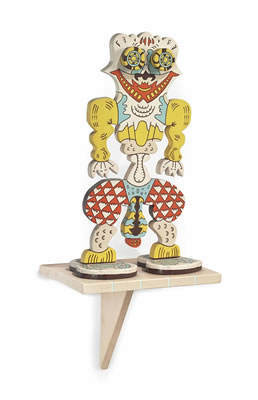
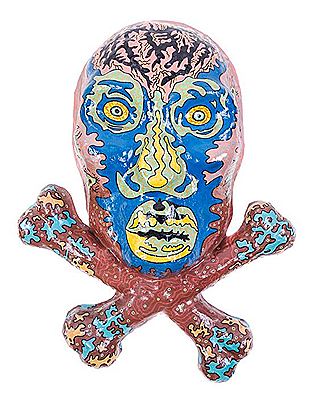
Mr. Wirsum’s achievement rested on his highly original synthesis of multiple sources — high and low, ancient and modern, East and West — and his fusion of organic and geometric forms. His figures almost inevitably combine a kinetic exuberance with something more sinister. Their masklike faces grin and grimace.
He cited as influences the art of Mesoamerica and New Guinea, medieval Madonnas and Japanese woodblock prints, as well as toys, marionettes and especially comics — but also the work of Picasso, Klee and Jean Dubuffet.
He got into the first Hairy Who show, at the Hyde Park Art Center in 1966, at the last minute. He was suggested by the center’s curator, Don Baum, and welcomed by the tight-knit cohort of artists who had proposed the show: Jim Falconer, Art Green, Jim Nutt, Gladys Nilsson and Suellen Rocca. He had graduated ahead of them from the School of the Art Institute of Chicago, and they considered him more mature, not realizing that he shared their subversive spirit.
Mr. Wirsum inadvertently originated the group’s name, asking “Harry who?” when the name of Harry Bouras, a well-known art critic for the Chicago radio station WFMT, came up.
Over the next four years, the group went on to stage three more raucous exhibitions at the center and one each in New York, Washington and San Francisco.
Image
Mr. Wirsum preferred cartoonish, not-quite-human beings that often resembled action figures or aliens. His early paintings and drawings tended to define these figures in jagged or wavy lines that gave them a manic, electrical energy. Later he smoothed their edges, armoring them in shapes of neon color.
In a 2015 interview for the online art magazine Hyperallergic, he called Abstract Expressionism “the active-painting school.” “I was interested in precision,” he said. But with their stiff frontality, artifice, high-key colors and stylization, his figures had a strong element of abstraction.
Karl August Wirsum was born in Chicago on Sept. 27, 1939, to August and Katharine (Gresik) Wirsum. Both his parents immigrated from Germany after World War I. His mother was a skilled seamstress whose work fascinated her son; his father had briefly studied commercial art before becoming a machinist, but continued to draw. Both parents encouraged his artistic interests.
Karl started drawing at the age of 4 when he was hospitalized for a month, recovering from a concussion. When he was 6, his parents enrolled him in Saturday art classes at the Art Institute, which he took for three years. After his parents died, he lived with their best friends. He moved to a Y.M.C.A. after graduating from Bowen High School on the South Side.
As an adolescent he frequented the Maxwell Street flea market, to shop and also to listen to the blues and R&B musicians who often played in nearby empty lots. Music remained a lifelong inspiration. The rhythmic patterns and loud colors of his figures could be seen to make their own kind of noise.
Mr. Wirsum attended the School of the Art Institute of Chicago on a full scholarship. He planned to become a cartoonist, but his interests were broadened by several of the school’s teachers, and by the museum’s collection. The artist Kathleen Blackshear, for example, taught an art history class from a global point of view, alerting him to the different kinds of stylized figuration that flourished beyond Western art. Soon he was studying painting and printmaking.
Teaching for three years in the early 1970s at Sacramento State University in California, he had a studio large enough to make nearly life-size puppets out of painted papier-mâché, with arms and legs that moved. He drew nonstop, in and out of class, and later relied on his sketchbooks for ideas. He preferred drawing to painting. “The drawings are more playful,” he said in the 2015 Hyperallergic interview, “and the paintings are more like washing dishes.”
After graduating from the Art Institute school in 1961, Mr. Wirsum spent five months in Mexico, traveling with the artist Ed Paschke, a classmate, and immersing himself in Mesoamerican art and contemporary relics, textiles and folk art. He found inspiration visiting New Orleans at Mardi Gras time.
In April 1968 he married Lorri Gunn, who under his tutelage became an artist. She survives him, as do their daughter, Ruby, a schoolteacher, and their son, Zack, who is also an artist.
In late May of that year the couple went to Europe for four months. One of the trip’s high points was visiting Dubuffet and his collection of Art Brut (outsider or self-taught art) in Paris. Mr. Wirsum was already aware of the phenomenon, having been among the first of the Hairy Who group to see and acquire the fantasy landscape drawings of the self-taught Black artist Joseph Yoakum, who was working in a storefront on Chicago’s South Side at the time. At an ethnographic museum in Rotterdam, Mr. Wirsum was transfixed by the intricately appliquéd Mola textiles of the Kuna people of Central America.
Upon his return to Chicago, Mr. Wirsum put the bright colors and flattened patterns of the Mola to immediate use in Screamin’ Jay Hawkins (1968), one of several powerful images he created of musicians, including Howlin’ Wolf, Junior Wells and James Brown. It was acquired by the Art Institute of Chicago in 1970, the same year Mr. Hawkins used it as the cover art for his album Because Is in Your Mind.
Mr. Wirsum had his first solo show at the Marjorie Dell Gallery in Chicago in 1967. By 1976 he had migrated to Phyllis Kind’s gallery, also in Chicago, where most of the other Hairy Who artists showed. For a while, he also showed in Ms. Kind’s New York gallery. But he went without a solo show in New York from 1988 to 2010, when Derek Eller began representing him. Over the next eight years the Eller gallery mounted six well-received shows focusing on different phases of his career. But he was never accorded the major museum retrospective that his art deserved.
Not that Mr. Wirsum seemed to notice. In the Hyperallergic interview, he said, “My model was thinking about the artist in the cold-water flat, where recognition didn’t arrive until you were under the ground.”Biography from the Archives of askART
 Karl Wirsum (born 1939 in Chicago, Illinois) is an American artist. A member of the notorious Chicago artistic group The Hairy Who, he helped set the foundation for Chicago's art scene in the 1970s. Wirsum is primarily a painter, though he has worked with prints, sculpture and even digital art.
He received a B.F.A. from the School of the Art Institute of Chicago in 1961.
Wirsum was one of the earliest members of The Hairy Who (along with James Falconer, Art Green, Gladys Nilsson, Jim Nutt, and Suellen Rocca). This group came to be known by the exhibition title of the same name, which was co-curated by Don Baum at the Hyde Park Art Center in 1966, and for which the group received national attention.
Subsequent shows followed in 1967 and in 1968, of which the latter went from the Hyde Park Art Center to the San Francisco Art Institute. In the winter of 1968-69 there was a Hairy Who drawing show at the School of Visual Arts in NY. In the Spring of 1969 the last Hairy Who show was at the Corcoran Gallery of Art, Dupont Center in Washington, DC.
By the early 1970s, several Hairy Who artists came to be known as Chicago Imagists, (a name for which critic Franz Schulz is credited for having developed) and this "group" expanded to include Ed Paschke, Roger Brown and Barbara Rossi, among others.
Numerous members of the Wirsum family are involved with making art. His wife Lorri Gunn is an accomplished artist, daughter Ruby Wirsum works in photography and ceramics, while son Zack Wirsum is a painter and was featured in New American Paintings #59.
Wirsum still lives in Chicago and works as a Full Adjunct Professor at the School of the Art Institute of Chicago.
The work of Wirsum and the artists of his generation has gone on to influence the course of art in America. American painter Eric Fischl has credited his exposure to the non-mainstream art of the Hairy Who as "revelatory experiences"
Source:
"Karl Wirsum", Wikipedia, http://en.wikipedia.org/wiki/Karl_Wirsum