Page loaded successfully. Showing biography for Leon Gaspard.
Leon Gaspard BIOGRAPHY
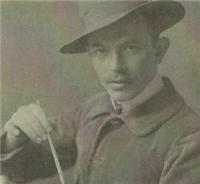
1882 Vitebsk, Russia - 1964 Taos, New Mexico. Known for: Figure, street-landscape, and genre painting.
Submitted by Dr. Elena Ivanova, art historian, independent researcher, author of the monograph “Leon Schuman Gaspard: The Real Story” (Mascot Books, 2023), former Chief Educator at Stark Museum of... Read full biography
Submitted by Dr. Elena Ivanova, art historian, independent researcher, author of the monograph “Leon Schuman Gaspard: The Real Story” (Mascot Books, 2023), former Chief Educator at Stark Museum of Art, Orange, Texas. Leon Gaspard was born on October 1 (2), 1883 (Julian calendar; October 13/14,... Read full biography
Submitted by Dr. Elena Ivanova, art historian, independent researcher, author of the monograph “Leon Schuman Gaspard: The Real Story” (Mascot Books, 2023), former Chief Educator at Stark Museum of Art, Orange, Texas. Leon Gaspard was born on October 1 (2), 1883 (Julian calendar; October 13/14, Gregorian calendar) in Vitebsk, Russian Empire (today Republic of Belarus), according to the documents at the Historical Archives of the Republic of Belarus. His birth name was Leiba Schulman; he was a... Read full biography
Submitted by Dr. Elena Ivanova, art historian, independent researcher, author of the monograph “Leon Schuman Gaspard: The Real Story” (Mascot Books, 2023), former Chief Educator at Stark Museum of Art, Orange, Texas. Leon Gaspard was born on October 1 (2), 1883 (Julian calendar; October 13/14, Gregorian calendar) in Vitebsk, Russian Empire (today Republic of Belarus), according to the documents at the Historical Archives of the Republic of Belarus. His birth name was Leiba Schulman; he was a son of Shmuel, a carpenter, and Cira (née Abraham) Schulman. He started his art education in Vitebsk at the art school of Yury (Yudel) Pen, a well-known Jewish-Belorussian artist. From 1899/1900 to 1904, he was enrolled at the Odessa Art School. In... Read full biography
Submitted by Dr. Elena Ivanova, art historian, independent researcher, author of the monograph “Leon Schuman Gaspard: The Real Story” (Mascot Books, 2023), former Chief Educator at Stark Museum of Art, Orange, Texas. Leon Gaspard was born on October 1 (2), 1883 (Julian calendar; October 13/14, Gregorian calendar) in Vitebsk, Russian Empire (today Republic of Belarus), according to the documents at the Historical Archives of the Republic of Belarus. His birth name was Leiba Schulman; he was a son of Shmuel, a carpenter, and Cira (née Abraham) Schulman. He started his art education in Vitebsk at the art school of Yury (Yudel) Pen, a well-known Jewish-Belorussian artist. From 1899/1900 to 1904, he was enrolled at the Odessa Art School. In 1905, Schulman departed for Paris where he studied for two months (May 8 – June 12 and October 30 – November 27, 1905) at the Académie Julia... Read full biography
Artist Biography
Biography page for Leon Gaspard ((1882 - 1964)), known for Figure, street-landscape, and genre painting. Showing 8 biographical entries and 0 sample artworks.
Leon Gaspard - Artist Info
About Leon Gaspard
Name variants
Leon Schulman
Biography from the Archives of askART
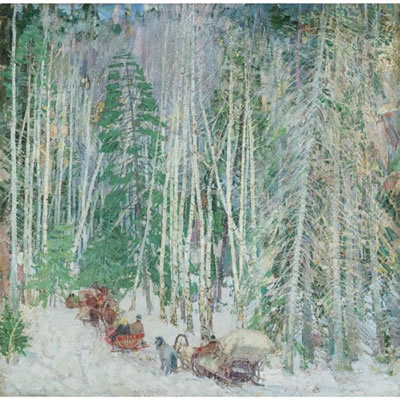 Submitted by Dr. Elena Ivanova, art historian, independent researcher, author of the monograph “Leon Schuman Gaspard: The Real Story” (Mascot Books, 2023), former Chief Educator at Stark Museum of Art, Orange, Texas.
Leon Gaspard was born on October 1 (2), 1883 (Julian calendar; October 13/14, Gregorian calendar) in Vitebsk, Russian Empire (today Republic of Belarus), according to the documents at the Historical Archives of the Republic of Belarus. His birth name was Leiba Schulman; he was a son of Shmuel, a carpenter, and Cira (née Abraham) Schulman. He started his art education in Vitebsk at the art school of Yury (Yudel) Pen, a well-known Jewish-Belorussian artist. From 1899/1900 to 1904, he was enrolled at the Odessa Art School.
In 1905, Schulman departed for Paris where he studied for two months (May 8 – June 12 and October 30 – November 27, 1905) at the Académie Julian. Although he later claimed that his teacher was William-Adolphe Bouguereau, his mentors at the Académie were Marcel Baschet and Edouard Toudouze. He began exhibiting at the Paris Salons in 1906, using a Gallicized version of his name, Léon Schulman(n): Salone d’Automne, Salon des Indépendants, Salon des Artistes Français, and Salon de la Société Nationale des Beaux-Arts (Salon du Champs-de-Mars). He also exhibited at
such galleries as Maison des Arts, Georges Petit, and Devambez. His paintings featuring Russian fairs and winter village scenes received critical acclaim in the Parisian press.
In 1908, Schulman met Evlyn Gasper, daughter of a wealthy American widow Eugenia Ward. They got married on December 24, 1908, in a civil ceremony at the Mayor's Office of the 14th arrondissement of Paris. In 1912, they were wed at the Russian Orthodox church in Vitebsk. Since 1911, Schulman was adding his wife's slightly modified maiden name to his own, using several variations before he settled on the name under which he is known today: Léon Gaspard. This change coincided with the couple’s move to the United States in 1915, where Gaspard reinvented himself as a son of a merchant of French descent. That step necessitated another invention – a new maiden name for Evlyn, which became Adel, a truncated version of her mother’s maiden name, Adelman.
When the Great War broke out, Gaspard enlisted in the French Army and served as an aerial observer in the balloon detachment, not in the French aviation, as he later claimed. He was wounded and spent several months recuperating in the south of France before he was sufficiently recovered to travel to the United States, arriving in New York on July 13, 1915. Gaspard’s first solo exhibition in the United States, “A Russian Painter’s Impressions of War: Scenes in Russia and France by Léon Gaspard,” took place at Reinhardt’s Galleries in New York on April 17 – May 6, 1916. The exhibition traveled to several cities, with more works added at each location. Gaspard regularly exhibited at the national venues, such as the National Academy of Design, Art Institute of Chicago, Corcoran Gallery, and Carnegie Institute. His paintings garnered critical and public acclaim for their colorful palette and decorative composition.
In 1917/1918, the couple moved to Chicago. In the summer of 1918, the Gaspards visited Taos, New Mexico, for the first time. Enchanted by the beauty of the area, they spend the following two summers in Taos before settling there permanently in 1921. In 1930, they moved into their own house, a whimsical architectural structure that combined features of a southwestern mudbrick house, a Gothic church, and a Russian peasant hut.
Gaspard enjoyed the major success of his career after his journey to East China and Mongolia in 1921. The exhibition “Paintings of the Far East by Leon Gaspard,” organized by Milch Galleries of New York, traveled around the country from 1923 to 1926. Some of the works were painted on coarse silk, which increased luminosity of colors and prompted comparisons with ancient mosaics. Gaspard undertook another journey in 1926, ostensibly, with the intention to travel for two years through Central Asia and West China (known at the time as Russian and Chinese Turkestan), but had to change his plans and returned to the United States in September of the same year. There is no evidence that he traveled beyond the Middle East. Despite his later stories of a two-and-a-half year-long wanderings through China, Mongolia, and Tibet, both trips lasted between three to five months. Gaspard made one more transatlantic journey, to North Africa (Morocco, Algeria, and Tunis), in 1932-33. The paintings based on that trip were exhibited at Stendahl Galleries in Los Angeles in 1936.
In the 1930s – 1940s, Gaspard continued painting Russia and other faraway places from memory and old sketches. His paintings became more whimsical and decorative, combining reality and fantasy. In the 1950s, he shifted his attention to nature and native peoples of New Mexico. He exhibited in Taos and Santa Fe, with solo exhibitions at La Fonda Gallery (1957) and Museum of New Mexico (1958). Two years after Evlyn’s death in 1956, Gaspard married artist Dora Kaminsky. In 1959, the newlyweds
departed on a transatlantic journey, visiting Egypt, Moscow, and Paris. Thanks to Dora’s entrepreneurial skills, several seminal articles about Gaspard were published in 1959-1962, and collectors of southwestern art, such as H. J. Lutcher Stark of Orange, Texas; Harrison Eiteljorg of Indianapolis, Indiana; and Eugene B. Adkins of Tulsa, Oklahoma, were actively buying his paintings. In 1962, the exhibition “Sketches of Leon Gaspard” took place at Southwest Museum in Los Angeles.
Gaspard died of a heart attack on February 21, 1964. According to his wishes, he was buried on his property. Later, his widow, Dora Kaminsky-Gaspard-Blackman, reburied his remains at the Sierra Vista Cemetery. The name on the headstone reads "Leon Maximovich Gaspard," a testament to the artist’s insistence on perpetuating his fictional biography. Two retrospective exhibitions took place within the next 18 months of his death: “Memorial Exhibition of Paintings and Sketches by Leon Gaspard” at West Texas Museum in Lubbock, November 29, 1964 – January 31, 1965, and “Leon Gaspard” at Museum of New Mexico, Santa Fe, September 19 – October 31, 1965. In the following years, commercial galleries contributed to the rising popularity of Gaspard’s art among collectors and general public: Maxwell Galleries, San Francisco (1967); Hammer Galleries, New York (1968); Kennedy Galleries, New York, and Arrowhead Fenn Galleries, Santa Fe (1974); Fenn Galleries, Santa Fe (1981); Gerald Peters Gallery, Santa Fe (1984), and Berry-Hill Galleries, New York (1986). Gaspard's work is often featured at art auctions, such as Sotheby’s, Christie’s, Coeur d'Alene, Santa Fe, and Scottsdale. The highest price for Gaspard’s work – $2,001,000 for “The Finish of the Kermesse” (1918) was realized at Christie's on November 29, 2007.
The largest collections of Gaspard’s art are at Stark Museum of Art, Orange, Texas; Eugene B. Adkins Collection at Fred Jones Jr. Museum of Art, University of Oklahoma, Norman, Oklahoma, and Philbrook Museum of Art, Tulsa, Oklahoma; New Mexico Museum of Art, Santa Fe, New Mexico; Frye Art Museum, Seattle, Washington; and Eiteljorg Museum of American Indians and Western Art in Indianapolis, Indiana.
Sources:
Leon Gaspard Papers, 1917-1964, Archives of American Arts, Smithsonian Institution, Washington, D.C.
Catalogue général des élèves répertoire alphabetique, 31, rue de Dragon, atelier de gauche, Bouguereau at Ferrier, 1903-1905; et atelier Toudouze et Baschet, 1905-1907,
Archives Nationales de France, microfilm 63 AS 1, 318.
Dugnat, Gaïte (2000). Les Catalogues des Salons de la Société Nationale des Beaux-Arts, vol. 4, p. 163.
Lobstein, Dominic (2003). Dictionnaire des Indépendents, 1884-1914, vol. 3, p. 1561.
Sanchez, Pierre (2006). Dictionnaire du Salon d'Automne: répertoire des expositions et liste des oeuvres presentées, 1903-1945, vol. 3, pp. 1238–39.
Sanchez, Pierre (1999). Les Catalogues des Salons des Beaux-Arts, vol. 22, Salon 1909, p. 134; Salon 1910, p. 144.
Sanchez, Pierre (2009). Les Expositions de la Galerie Berthe Weil (1901-1942) et de la Galerie Devambez (1907-1926), vol. 2, p. 448.
Sanchez, Pierre (2011). Les Expositions de la Galerie Georges Petit (1881-1934), vol. 1, p. 35.
Cahill, Edgar (1923). “Gaspard and America’s Growth”. Shadowland, September, p. 11, 76.
Comstock, Helen (1923). “Gaspard Paints the East.” International Studio, October 1923, p. 16-20.
Dorfman, John (2009). "From Russia, With Love". Art & Antiques: 98–105.
Ivanova, Elena (2023). Leon Schulman Gaspard: The Real Story. Mascot Books. 2023.
ISBN 978-1-63755-245-2.
Jellico, John (1962). “Leon Gaspard, Veteran Painter of Taos.” American Artist, May, p. 45-50.
Leon Gaspard: A Retrospective Exhibition. (1965). Exhibition catalogue, Santa Fe: Museum of New Mexico.
Leon Gaspard 1882 – 1964. (1967). Exhibition catalogue, Maxwell Galleries, Hogan and Kaus Lithograph Co.
Leon Gaspard: The Artist, the Land (1986). Exhibition catalogue, Museum of Texas Tech University, Lubbock, Texas.
Savoy, Maggie (1961). “It’s Not Too Far”. Arizona Republic, April 30, p. 174.
Skolle, John (1959). “Leon Gaspard, Painter of the Proud Orient”. November 19, unidentified periodical, Leon Gaspard Papers, 1917 – 1964, Archives of American Arts,
Smithsonian Institution, Washington, D.C.
Stewart, Rick (1986). The Art of Leon Gaspard. Catalogue of the exhibition “Leon Gaspard,” May 5-23, Berry-Hill Galleries, New York.
"The Gaspards Return Home From Travels" (1959). The Taos News. August 20, p. 5.
Waters, Frank (1981). Leon Gaspard. Northland Press. ISBN-10 0873582993.Biography from Nedra Matteucci Galleries
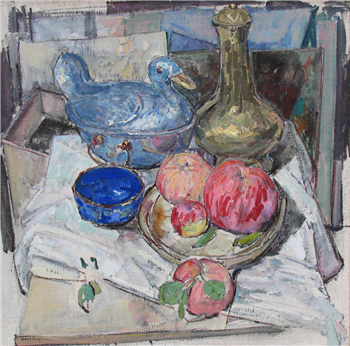 LEON GASPARD (1882-1964)
The individuality and strong character of Leon Gaspard is expressed in his remarkable paintings, which span continents and decades. Born in Vitebsk, Russia, Gaspard accompanied his father on fur trades to Asia. This exposure to the colorful and exotic cultures would remain a theme of his work throughout his life.
Gaspard's artistic studies began in Vitebsk and were followed by further study in Odessa and at the Academy of Moscow. He travelled to Paris in 1901 to study with Adolphe Bouguereau and Edouard Toudouze at the Académie Julian. There he met his future wife, Evelyn Adell, an American ballet student.
Their unusual honeymoon, a two-year pack trip through the Siberian wilderness, allowed Gaspard to create hundreds of sketches. These sketches, as well as others made on his later travels throughout Asia, Europe, North Africa and America, became the foundation for his finished paintings.
Gaspard's highly successful Parisian career was interrupted by World War I, when he flew with the French Air Corps as an aerial observer. His plane was shot down, and Gaspard was badly injured. His wife's family arranged for him to come to New York to recuperate. In 1919 the Gaspards moved to Taos, seeking a more beneficial climate. The native cultures of the Southwest reminded Gaspard of his beloved homeland. Though they continued to travel, the Gaspards made Taos their permanent home in 1924.
Gaspard's paintings are anomalous among the work of the Taos painters, since they have many cultures from many lands as their theme. His paintings combine the clear bright colors associated with Impressionism and the influences of more modern and interpretive representation. Gaspard's vibrant paintings, filled with movement and rendered in brilliant colors, are a historic legacy of cultures from around the world.Biography from Altermann Galleries and Auctioneers, II
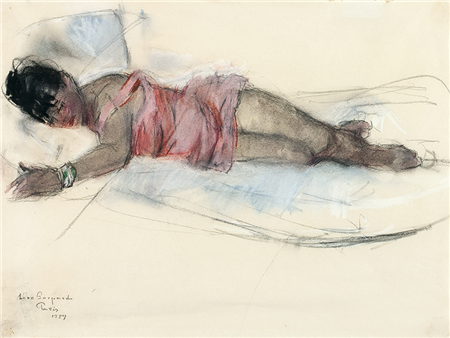 Born: Vitebsk, Russia 1882
Died: Taos, New Mexico 1964
Important Taos painter.
Gaspard was the son of a retired Russian army officer who took him along as a boy on fur trading trips to Siberia. In Vitebsk he became the pupil of Julius Penn, along with Marc Chagall, a most important Post-Impressionist artist. Gaspard also studied in Odessa and Moscow before going to Paris at 17 for study at the Julien Academy with Edouard Toudouze and Bouguereau, "the supreme academician." His first one-man show while still a student resulted in the purchase of 35 Paris sketches by a New York collector. Gaspard took his American wife on a two-year horseback honeymoon in Siberia in 1908. The resulting paintings were a Paris success. He was seriously wounded as a French aviator shot down in WWI and moved to New York City in 1916.
When his doctors recommended a warmer climate, he settled in Taos in 1918. Although the established Taos artists received him coldly, except for Dunton, Gaspard found in the Indians and the terrain the basis for commercial success with his "bright palette and freely drawn, loosely painted scenes." His paintings show "a love of exciting color and highly developed pattern. The intricate fabric of his methods of design are to an extent concealed by the accomplished way in which he preserves the casual immediacy of a sketch, even in large-scale studio work. Gaspard continued to travel extensively and to paint productively until his death.
Resource: SAMUELS' Encyclopedia of ARTISTS of THE AMERICAN WEST,
Peggy and Harold Samuels, 1985, Castle PublishingBiography from Mark Sublette Medicine Man Gallery
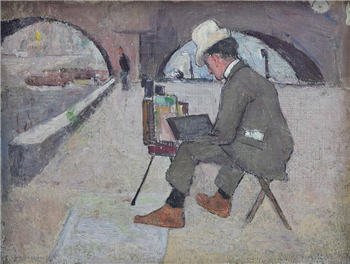 Leon Gaspard was an interesting addition to the New Mexico arts scene when he arrived there in 1918. A Russian-born, French-trained veteran of the airborne campaigns of the Great War, he arrived physically diminished from a horrific plane crash that had put him in a French hospital for two years. Seeking a more hospitable climate, he arrived in Taos to find a vibrant arts community and an exotic blend of native, western and Hispanic cultures.
Having traveled widely throughout Russia, China, Mongolia, Tibet, Morocco and Northern Africa as a fur trader, successful painter, army pilot and international spy, Gaspard had a love of foreign cultures and a desire to document them artistically. Taos allowed him just such an opportunity, and he set out to paint the Taos Indians in much the same way he had painted the natives of North Africa and Asia while in Paris.
A pariah of sorts when he first arrived, Gaspard was saved socially when Herbert "Buck" Dunton took a liking to him and began to bring him around to meet the artists of Taos. A kindly and gregarious man, Gaspard eventually became quite well-liked, in part because of his propensity to sing romantic songs from various cultures and tell stories of his life and travels.Biography from William A. Karges Fine Art
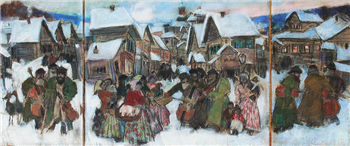 Leon Gaspard was born near Moscow, Russia, in 1882, to parents who encouraged his artistic talents, and his move to Paris to study at the Academie Julian. Gaspard was enthralled by the creative climate and the creativity that was around him. For several years he studied and showed his works at the Paris Salon.
Following a two-year recovery from an airplane accident, Gaspard moved to New York in 1916, where he would live and exhibit for only 2 years before settling in Taos, New Mexico. In Taos, Gaspard was fascinated by the indigenous culture, and set about learning and painting it. His vibrant style was rooted in Impressionism, and resisted many Moderist trends.Biography from Thomas Nygard Gallery
LEON GASPARD (1882-1964)
Provenance:
® Fenn Galleries, Santa Fe, New Mexico
® Private Collection, Albuquerque, New Mexico
Literature:
® Leon Gaspard by Frank Waters, Northland Press, Arizona,1981
Illustrated page 71.
Born to a retired Russian officer, Leon Gaspard traveled with his father to the steppes of Siberia to buy furs from the nomadic tribesman. Reluctantly, his father, hoping that he would pursue the art of the violin, allowed him to enroll in art classes taught by Julius Penn in Vitebsk. Seeking continued education Gaspard studied art in Odessa and Moscow before he was able to enroll at the Julien Academy at the age of 17. Living hand to mouth in Paris he held various odd jobs while sketching everything Parisian. With no income from his parents who had died with nothing to give, he was very fortunate to have a successful sale to a Paris art dealer. So excited about the quality of his work, the dealer, George Petite, arranged a show of his sketches. At the end of the show Gaspard was 4,000 francs the richer.
With his new finances Gaspard was working at his sketches when he was approached by the American George D. Pratt, a director of Standard Oil. Pratt bought over thirty five pieces from Gaspard. More good fortune came to Gaspard from America in the form of Evelyn Adell, with whom he eventually married and traveled to New York with. In 1918, they were settled in Taos, New Mexico. A late comer to the art scene in Taos, he was received coolly at first until "Buck" Dunton made him his friend. Painting and traveling, Gaspard was able to establish himself as an important painter of Europe and the West.Biography from Hubbell Trading Post National Historic Site
If Gaspard went to Hopi, he visited Hubbell on the way. It is good enough for me to say he did - knowing how people traveled in those days. The only way he would have avoided Hubbell would have been to train from Santa Fe to Winslow and horseback ride to the Hopi Mesas. But, my money is on him riding from Taos to Hopi via Chaco Ruins then Ganado then Keams
Canyon and the Mesas.
Source:
Ed Chamberlin, Curator, Hubbell Trading Post, email 9/2/2008Biography from Artistic Gallery
Of Russian origin, he was fascinated with regional color, costumes and rituals, especially of local people of Taos, New Mexico where he arrived in 1919. His work of wide-ranging subjects is noted for its brilliant color and intricate patterning. His style combined elements of French Impressionism with Realism.
He was born in Vitebsk, near Moscow, into a family that nurtured his talents. By the age of fifteen he was taking art classes, and one of his fellow students was Marc Chagall.
Seeking more training, Gaspard moved to Paris and enrolled in the Academie Julian. He was enamored of French Impressionism, the abstract, innovative painting of Modigliani and Matisse, and especially by the expressive style of the sculpture of Rodin. It was an exciting time because Paris was then the capital of creativity of the western world in art and music and literature. For several years, he showed his paintings in the annual Salon exhibition.
But seeking the world beyond, he chose to leave and in 1909, he and his new bride, Evelyn Adell, daughter of a wealthy American family, began a pattern of traveling with a two-year honeymoon journey through Siberia.
In 1914, he enlisted in the French Aviation Corps and was seriously wounded in a plane crash. He spent two years in a French hospital, and his wife went home to America where he joined her in New York in 1916. In that city, he quickly became a part of the art community and exhibited at the National Academy of Design and the Vanderbilt Gallery. He and his wife visited artist Sheldon Parsons in Santa Fe but more impressed by the environs of Taos, they moved there in 1918.
He and Evelyn traveled extensively from Taos, using every form of transportation to see far-away-places including China, Mongolia, Tibet, Morocco, and Northern Africa. He became adept at drawing or sketching on horseback or in wagons and traveled thousands of miles by pony, camel, river boat, steamship, automobile, truck, and airplane. It was said that regardless of where he was, he always lived in the big world in that he was filled with expansive ideas and creative spirit.
In Morocco, he was on a secret mission for the French government, something he never revealed. He and his wife stayed in Tunis for several years during the Depression because a closed bank in America had frozen their funds.
Although advised by John Marin to become a modernist, Gaspard resisted and stayed to a vigorous, realistic style. He was a popular man, with a warm personality and good humor, full of entertaining stories and romantic songs.