Page loaded successfully. Showing biography for Leon Zack.
Leon Zack BIOGRAPHY
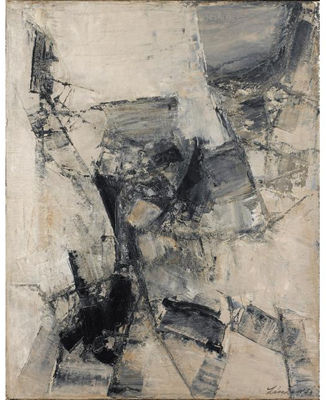
1892 Nijni-Novgorod, Russia - 1980 Vanves, France. Known for: Abstract paintings, sculpture, illustration, design.
Leon Zack (1892 – 1980) . School of Paris painter, sculptor, illustrator and designer. Born at Nijni-Novgorod in Russia. Studied literature at Moscow University and painting under Rerberg and... Read full biography
Leon Zack (1892 – 1980) . School of Paris painter, sculptor, illustrator and designer. Born at Nijni-Novgorod in Russia. Studied literature at Moscow University and painting under Rerberg and Nachkoff. Left Russia in 1920 and spent two years in Florence and one in Berlin, where he designed sets and... Read full biography
Leon Zack (1892 – 1980) . School of Paris painter, sculptor, illustrator and designer. Born at Nijni-Novgorod in Russia. Studied literature at Moscow University and painting under Rerberg and Nachkoff. Left Russia in 1920 and spent two years in Florence and one in Berlin, where he designed sets and costumes for the Ballets Romantiques Russes. Settled in Paris 1923. First one-man exhibition at the Galerie d'Art Contemporain, Paris, 1926. Painted in representational styles for many years: faces... Read full biography
Leon Zack (1892 – 1980) . School of Paris painter, sculptor, illustrator and designer. Born at Nijni-Novgorod in Russia. Studied literature at Moscow University and painting under Rerberg and Nachkoff. Left Russia in 1920 and spent two years in Florence and one in Berlin, where he designed sets and costumes for the Ballets Romantiques Russes. Settled in Paris 1923. First one-man exhibition at the Galerie d'Art Contemporain, Paris, 1926. Painted in representational styles for many years: faces of restless, dreamy youths, pictures of harlequins, vagabonds and gypsies. Became a French citizen in 1938. Took refuge at Villefranche-sur-Mer and a village in the Isère 1940-5, then returned to Paris. Designed sets and costumes for the ballet... Read full biography
Leon Zack (1892 – 1980) . School of Paris painter, sculptor, illustrator and designer. Born at Nijni-Novgorod in Russia. Studied literature at Moscow University and painting under Rerberg and Nachkoff. Left Russia in 1920 and spent two years in Florence and one in Berlin, where he designed sets and costumes for the Ballets Romantiques Russes. Settled in Paris 1923. First one-man exhibition at the Galerie d'Art Contemporain, Paris, 1926. Painted in representational styles for many years: faces of restless, dreamy youths, pictures of harlequins, vagabonds and gypsies. Became a French citizen in 1938. Took refuge at Villefranche-sur-Mer and a village in the Isère 1940-5, then returned to Paris. Designed sets and costumes for the ballet Concerto for the Opéra-Comique 1947. Gradually developed towards abstraction, his paintings becoming completely non-figurative... Read full biography
Artist Biography
Biography page for Leon Zack ((1892 - 1980)), known for Abstract paintings, sculpture, illustration, design. Showing 3 biographical entries and 0 sample artworks.
Leon Zack - Artist Info
About Leon Zack
Name variants
Leon Zak, Lev Vasilevich Zak
Biography from the Archives of askART
 Leon Zack (1892 – 1980)
School of Paris painter, sculptor, illustrator and designer. Born at Nijni-Novgorod in Russia. Studied literature at Moscow University and painting under Rerberg and Nachkoff. Left Russia in 1920 and spent two years in Florence and one in Berlin, where he designed sets and costumes for the Ballets Romantiques Russes. Settled in Paris 1923.
First one-man exhibition at the Galerie d'Art Contemporain, Paris, 1926. Painted in representational styles for many years: faces of restless, dreamy youths, pictures of harlequins, vagabonds and gypsies. Became a French citizen in 1938.
Took refuge at Villefranche-sur-Mer and a village in the Isère 1940-5, then returned to Paris. Designed sets and costumes for the ballet Concerto for the Opéra-Comique 1947.
Gradually developed towards abstraction, his paintings becoming completely non-figurative in 1947. Also active since 1950 in the field of religious art: made crucifixes and other sculptures for various churches, and designed stained glass for the chapel of Notre Dame des Pauvres at Issy-les-Moulineaux (Seine) and elsewhere.
Lived and died at Vanves, on the outskirts of Paris.
Source:
Tate Modern, London, England
Leon Zack was a Russian émigré who became a leading exponent of the Abstraction Lyrique movement, which was the European equivalent to Abstract Expressionism in America. A painter, sculptor, illustrator and creator of tapestries and mosaics, Léon Zack left a body of work which spans the twentieth-century. From his early, Impressionist-influenced painting to late lyrical abstraction, all his work displays a particularly Russian sensitivity which is almost mystical in tone.
Born Lev Vasil'evich Zak in Nizhni-Novgorod (Gorki), Russia, the son of a pharmacist, Zack took drawing lessons from a young age, having decided at the age of six to become a painter. He studied painting at various private schools and in 1907 was exposed for the first time to the painters of the Salon de la Federation in Moscow.
At the home of the noted collector Serguei Chtchoukine he came across the Impressionists, Cezanne and Matisse – painters who undoubtedly cast influence over his early work and his subsequent decision to move to France.
Whilst studying literature at Moscow University, he came under the influence of Jakimchenko, who reinforced this interest in contemporary French painting. He then worked in the studios of Rerberg and Machkoff (the latter, of the ‘Jack of Diamonds’ group).
Marrying in 1917, he left Russia for Rome and Florence, where he lived until 1921. In 1922 he went to Berlin to take up a commission designing the stage scenery for the Boris Romanoff’s Russian Romantic Ballet. he following year he moved to Paris, which he would make his permanent home, with the exception of the war years 1940-45 (during which he lived in Villefranche-sur-Mer, near Grenoble in an alpine village under an assumed identity).
In Paris Zack exhibited at the Salon des Indépendants, the Salon d’Automne and the Salon des Surindépendants. In 1926 he had his first solo exhibition at the Galerie d’Art Contemporain. The following year saw a one-man show at the Galerie Percier. From 1930-37 he produced work that came to be associated with the ‘neo-Humanist’ group of painters (most notably Hosiasson, Eugene Berman, Christian Berard and Pavel Tchelitchev).
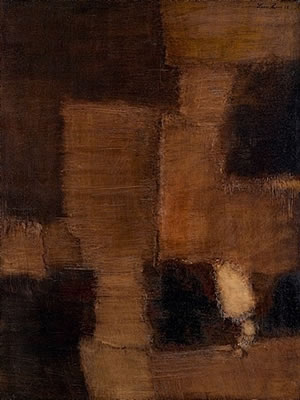
After 1938 his painting, whilst figurative, became increasingly expressionistic. Returning to Paris in 1945, Zack continued to exhibit widely – including a solo show at the Galerie Granoff in 1946 – and after 1947 his work turned to lyrical abstraction. Finding that subject matter was playing no useful role in his painting, Zack eliminated it to concentrate on abstract expression; the muted colours, and often blurred nebulous forms convey a sensuous, evocative mystical quality.
Zack had a number of solo shows at the Bonjean and Beaux-Arts Galleries in Paris and took part in exhibitions in Basel, Brussels, Cologne, Copenhagen, Dublin, London, Oslo and Venice. He became an established exponent of the Abstraction Lyrique movement in Europe.
The artist’s work is now represented in numerous museums of Modern Art worldwide including the Musée National d’Art Moderne, Paris; the Tate Modern, London; the Philips Collection, Washington; and the museums of Brussels, Anvers, Luxembourg and the Vatican.
Source:
Hanina Fine Arts, London, England
Submitted to askART by M.D. Silverbrooke.Biography from Auctionata
Léon Zack was born in 1892. The Russian-French painter had already started drawing at the age of 13, and became part of the Russian Futurism. He was taught by Fjodor Iwanowitsch Rerberg, and Ilja Iwanowitsch Maschkow. The latter introduced him to French artists such as Paul Cézanne and André Derain.
Together with his wife, he lived in Florence for two years. From there, Zack traveled to Paris in 1921, where he met Pablo Picasso and Mikhail Larionov. He exhibited some lithographs in the Salon des Indépendants and Salon d’Hivers.
In 1922, the family moved to Berlin, where Zack created set and costumes for ballets of the Russian Romantic Theater. He also exhibited his works several times in the gallery of Alfred Flechtheim.
Zack eventually settled down in Paris permanently. In the years that followed, he took part in numerous exhibitions. He returned to Paris in 1945, after he had spent the years during the war far away from Paris. He again took part in numerous exhibitions.
Over time, his painting style changed increasingly from the figurative to the abstract. Toward 1948, he exclusively exhibited works with geometric and abstract shapes in a solo exhibition at the Galerie des Garets.
In 1950, along with his daughter, the sculptor Irène Zack, he started designing the interiors of several churches. For this purpose, Zack created stained glass windows, tapestries, and sacred objects such as crosses and altars.
Leon Zack passed away in 1980.Biography from Bonhams Bond Street
Leon Zack studied painting in private academies and literature at the University of Moscow. He then spent time in several studios where he met avant-garde artist Ilya Mashkov, the founding member of the group Jack of Diamonds which referred to Cézanne's Fauvism and presages of Cubism.
In 1913, he published a collection of poems signed under the pseudonym Chrysanthe and married, in 1917, Nadia Braudo with whom he had two children: Irene, who became a sculptor, and Florent.
In 1920, Zack and his family left Russia for France via Rome, Florence, and Berlin, where he produced set designs and costumes for the Russian romantic ballets directed by Boris Romanov. Ten years later, Zack joined the neo-humanists movement inspired by the art critic Waldemar George.
During this time, Léon Zack also worked for the Monte-Carlo Ballet and illustrated works by Arthur Rimbaud, Verlaine, Mallarmé, and Baudelaire. In 1940, he left Paris and took refuge in Arcachon, Villefranche-sur-Mer, and Grenoble.
He returned to Paris in 1945 where he exhibited his first abstract works at Katia Granoff's and at the Garets gallery. From 1955 onwards, Zack dedicated his career to religious art and specialised in the production of stained-glass windows for Notre-Dame-des-Pauvres at Issy-Les-Moulineaux and for numerous churches in Paris and French provinces.