Page loaded successfully. Showing biography for Lesser Ury.
Lesser Ury BIOGRAPHY
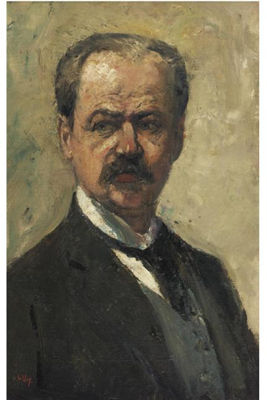
1861 Birnbaum - 1931 Berlin. Known for: Painting.
Lesser Ury was born in Birnbaum in 1861. Lesser Ury, a "forgotten" artist from Berlin's turbulent Secession era, came to Berlin in 1871 from the small town of Birnbaum in the former province of... Read full biography
Lesser Ury was born in Birnbaum in 1861. Lesser Ury, a "forgotten" artist from Berlin's turbulent Secession era, came to Berlin in 1871 from the small town of Birnbaum in the former province of Posen. From the very first moment, Ury felt a very special sympathy for the cosmopolitan city. This was... Read full biography
Lesser Ury was born in Birnbaum in 1861. Lesser Ury, a "forgotten" artist from Berlin's turbulent Secession era, came to Berlin in 1871 from the small town of Birnbaum in the former province of Posen. From the very first moment, Ury felt a very special sympathy for the cosmopolitan city. This was reflected in his art. Ury was honored by the mayor of Berlin on his 60th birthday as an "artistic glorifier of the imperial capital." . But before Ury finally made Berlin his long-term residence, he... Read full biography
Lesser Ury was born in Birnbaum in 1861. Lesser Ury, a "forgotten" artist from Berlin's turbulent Secession era, came to Berlin in 1871 from the small town of Birnbaum in the former province of Posen. From the very first moment, Ury felt a very special sympathy for the cosmopolitan city. This was reflected in his art. Ury was honored by the mayor of Berlin on his 60th birthday as an "artistic glorifier of the imperial capital." . But before Ury finally made Berlin his long-term residence, he studied painting in Düsseldorf and Brussels. Ury gained valuable experience in Paris, including with Lefebvre. He explored Flanders and Munich, where he enrolled for a short time at the Academy of Fine Arts in 1886. The following year he settled... Read full biography
Lesser Ury was born in Birnbaum in 1861. Lesser Ury, a "forgotten" artist from Berlin's turbulent Secession era, came to Berlin in 1871 from the small town of Birnbaum in the former province of Posen. From the very first moment, Ury felt a very special sympathy for the cosmopolitan city. This was reflected in his art. Ury was honored by the mayor of Berlin on his 60th birthday as an "artistic glorifier of the imperial capital." . But before Ury finally made Berlin his long-term residence, he studied painting in Düsseldorf and Brussels. Ury gained valuable experience in Paris, including with Lefebvre. He explored Flanders and Munich, where he enrolled for a short time at the Academy of Fine Arts in 1886. The following year he settled permanently in Berlin. Ury was a virtuoso with oil painting, which allowed the artist to produce flower pictu... Read full biography
Artist Biography
Biography page for Lesser Ury ((1861 - 1931)), known for Painting. Showing 3 biographical entries and 0 sample artworks.
Lesser Ury - Artist Info
About Lesser Ury
Biography from Ketterer Kunst, Munich
Lesser Ury was born in Birnbaum in 1861. Lesser Ury, a "forgotten" artist from Berlin's turbulent Secession era, came to Berlin in 1871 from the small town of Birnbaum in the former province of Posen. From the very first moment, Ury felt a very special sympathy for the cosmopolitan city. This was reflected in his art. Ury was honored by the mayor of Berlin on his 60th birthday as an "artistic glorifier of the imperial capital."
But before Ury finally made Berlin his long-term residence, he studied painting in Düsseldorf and Brussels. Ury gained valuable experience in Paris, including with Lefebvre. He explored Flanders and Munich, where he enrolled for a short time at the Academy of Fine Arts in 1886. The following year he settled permanently in Berlin.
Ury was a virtuoso with oil painting, which allowed the artist to produce flower pictures, still lifes, and the typical coffee house and street scenes. Ury mastered the pastel technique, which allowed him to depict the air and light reflections of the landscapes in a richly nuanced way.
While his Berlin contemporaries Liebermann, Slevogt and Corinth shared common artistic intentions, Ury was a loner who went his own way in art. Ury's increasing fame was a thorn in the side of Max Liebermann, the president of the academy and influential spokesman of the art scene. Probably for competitive reasons, as Liebermann tried by all means to block Ury's artistic career. It was only when Lovis Corinth succeeded Liebermann that Ury was able to exhibit regularly and successfully in the Secession.
In 1921 Ury became an honorary member of the Secession. During this decade Ury travelled several times to London, Paris and various German cities, each time bringing back a wealth of new paintings.
After a heart attack shortly after a trip to Paris in 1928 the painter's health deteriorated. Three weeks before his 70th birthday, on which the National Gallery and the Secession wanted to honour Ury's life's work, the artist died in his Berlin studio. He passed away in 1931.Biography from Lehr Kunstauktionen
Lesser Ury (1861-1931)
He is considered among the groundbreaking representatives of Impressionism in Germany, where not only his streets by night but also his landscape views contributed to his popularity. He realized early on that he was not cut out for the pedantic operation of German academies and sought his fortune in Brussels and Paris.
From 1880 to 1886 he found in plein - air painting his determination, his refuge . Ury had his difficulties with interpersonal relationships, so that he often preferred the solitude of painting. In the summer of 1892 he decided to travel for three months to Schleswig -Holstein, in order to work undisturbed over there. On the recommendation of the older fellow painter Hans Olde, the choice fell on a village beach on the Kiel Fjord . Ury wrote to Olde : "If I find any village through your kindness, in which the people are not too rough and let me work undisturbed, above all, I can not drink beer, only find milk, eggs, bread and butter, then I'm satisfied. I want to paint a canvas once down 2-3 meters from nature. " (after Schlogel 1995) The wide North German countryside with scattered mounts of hay fascinated Ury . Ury was an outstanding mood painter who dominated the entire gamut of color shades and color games.Biography from Auctionata
Lesser Ury was born in 1861 in Birnbaum near Posen. After his father's death, the Jewish family moved to Berlin in 1873. Ury started a business training after secondary school, but quit after a year for attending the Art Academy in Düsseldorf. Beginning in 1882, he continued his studies at the Académie Royale in Brussels, and under Jules Joseph Lefèbvre in Paris starting in 1883. Until 1986 he trained at the academies in Stuttgart, Karlsruhe and Munich. When Fritz Gurlitt exhibited Ury’s first solo exhibitions in 1889/1890, it was no success. Lesser Ury traveled a lot in the following years. In 1914, Lovis Corinth convinced him to join the Berlin Secession, a group of artists, which was regarded as ‘avant-garde’ at that time and which made him an honorary member in 1921. He gained mainly notoriety through exhibitions at the galleries of Paul Cassirer in 1916 and Heinrich Thannhauser in 1917.
Until his death in 1931, the artist created an extensive body of work, comprising oil paintings, pastels and prints, influenced by Impressionism. (cko) Lesser Ury is recorded mainly for his impressionist Berlin city views, streets at night, rain depictions and café house scenes. This atmospheric style of painting can also be found in his landscapes.